rtemis
Machine Learning and Visualization
Machine learning and visualization package with an 'S7' backend featuring comprehensive type checking and validation, paired with an efficient functional user-facing API. train(), cluster(), and decomp() provide one-call access to supervised and unsupervised learning. All configuration steps are performed using setup functions and validated. A single call to train() handles preprocessing, hyperparameter tuning, and testing with nested resampling. Supports 'data.frame', 'data.table', and 'tibble' inputs, parallel execution, and interactive visualizations. The package first appeared in E.D. Gennatas (2017) < https://repository.upenn.edu/entities/publication/d81892ea-3087-4b71-a6f5-739c58626d64>.

rtemis: Advanced Machine Learning & Visualization.
This is the new version of the rtemis R package and remains under active development.
The new version (0.99+) features:
- Backend: complete rewrite of the supervised and unsupervised learning backend using the new S7 class system, replacing all previous use of R6 and S3 classes.
- API: Functional user-facing API, to maintain a consistent, user-friendly interface.
- Extended use of
setup_()functions, to offer increased transparency of configuration options. - Strict type checking and condition validation throughout to minimize user error and provide highly focused error messages & suggestions.
- Expanded transparent messaging through each step.
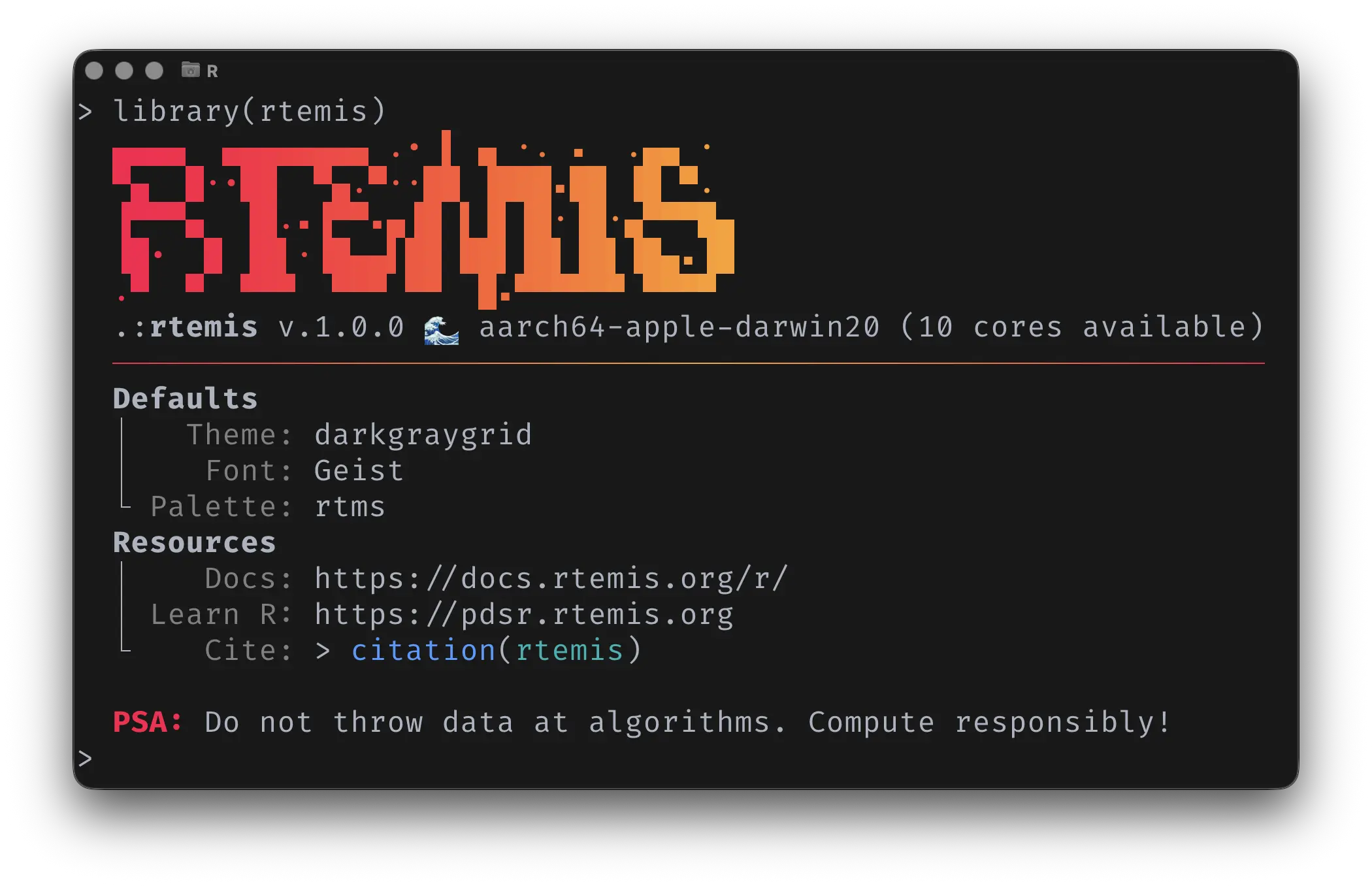
Installation
From CRAN
pak::pak("rtemis")
or
install.packages("rtemis")
Latest version from GitHub
pak::pak("rtemis-org/rtemis")
Latest version from r-universe
pak::repo_add(rtemis_universe = "https://rtemis-org.r-universe.dev")
pak::pak("rtemis")
or using install.packages:
install.packages(
  'rtemis',
  repos = c('https://rtemis-org.r-universe.dev', 'https://cloud.r-project.org')
)
Installation of dependencies
Every rtemis call that uses external packages includes a check for required dependencies and will print a message if any are missing.
Transparent messaging
It is essential to maintain transparency of operations at all times.
rtemis functions often call multiple other functions, sometime recursively. The package uses a formatted messaging system to provide logging output which includes:
- Timestamp
- Message
- Origin (function name)
Most function include a verbosity argument to control the level of messaging output, with support for three levels:
0: silent1: normal messaging2: detailed messaging for debugging
Text formatting
rtemis includes an automatic text formatting system, which supports:
- plain text output (for output to log files)
- ANSI colored output (for R console)
- HTML formatted output (for Quarto documents, shiny apps, etc.)
setup_ functions
Machine learning workflows involve multiple steps, each with their own configuration options.
It is essential that a) the user has complete control over each step, while maintaining an intuitive, user-friendly interface, and b) the user input is validated immediately and before a potentially long-running operation is started.
The following setup_ functions are available to configure each step of the workflow:
- Supervised Learning:
setup_CART(),setup_GAM(), etc. - Tuning:
setup_GridSearch() - Clustering:
setup_CMeans(),setup_HardCL(), etc. - Decomposition:
setup_NMF(),setup_ICA(), etc. - Resampling:
setup_Resampler() - Preprocessing:
setup_Preprocessor()
Supervised Learning
The following will perform hyperparameter tuning and 10-fold cross-validation.
It will train (3*3*2*5 + 1) * 25 = 2275 models total (!).
mod_lightgbm <- train(
  dat,
  hyperparameters = setup_LightGBM(
        num_leaves = 2^(1:3),
        learning_rate = c(.001, .005, .01),
        subsample = c(.6, .9)
  ),
  outer_resampling_config = setup_Resampler(
    n_resamples = 25L,
    type = "StratSub"
  )
)
Clustering
clust_cmeans <- cluster(
  dat,
  config = setup_CMeans(k = 4L)
)
Decomposition
decomp_ica <- decomp(
  dat,
  config = setup_ICA(k = 12L)
)
Changes from original implementation & Ongoing work
Algorithms
The original version included a long list of algorithms for supervised and unsupervised learning for testing and experimentation, many of which were rarely used. The initial release of the new version focuses on a smaller set of core algorithms, that will keep growing.
Visualization
The original version included the mplot3 family of visualization functions using base R graphics and the dplot3 family using plotly.
The new release includes the draw family of functions, the evolution of the dplot3 family.
Documentation
The documentation is available at docs.rtemis.org/r/ml, which includes walkthroughs of main features and full API reference.
Ongoing work
There is a lot more coming - both within this package and the other packages in the rtemis framework.
rtemisalpha
The original, unmaintained version of rtemis remains available as rtemisalpha at rtemis-org/rtemis-legacy.
© 2016–2026 E.D. Gennatas. Licensed under GPL (>= 3).