CIDER
Meta-Clustering for scRNA-Seq Integration and Evaluation
A workflow of (a) meta-clustering based on
inter-group similarity measures and (b) a ground-truth-free test metric to
assess the biological correctness of integration in real datasets. See Hu Z,
Ahmed A, Yau C (2021)
CIDER
CIDER is a meta-clustering workflow designed to handle scRNA-seq data that span multiple samples or conditions. Often, these datasets are confounded by batch effects or other variables. Many existing batch-removal methods assume near-identical cell population compositions across samples. CIDER, in contrast, leverages inter-group similarity measures to guide clustering without requiring such strict assumptions.
- Genome Biology (2021) publication: CIDER article
- Original prototype: Hu et al., Cancer Cell 2020
Highlights
- Clustering: Overcome confounders in scRNA-seq data (e.g., batch effects) without requiring identical cell-type composition.
- Evaluation metric: Assess whether integrated data from methods like Seurat-CCA, Harmony, or Scanorama preserve meaningful biological structure—no prior cell-type labels required.
Installation
You can install CIDER from github with:
# install.packages("devtools")
devtools::install_github('zhiyuan-hu-lab/CIDER')
Quick Start: Using CIDER as an Evaluation Metric
If you have already integrated your scRNA-seq data (e.g., using Seurat-CCA, Harmony, or Scanorama) and want to evaluate how well the biological populations align post-integration, you can use CIDER as follows.
- Before running CIDER evaluation functions, make sure that you have a
Seurat object (e.g.
seu.integrated) with corrected PCs in
seu.integrated@[email protected]`
- Seurat-CCA automatically put the corrected PCs there.
- If other methods are used, the corrected PCs can be added using
seu.integrated@[email protected] <- corrected.PCs
- Run hdbscan clustering (optional) and compute the IDER score:
library(CIDER)
seu.integrated <- hdbscan.seurat(seu.integrated)
ider <- getIDEr(seu.integrated, verbose = FALSE)
seu.integrated <- estimateProb(seu.integrated, ider)
- Visualize evaluation scores on t-SNE or UMAP:
The evaluation scores (IDER-based similarity and empirical p values) can
be visualised by the scatterPlot function.
p1 <- scatterPlot(seu.integrated, "tsne", colour.by = "similarity")
p2 <- scatterPlot(seu.integrated, "tsne", colour.by = "pvalue")
plot_grid(p1,p2, ncol = 2)
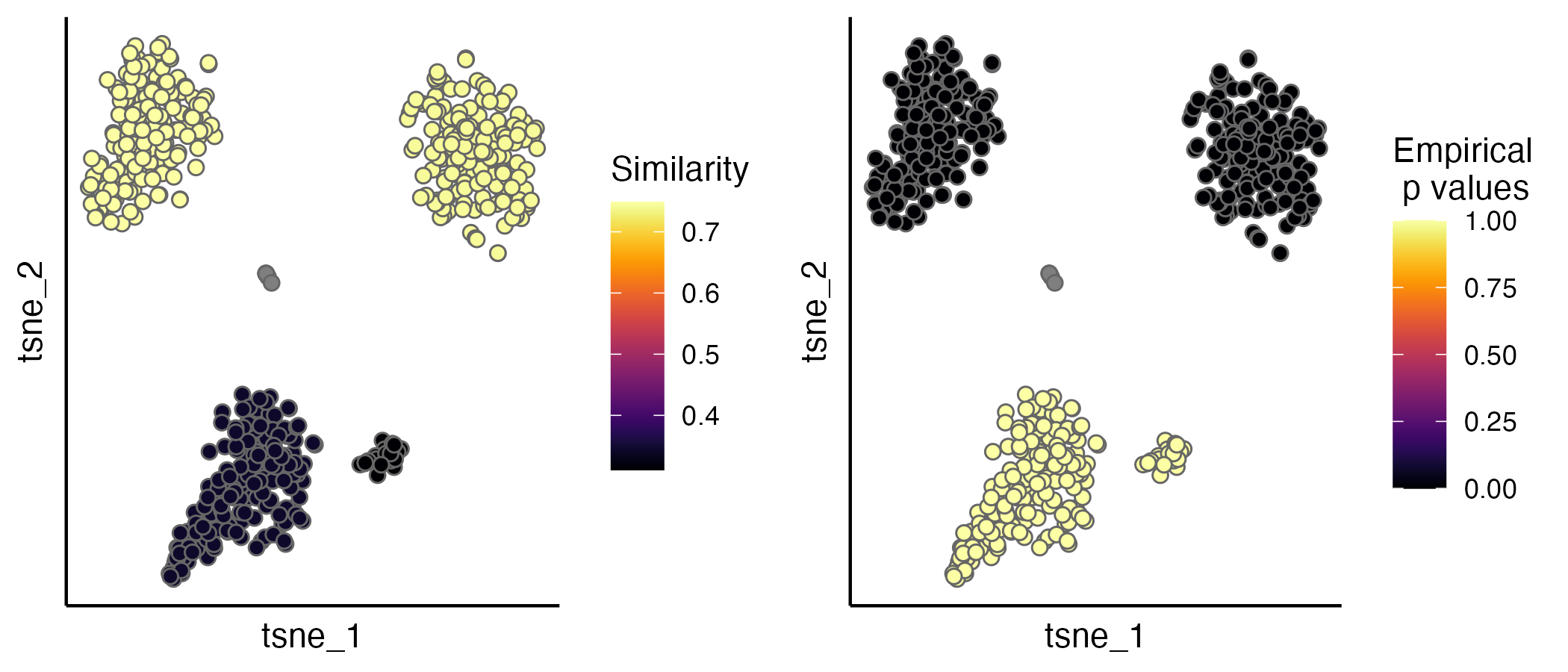 Evaluation scatterplot showing
CIDER-based p-values and similarity
Evaluation scatterplot showing
CIDER-based p-values and similarity
For a more detailed walkthrough, see the detailed tutorial of evaluation
Using CIDER for Clustering Tasks
In many scenarios, you do not start with an integrated Seurat object but still need to cluster multi-batch scRNA-seq data in a robust way. CIDER provides meta-clustering approaches:
- asCIDER: When you have initial batch-specific clusters.
- dnCIDER: When you do not have any initial cluster labels.
Quick Start with asCIDER
If your Seurat object (seu) has:
initial_clusterin[email protected]for per-batch clusters, andBatchfor batch labels,
then two main steps are:
# Step 1: Compute IDER-based similarity
ider <- getIDEr(seu,
                group.by.var = "initial_cluster",
                batch.by.var = "Batch")

# Step 2: Perform final clustering
seu <- finalClustering(seu, ider, cutree.h = 0.45)
The final clusters will be stored in [email protected]$final_cluster (by
default).
- Detailed tutorial: asCIDER tutorial
- If you do not have prior batch-specific clusters, see dnCIDER high-level or the dnCIDER detailed walk-through.
Citation
If you find CIDER helpful for your research, please cite:
Z. Hu, A. A. Ahmed, C. Yau. CIDER: an interpretable meta-clustering framework for single-cell RNA-seq data integration and evaluation. Genome Biology 22, Article number: 337 (2021); doi: https://doi.org/10.1186/s13059-021-02561-2
Z. Hu, M. Artibani, A. Alsaadi, N. Wietek, M. Morotti, T. Shi, Z. Zhong, L. Santana Gonzalez, S. El-Sahhar, M. KaramiNejadRanjbar, G. Mallett, Y. Feng, K. Masuda, Y. Zheng, K. Chong, S. Damato, S. Dhar, L. Campo, R. Garruto Campanile, V. Rai, D. Maldonado-Perez, S. Jones, V. Cerundolo, T. Sauka-Spengler, C. Yau*, A. A. Ahmed*. The repertoire of serous ovarian cancer non-genetic heterogeneity revealed by single-cell sequencing of normal fallopian tube epithelial cells. Cancer Cell 37 (2), p226-242.E7 (2020). doi: https://doi.org/10.1101/2021.03.29.437525