quollr
Visualising How Nonlinear Dimension Reduction Warps Your Data
To construct a model in 2-D space from 2-D nonlinear dimension reduction data and then lift it to the high-dimensional space. Additionally, provides tools to visualise the model overlay the data in 2-D and high-dimensional space. Furthermore, provides summaries and diagnostics to evaluate the nonlinear dimension reduction layout.
quollr 
Nonlinear dimension reduction (NLDR) techniques provide a
low-dimensional representation of high-dimensional data by applying a
non-linear transformation. The complexity of the transformations and
data structure can create wildly different representations depending on
the method and parameter choices. It is difficult to determine whether
any are accurate, which is best, or whether they have missed structure.
To help assess the NLDR and decide on which, if any, is best, we have
developed an algorithm to create a model that is then used to display as
a wireframe in high dimensions. The quollr package provides functions
to implement the algorithm.
For a thorough background and discussion on this work, please read our paper https://arxiv.org/abs/2506.22051.
Installation
You can install the released version of quollr from
CRAN with:
install.packages("quollr")
The development version from GitHub with:
install.packages("pak")
pak::pak("JayaniLakshika/quollr")
Usage
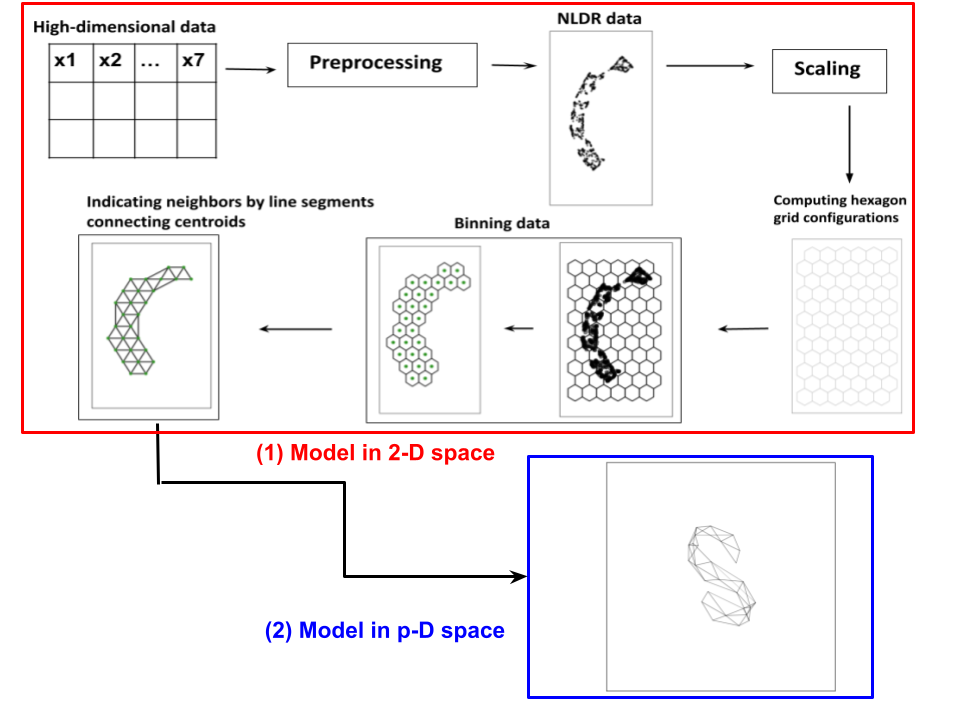
Our approach involves dividing the high-dimensional data set into two parts: a training set to construct the model and a test set to generate model summaries. To implement our approach, first we use a $2\text{-}D$ embedding data set as the initial point. The output of our algorithm is a tour that displays the model overlaid on high-dimensional data. Our algorithm comprises two main phases: (1) generate the model in the $2\text{-}D$ space, and (2) lift the model into high-dimensional space. This methodology is available in this package.
About the name
questioning how a high-dimensional object looks in low-dimensions using r
Roadmap
- Quick start guide: 1. Quick start
- To learn more about the data preprocessing: 2. Data preprocessing
- To create the full hexagonal grid: 3. Algorithm for binning data
- To learn more about the main steps of the algorithm: 4. Algorithm for visualising the model overlaid on high-dimensional data
- To generate model summaries: 5. Generating model summaries
- To select the optimal bin width: 6. Selecting the best bin width
- To select the most reasonable NLDR layout: 7. Selecting the best fit
- To generate linked plots with
detourr: 8. Linked plots with detourr
Copyright
This package is licensed under the MIT license.