panglm
Generalized Linear Models for Panel Data
Provides generalized linear models for panel data, including
pooled, fixed-effects, and random-effects estimators for continuous,
binary, and count outcomes. Offers a unified interface for fitting and
analysing panel regression models, with efficient computation for large
datasets. Estimators and tests follow standard panel-data references,
including Hausman (1978)
panglm



Fast generalized linear models for panel data: pooled, fixed-effects
("within"), and random-effects estimators for gaussian, poisson,
binomial, and negative binomial outcomes, backed by an
Rcpp/RcppArmadillo/RcppParallel numerical core. Every estimator here is
validated against an external reference implementation (plm, pglm,
fixest, MASS::glm.nb, survival::clogit, pscl::hurdle, or
glmmTMB), not just checked for "it runs" -- see the Validation section
below and vignette("panglm-methods").
Installation
# install.packages("remotes")
remotes::install_github("ielbadisy/panglm")
Fixed effects, exactly matching plm
library(panglm)
data(Grunfeld, package = "plm")

f_panglm <- panglm(inv ~ value + capital, data = Grunfeld,
                    index = c("firm", "year"), model = "within", family = "gaussian")
f_plm    <- plm::plm(inv ~ value + capital, data = Grunfeld,
                      index = c("firm", "year"), model = "within")

summary(f_panglm)
#>
#> Call:
#> panglm(formula = inv ~ value + capital, data = Grunfeld, index = c("firm",
#>     "year"), model = "within", family = "gaussian")
#>
#> Family: gaussian  Link: identity  Model: within  Effect: individual
#> N = 200  groups = 10  vcov: classical
#>
#> Coefficients:
#>         Estimate Std. Error z value Pr(>|z|)
#> value    0.11012    0.01186   9.288   <2e-16 ***
#> capital  0.31007    0.01735  17.867   <2e-16 ***
#> ---
#> Signif. codes:  0 '***' 0.001 '**' 0.01 '*' 0.05 '.' 0.1 ' ' 1
#>
#> Dispersion parameter: 2784
#> Residual df: 188  Iterations: 2
cbind(panglm = coef(f_panglm), plm = coef(f_plm), diff = coef(f_panglm) - coef(f_plm))
#>            panglm       plm          diff
#> value   0.1101238 0.1101238 -4.163336e-17
#> capital 0.3100653 0.3100653  4.996004e-16
est <- rbind(
  data.frame(term = names(coef(f_panglm)), estimate = coef(f_panglm),
             se = sqrt(diag(vcov(f_panglm))), fit = "panglm"),
  data.frame(term = names(coef(f_plm)), estimate = coef(f_plm),
             se = sqrt(diag(vcov(f_plm))), fit = "plm")
)
ggplot2::ggplot(est, ggplot2::aes(x = estimate, y = term, color = fit)) +
  ggplot2::geom_pointrange(
    ggplot2::aes(xmin = estimate - 1.96 * se, xmax = estimate + 1.96 * se),
    position = ggplot2::position_dodge(width = 0.4), fatten = 3
  ) +
  ggplot2::scale_color_manual(values = c(panglm = "#2a78d6", plm = "#eb6834")) +
  ggplot2::labs(title = "Fixed-effects coefficients: panglm vs. plm (Grunfeld)",
                x = "Estimate (95% CI)", y = NULL, color = NULL) +
  ggplot2::theme_minimal(base_size = 11)
#> Warning: The `fatten` argument of `geom_pointrange()` is deprecated as of ggplot2 4.0.0.
#> ℹ Please use the `size` aesthetic instead.
#> This warning is displayed once per session.
#> Call `lifecycle::last_lifecycle_warnings()` to see where this warning was generated.
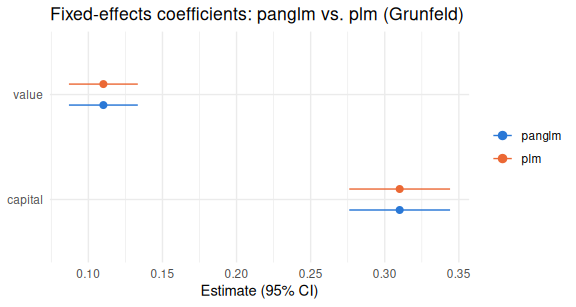
The two estimates are indistinguishable, as they should be: panglm's
model = "within" is an exact, closed-form demeaning estimator, not an
approximation of plm's.
Count panels: fixed-effects Poisson and negative binomial
set.seed(1)
Grunfeld$count <- rpois(nrow(Grunfeld), lambda = exp(0.5 + 0.0001 * Grunfeld$value))

f_pois <- panglm(count ~ value + capital, data = Grunfeld,
                  index = c("firm", "year"), model = "within", family = "poisson")
coef(f_pois)
#>         value       capital
#> -2.805999e-05  2.672632e-04
u <- rep(rgamma(10, shape = 5, rate = 5), each = 20)
Grunfeld$count_nb <- rpois(nrow(Grunfeld), lambda = u * exp(1 + 0.0002 * Grunfeld$value))

f_nb <- panglm(count_nb ~ value + capital, data = Grunfeld,
               index = c("firm", "year"), model = "within", family = "negbin")
coef(f_nb)
#>        value      capital
#> 0.0001173754 0.0001871722
fixest::fenegbin(count_nb ~ value + capital | firm, data = Grunfeld) |> coef()
#> Warning: [femlm]: The information matrix is singular: presence of collinearity.
#> Very high value of theta (10000). There is no sign of overdispersion, you may consider a Poisson
#> model.
#>        value      capital
#> 0.0001173811 0.0001872010
family = "negbin" uses the Allison-Waterman (2002) unconditional
dummy-variable estimator and matches fixest::fenegbin() exactly,
including effect = "twoways" (individual + time fixed effects);
family = "poisson" uses the conditional (concentrated) MLE (Hausman,
Hall & Griliches 1984), matching
pglm(model = "within", family = poisson).
The negative binomial dummy-variable model remains an unconditional nonlinear fixed-effects estimator. Finite-T incidental-parameter bias can be relevant in short panels, so agreement with another implementation should not be interpreted as eliminating that statistical concern.
Structural zeros: a fixed-effects hurdle model
Ordinary Poisson/NB can't distinguish a structural zero (a group that
never has the event) from an ordinary sampling zero at low mean -- it
just shows up as extreme overdispersion regardless of family.
panglm_hurdle() decomposes the two:
set.seed(9)
N <- 60; Tt <- 8
d <- data.frame(id = rep(1:N, each = Tt), time = rep(1:Tt, N))
d$x1  <- rnorm(N * Tt)
a_i   <- rep(rnorm(N, sd = 1.5), each = Tt)
mu    <- exp(0.3 + 0.5 * d$x1 + a_i)
p0    <- plogis(1 - 1.2 * a_i)
zero  <- rbinom(N * Tt, 1, p0) == 1
d$y   <- ifelse(zero, 0, rpois(N * Tt, mu))

fit <- panglm_hurdle(y ~ x1, data = d, index = c("id", "time"))
#> 18 group(s) with no within-group outcome variation dropped (all-0 or all-1) -- they carry no information for the conditional likelihood.
fit
#>
#> Fixed-effects hurdle model for panel count data
#> Zero part (1(y>0), conditional logit):
#>        x1
#> 0.1394545
#>
#> Count part (zero-truncated Poisson, N = 186 positive obs of 480):
#>        x1
#> 0.4847225
The count part (zero-truncated Poisson, fit only on y > 0) recovers
the true slope of 0.5; the zero part is fit via the same exact
conditional logistic regression panglm(..., family = "binomial")
already uses.
Standard errors: classical, HC1, or cluster-robust
sqrt(diag(vcov(f_panglm, type = "classical")))
#>      value    capital
#> 0.01185669 0.01735450
sqrt(diag(vcov(f_panglm, type = "cluster")))
#>      value    capital
#> 0.01515608 0.05261839
R formula factors and interactions are supported. Rank-deficient columns
are reported and omitted before fitting, and na.exclude is respected
by fitted values and residuals. Nontrivial observation weights and
nonzero offsets are rejected explicitly because the corresponding
weighted conditional panel estimators are not currently implemented.
What's estimated, and against what
model |
family |
Method | Validated against |
|---|---|---|---|
pooling |
gaussian/poisson/binomial | IRLS | stats::glm() |
pooling |
negbin | theta-profiled IRLS | MASS::glm.nb() |
within |
gaussian | exact demeaning (one-way or twoways) |
plm(model="within") |
within |
poisson | conditional MLE (one-way or twoways) |
pglm(), fixest::feglm() |
within |
negbin | Allison-Waterman dummy-variable (one-way or twoways) |
fixest::fenegbin() |
within |
binomial | exact conditional logit (Chamberlain 1980) | survival::clogit(method="exact") |
random |
gaussian | Swamy-Arora | plm(model="random") |
random |
poisson | Poisson-Gamma marginal | pglm(model="random") |
random |
negbin | 2-parameter beta-negative-binomial marginal | pglm()'s lnl.negbin.R |
random |
binomial | Gauss-Hermite quadrature | glmmTMB (approximate, different mixing distribution) |
| -- | -- | panglm_hurdle(): conditional logit + zero-truncated Poisson |
pscl::hurdle() |
Also included: panglm_hausman() (FE-vs-RE specification test),
panglm_dispersiontest() (Pearson chi-squared/df overdispersion test),
confint.panglm(), and tidy()/glance() methods for
broom/modelsummary pipelines.
Not covered: effect = "twoways" for binomial (no general closed-form
two-way conditional logit exists), between effects, and ordinal/tobit
families. See NEWS.md.
Validation
Every estimator above is checked against its reference implementation in
tests/testthat/, not just smoke-tested:
res <- testthat::test_local(reporter = testthat::SilentReporter$new())
#> 21 group(s) with no within-group outcome variation dropped (all-0 or all-1) -- they carry no information for the conditional likelihood.
#> 2 group(s) with all-zero outcomes dropped -- their fixed effect is unbounded under the dummy-variable NB2 MLE and carries no information about the shared slope.
df  <- as.data.frame(res)
c(pass = sum(df$passed), fail = sum(df$failed), warn = sum(df$warning), skip = sum(df$skipped))
#> pass fail warn skip
#>  158    0    0    0
See vignette("panglm-methods") for the full walkthrough (33+
executable validation chunks) and NEWS.md for what changed and when.