fmesher
Triangle Meshes and Related Geometry Tools
Generate planar and spherical triangle meshes,
compute finite element calculations for 1-, 2-, and 3-dimensional flat
and curved manifolds with associated basis function spaces, methods for
lines and polygons, and transparent handling of coordinate reference
systems and coordinate transformation, including 'sf' and 'sp' geometries.
The core 'fmesher' library code was originally part of the 'INLA' package,
and implements parts of "Triangulations and Applications" by
Hjelle and Daehlen (2006)
fmesher: Triangle Meshes and Other Geometry Tools



Generate planar and spherical triangle meshes, compute finite element
calculations for 1- and 2-dimensional flat and curved manifolds with
associated basis function spaces, methods for lines and polygons, and
transparent handling of coordinate reference systems and coordinate
transformation, including sf and sp geometries. The core fmesher
library code was originally part of the INLA
package, and also distributed in the EUSTACE Horizon 2020
project, and
implements parts of “Triangulations and Applications” by Hjelle and
Dæhlen (2006). The expanded
crs/CRS support started as an add-on feature of
inlabru.
Installation
You can install the current CRAN
version version of
fmesher:
install.packages("fmesher")
or
# install.packages("pak")
pak::pak("inlabru")
Development version on r-universe
Track the development version builds via inlabru-org.r-universe.dev:
options(repos = c(
  inlabruorg = "https://inlabru-org.r-universe.dev",
  getOption("repos")
))
pak::pak("fmesher")
This will pick the r-universe version if it is more recent than the CRAN version.
Development version on github
Install the development version GitHub with
pak::pak("inlabru-org/inlabru")
Online documentation
https://inlabru-org.github.io/fmesher/
Examples
2D triangular meshes
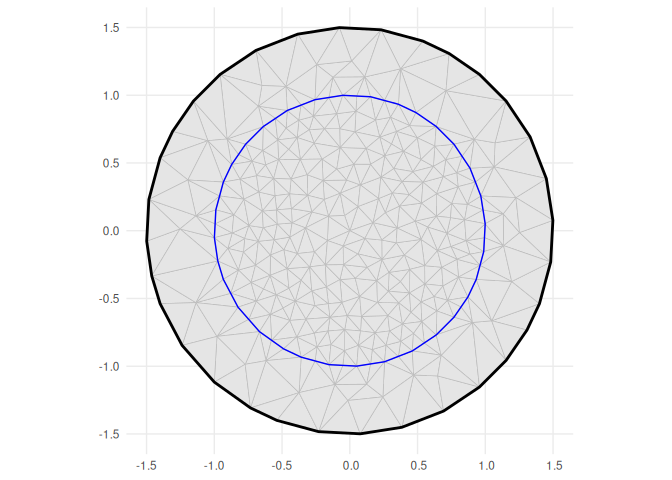
Refined constrained Delaunay triangulations can be constructed by
fm_rcdt_2d() and fm_mesh_2d(). The _inla() versions of these will
usually return the same meshes as the old INLA methods,
INLA::inla.mesh.create() and INLA::inla.mesh.2d().
suppressPackageStartupMessages(library(fmesher))
suppressPackageStartupMessages(library(ggplot2))

bnd <- fm_extensions(cbind(0, 0), convex = c(1, 1.5))
(mesh <- fm_mesh_2d(
  boundary = bnd,
  max.edge = c(0.2, 0.5)
))
#> fm_mesh_2d object:
#>   Manifold:  R2
#>   V / E / T: 304 / 877 / 574
#>   Euler char.:   1
#>   Constraints:   Boundary: 32 boundary edges (1 group: 1), Interior: 54 interior edges (1 group: 1)
#>   Bounding box: (-1.498873, 1.498873) x (-1.498873, 1.498873)
#>   Basis d.o.f.:  304
ggplot() +
  geom_fm(data = mesh) +
  theme_minimal()
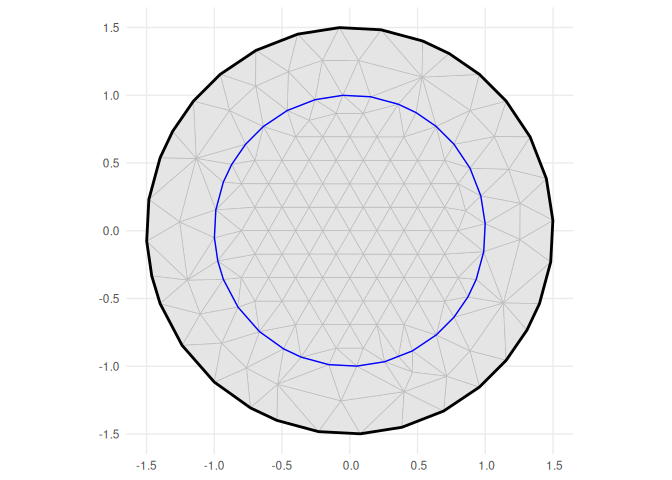
Mostly regular triangulations can be constructed by supplying a regular
set of input points. The fm_hexagon_lattice() function (developed by
Man Ho Suen) generates points in a regular hexagonal lattice pattern,
contained in a given sf polygon.
hex_points <- fm_hexagon_lattice(bnd = bnd[[1]], edge_len = 0.2)
(mesh_hex <- fm_mesh_2d(
  loc = hex_points,
  boundary = bnd,
  max.edge = c(0.3, 0.5)
))
#> fm_mesh_2d object:
#>   Manifold:  R2
#>   V / E / T: 164 / 457 / 294
#>   Euler char.:   1
#>   Constraints:   Boundary: 32 boundary edges (1 group: 1), Interior: 33 interior edges (1 group: 1)
#>   Bounding box: (-1.498873, 1.498873) x (-1.498873, 1.498873)
#>   Basis d.o.f.:  164
ggplot() +
  geom_fm(data = mesh_hex) +
  theme_minimal()
1D B-spline function spaces
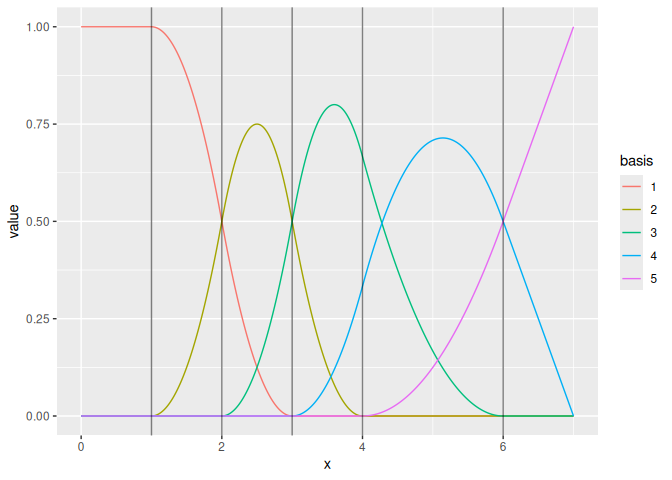
(mesh <- fm_mesh_1d(c(1, 2, 3, 4, 6),
  boundary = c("neumann", "free"),
  degree = 2
))
#> fm_mesh_1d object:
#>   Manifold:  R1
#>   #{knots}:  5
#>   Interval:  (1, 6)
#>   Boundary:  (neumann, free)
#>   B-spline degree:   2
#>   Basis d.o.f.:  5
ggplot() +
  geom_fm(data = mesh, xlim = c(0, 7))
Extended helper methods for CRS handling
The package provides methods fm_crs() and fm_CRS() for extracting
CRS information from sf and sp objects and automatically converts to
the desired output format. The fm_transform() wrapper similarly
handles a variety of objects, as well as special handling for converting
between spheres and globes of different radii, e.g. used to map between
the Earth and a unit radius sphere uses as a model of the Earth.
# longlat for a spherical version of the Earth
print(fm_proj4string(fm_crs("longlat_globe")))
#> [1] "+proj=longlat +ellps=sphere +no_defs"

# longlat for a sphere of radius 1m
print(fm_proj4string(fm_crs("longlat_norm")))
#> [1] "+proj=longlat +R=1 +no_defs"

# A sphere of radius 1m
print(fm_proj4string(fm_crs("sphere")))
#> [1] "+proj=geocent +R=1 +units=m +no_defs"