functiondepends
Find Functions and their Dependencies
Find functions in an unstructured directory and explore their dependencies. Sourcing of R source files is performed without side-effects: from R scripts that have executable code and function definitions only functions are sourced.
functiondepends 


The goal of functiondepends is to allow for tidy exploration of unstructured codebase without evaluation of code.
Installation
One can install functiondepends from CRAN:
install.packages("functiondepends")
or development version from GitHub:
# install.packages("devtools")
devtools::install_github("jakubsob/functiondepends")
Examples
library(functiondepends)
# Create environment for loaded functions
envir <- new.env()
# Search recursively current directory
functions <- find_functions(".", envir = envir, recursive = TRUE)
functions
#> # A tibble: 5 × 3
#>   Path  Function          SourceFile
#>   <chr> <chr>             <chr>
#> 1 R     find_dependencies find-dependencies.R
#> 2 R     is_function       find-functions.R
#> 3 R     get_function_name find-functions.R
#> 4 R     is_assign         find-functions.R
#> 5 R     find_functions    find-functions.R
Search for dependencies of function find_functions within parsed
functions:
dependency <- find_dependencies("find_functions", envir = envir, in_envir = TRUE)
dependency
#> # A tibble: 2 × 5
#>   Source            SourceRep SourceNamespace Target         TargetInDegree
#>   <chr>                 <int> <chr>           <chr>                   <int>
#> 1 get_function_name         1 user-defined    find_functions              2
#> 2 is_function               1 user-defined    find_functions              2
Note that SourceNamespace column has value user-defined as the
functions are searched within source of the package.
Search for all dependencies of find_functions function:
library(ggplot2)
library(dplyr)

dependency <- find_dependencies("find_functions", envir = envir, in_envir = FALSE)
dependency %>%
  slice_max(SourceRep, n = 10) %>%
  mutate(Source = reorder(Source, SourceRep)) %>%
  ggplot(aes(x = Source, y = SourceRep, fill = SourceNamespace)) +
  geom_col() +
  coord_flip() +
  labs(caption = "Top 10 most repeated calls in 'find_functions'.")
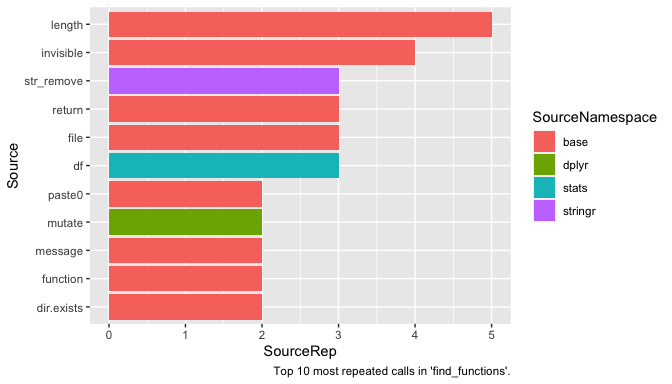
Note that name df is often used to store object of type data.frame.
df is also a name of F distribution density function from stats
package. If you suspect that given function ought not to use a specific
package, see the source code of function to check the context. To do so,
one can execute find_dependencies function with add_info argument
set to TRUE.
library(tidyr)

dependency <- find_dependencies("find_functions", envir = envir, in_envir = FALSE, add_info = TRUE)
dependency %>%
  filter(SourceNamespace == "stats") %>%
  select(Source, SourcePosition, SourceContext) %>%
  unnest(c(SourcePosition, SourceContext))
#> # A tibble: 6 × 3
#>   Source SourcePosition SourceContext
#>   <chr>           <dbl> <chr>
#> 1 df                 10 "    df <- purrr::map_dfr(sourceFiles, function(file) {"
#> 2 df                 19 "    source_name <- basename(df$Path)"
#> 3 df                 21 "    df <- df %>% dplyr::mutate(Path = stringr::str_rem…
#> 4 df                 23 "        paths <- stringr::str_split(df$Path, \"/|\\\\\…
#> 5 df                 25 "        df <- tidyr::separate(df, \"Path\", into = pas…
#> 6 df                 27 "    df %>% dplyr::mutate(SourceFile = source_name)"
One can see that indeed df is not a call to function stats::df.
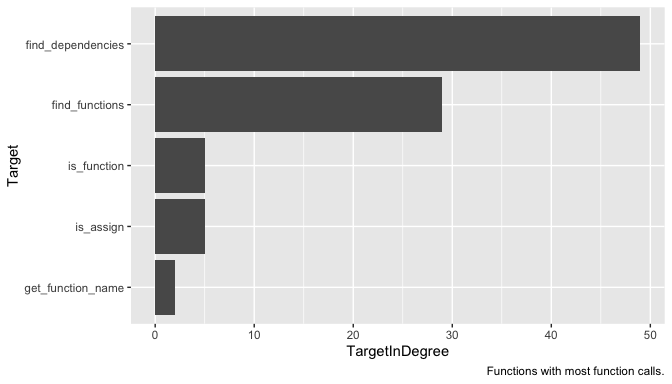
dependency <- find_dependencies(unique(functions$Function), envir = envir, in_envir = FALSE)
dependency %>%
  distinct(Target, TargetInDegree) %>%
  mutate(Target = reorder(Target, TargetInDegree)) %>%
  ggplot(aes(x = Target, y = TargetInDegree)) +
  geom_col() +
  coord_flip() +
  labs(caption = "Functions with most function calls.")
dependency <- find_dependencies(unique(functions$Function), envir = envir, in_envir = FALSE)
dependency %>%
  group_by(SourceNamespace) %>%
  tally(name = "Count") %>%
  slice_max(Count, n = 10) %>%
  mutate(SourceNamespace = reorder(SourceNamespace, Count)) %>%
  ggplot(aes(x = SourceNamespace, y = Count)) +
  geom_col() +
  coord_flip() +
  labs(caption = "Top 10 used namespaces.")
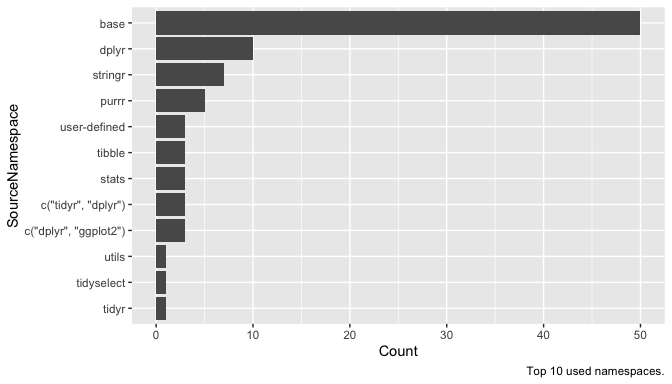
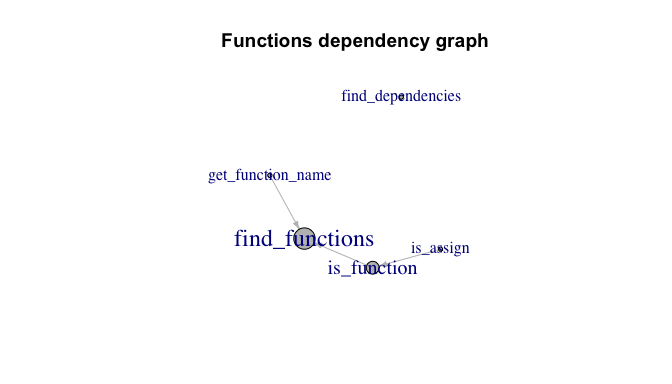
See which user-defined functions depend most on other user-defined functions within searched codebase.
dependency <- find_dependencies(unique(functions$Function), envir = envir, in_envir = TRUE)
dependency %>%
  distinct(Target, TargetInDegree) %>%
  arrange(-TargetInDegree)
#> # A tibble: 5 × 2
#>   Target            TargetInDegree
#>   <chr>                      <dbl>
#> 1 find_functions                 2
#> 2 is_function                    1
#> 3 find_dependencies              0
#> 4 get_function_name              0
#> 5 is_assign                      0
library(igraph)

edges <- dependency %>%
  select(Source, Target) %>%
  na.omit()

vertices <- unique(c(dependency$Source, dependency$Target))
vertices <- vertices[!is.na(vertices)]

g <- graph_from_data_frame(d = edges, vertices = vertices)
deg <- degree(g, mode = "in")
V(g)$size <- deg * 10 + 5
V(g)$label.cex <- (degree(g, mode = "in", normalized = TRUE) + 1)

plot(
  g,
  vertex.color = "grey",
  edge.color = "grey",
  edge.arrow.size = .4,
  main = "Functions dependency graph"
)
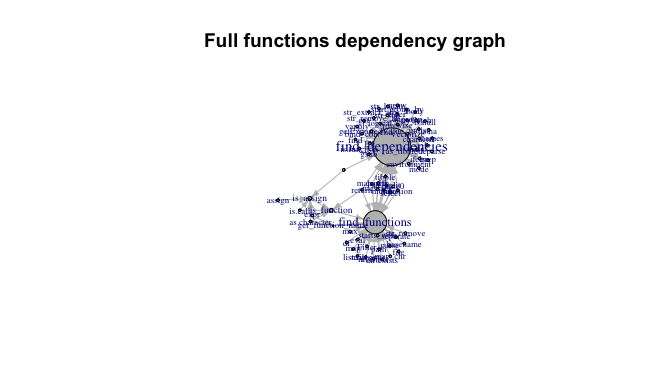
dependency <- find_dependencies(unique(functions$Function), envir = envir, in_envir = FALSE)
edges <- dependency %>%
  select(Source, Target) %>%
  na.omit()
vertices <- unique(c(edges$Source, edges$Target))

g <- graph_from_data_frame(edges)
deg <- degree(g, mode = "in")
V(g)$size <- deg
V(g)$label.cex <- (degree(g, mode = "in", normalized = TRUE) + 1) / 1.8

plot(
  g,
  vertex.color = "grey",
  edge.color = "grey",
  edge.arrow.size = .4,
  main = "Full functions dependency graph"
)