diffudist
Diffusion Distance for Complex Networks
Enables the evaluation of diffusion distances for complex single-layer networks.
Given a network one can define different types of Laplacian (or transition)
matrices corresponding to different continuous-time random walks dynamics on the network.
This package enables the evaluation of Laplacians, stochastic matrices, and the
corresponding diffusion distance matrices. The metric structure induced by the network-driven
process is richer and more robust than the one given by shortest-paths and allows to study
the geometry induced by different types of diffusion-like communication mechanisms taking
place on complex networks.
For more details see: De Domenico, M. (2017)
diffudist 


Overview
The diffudist package provides several functions for evaluating the
diffusion distance between nodes of a complex network.
Installation
# Or the development version from GitHub
# install.packages("devtools")
devtools::install_github("gbertagnolli/diffudist")
Usage
Additionally to diffudist you will also need the igraph package,
because the main arguments of the functions in diffudist are networks
as igraph objects.
library(diffudist)
library(igraph)
#>
#> Attaching package: 'igraph'
#> The following objects are masked from 'package:stats':
#>
#>     decompose, spectrum
#> The following object is masked from 'package:base':
#>
#>     union
library(ggplot2)
igraph_options(
  vertex.frame.color = "white",
  vertex.color = "#00B4A6",
  label.family = "sans-serif")
Examples
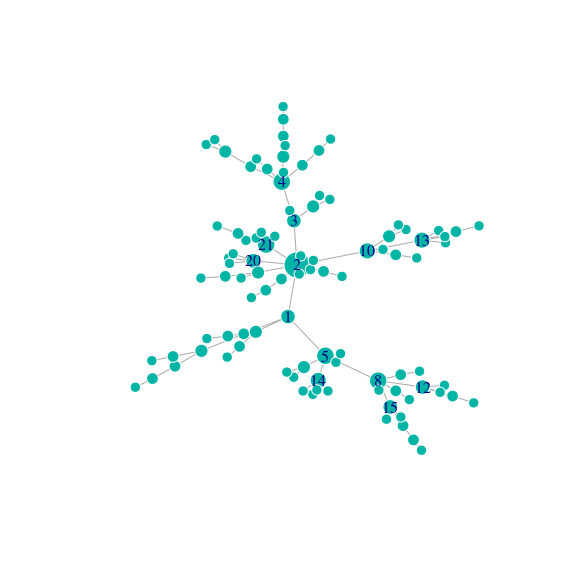
N <- 100
g <- sample_pa(N, directed = FALSE)
deg_g <- degree(g)
vertex_labels <- 1:N
vertex_labels[which(deg_g < quantile(deg_g, .9))] <- NA
plot(g, vertex.label = vertex_labels, vertex.size = 6 + 10 * (deg_g - min(deg_g)) / max(deg_g))
D <- get_distance_matrix(g, tau = 2, type = "Normalized Laplacian", verbose = FALSE)
# or, for short:
# get_DDM(g, tau = 2, type = "Normalized Laplacian", verbose = FALSE)
MERW_Pt <- get_diffusion_probability_matrix(g, tau = 2, type = "MERW")
#> Unweighted network.
#> Evaluating the MERW Normalized Laplacian matrix
The probability transition matrix returned from
get_diffusion_probability_matrix (or its shortened version
get_diffu_Pt) is the matrix e−τ**Lrw. The
diffusion dynamics is controlled by the specific Laplacian matrix
Lrw = I − Trw, where Trw is the
jump matrix of the discrete-time random walk corresponding to our
continuous-time dynamics.
Let us check that MERW_Pt is an actual stochastic (transition) matrix,
i.e., that its rows are probability vectors
if (sum(MERW_Pt)  - N > 1e-6) {
  print("MERW_Pt is not a stochastic matrix")
} else {
  print("MERW_Pt is a stochastic matrix")
}
#> [1] "MERW_Pt is a stochastic matrix"
Compute diffusion distances from the Probability matrix MERW_Pt as
follows:
if (requireNamespace("parallelDist", quietly = TRUE)) {
  # parallel dist
  D_MERW <- as.matrix(parallelDist::parDist(MERW_Pt))
} else {
  # dist
  D_MERW <- as.matrix(stats::dist(MERW_Pt))
}
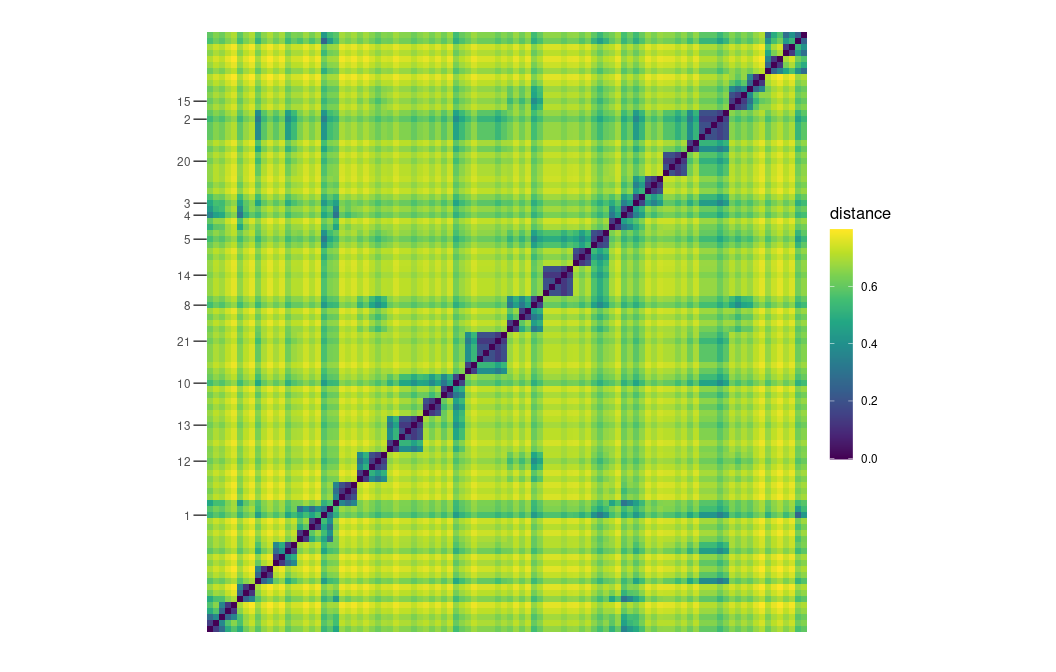
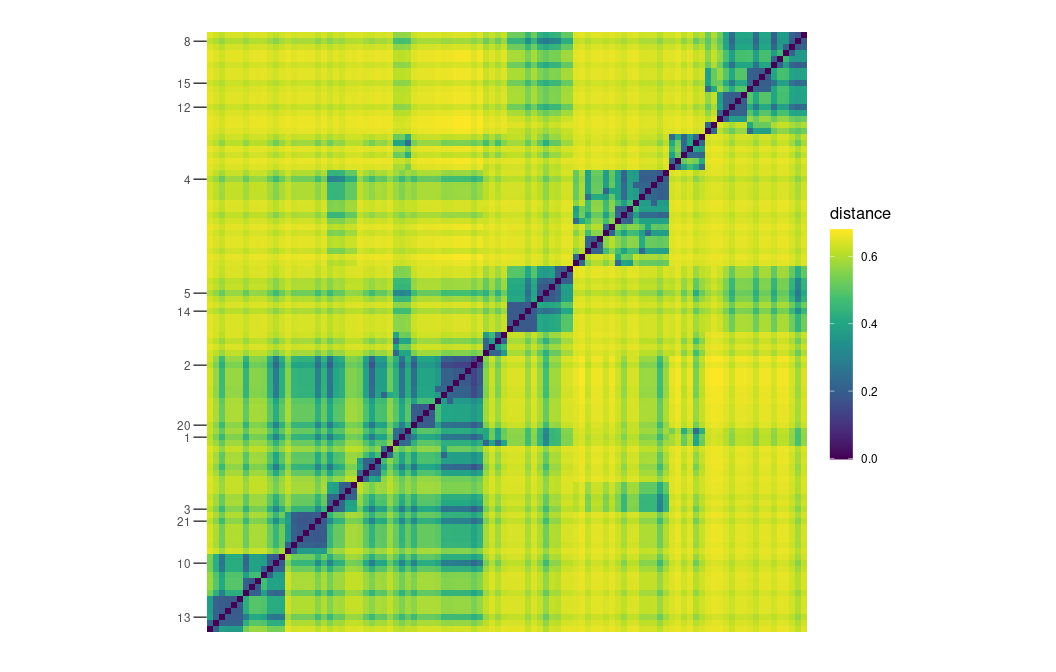
Plot distance matrix
And finally plot the distance matrices (requires ggplot2 and
ggdengro)
plot_distance_matrix(D, show_dendro = FALSE) +
  scale_y_discrete(breaks = vertex_labels[!is.na(vertex_labels)])
plot_distance_matrix(D_MERW, show_dendro = FALSE) +
  scale_y_discrete(breaks = vertex_labels[!is.na(vertex_labels)])
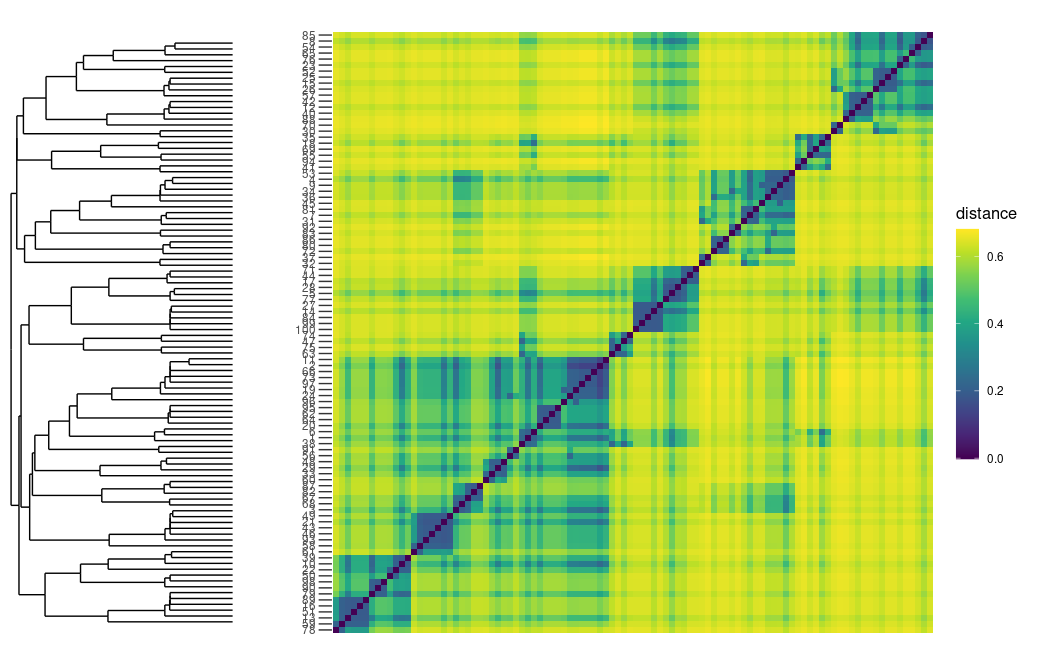
Adding the hierarchical clustering, i.e., visualising a dendrogram.
plot_distance_matrix(D)
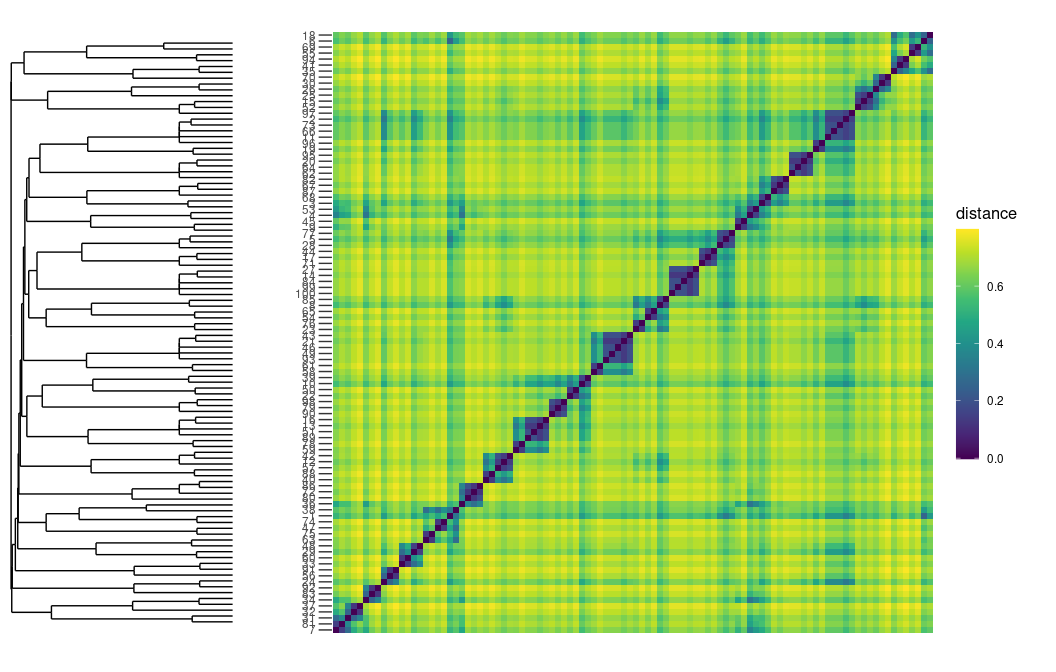
plot_distance_matrix(D_MERW)
References
Bertagnolli, G., & De Domenico, M. (2021). Diffusion geometry of multiplex and interdependent systems. Physical Review E, 103(4), 042301. DOI: 10.1103/PhysRevE.103.042301, arXiv: 2006.13032, my-website.