demcon
Interfacing with Popular Polity, Institutional, and Constitutional Datasets
An open-source toolkit developed by ISciences, LLC and the DANTE
Project that is intended for learning, accessing, pre-processing, and
visualizing popular political, institutional, and constitutional datasets.
‘demcon' aims to reduce barriers to entry in political science research by
automating common acquisition and pre-processing procedures. This package
particularly focuses on the V-Dem dataset (< https://www.v-dem.net/vdemds.html>),
and provides adaptations of methods presented in Fjelde, H., Knutsen, C. H.
& Nygård, H. M. 2021,

demcon
demcon is designed to provide researchers and practitioners with brief literature reviews and programmatic access to several popular polity, democratic, institutional, and constitutional datasets. This package provides comparative context to the datasets in addition to documented functions that help users acquire, process, and visualize widely used political science datasets.
demcon was developed as part of the DANTE Project, which is led by ISciences LLC in partnership with the Center for International Earth Science Information Network (CIESIN), and CASE Consultants International. This project was made possible by generous support from the U.S. Army Engineer Research and Development Center (ERDC). DANTE is an open science platform designed to increase accessibility to and accelerate the interdisciplinary study of environmental stresses, demographics, economics, health, political instability, and humanitarian response. The platform is designed to be inclusive and welcomes contributions from environment-security students, scholars, and practitioners worldwide.
Installation
You can install the current stable release of demcon from CRAN:
install.packages('demcon')
Or, you may install the latest development version over GitLab from DANTE’s GitLab project.
devtools::install_gitlab("dante-sttr/demcon")
For more detailed information visit the demcon package website.
Support
demcon currently provides brief review or programmatic support for several political datasets:
- Varieties of Democracy
- Polity5
- Freedom House’s Freedom in the World
- Database of Political Institutions
- The Economists’ Democracy Index
- Institutions and Elections Project
- Comparative Constitution Project:
- Characteristics of National Constitutions
- Chronology of Constitutional Events
- Constitute
- cshapes
This also includes functions that adapt peer-reviewed methodologies from current high impact publications. These include:
- Vertical and horizontal constraints indices adapted from Fjelde, H., Knutsen, C. H. & Nygård, H. M. 2021. Which Institutions Matter? Re-Considering the Democratic Civil Peace. International Studies Quarterly 65, 223–237.
- Polity 5 regime classifications as described in Goldstone, J. A. et al. A Global Model for Forecasting Political Instability. American Journal of Political Science 54, 190–208 2010.
- Pernicious and rapid polarization as described in Pernicious polarization, autocratization and opposition strategies, Democratization, 20, 929-948, 2021.
demcon also provides short vignettes that help users acquaint themselves with key constitutional datasets and analytic techniques. These include:
- A Brief Review of Constitutional Datasets
- A Brief Review of Democratic and Authoritarian Datasets
- Pre-Processing the Varieties of Democracy Dataset
- Calculating Executive Constraints Indices
- Country Coding Considerations for Dataset Harmonization and Applied Uses
Using demcon
Currently, demcon can be used to acquire, process, and visualize select number of political datasets.
Acquiring Data
Download Polity5, load into the local environment, and delete the
downloaded .zip file.
polity<-demcon::get_polity5(load = TRUE, del_file = TRUE)
head(polity)
#> # A tibble: 6 × 37
#> p5 cyear ccode scode country year flag fragm…¹ democ autoc polity polity2
#> <chr> <chr> <chr> <chr> <chr> <chr> <chr> <chr> <chr> <chr> <chr> <chr>
#> 1 0 7001… 700 AFG Afghan… 1800 0 <NA> 1 7 -6 -6
#> 2 0 7001… 700 AFG Afghan… 1801 0 <NA> 1 7 -6 -6
#> 3 0 7001… 700 AFG Afghan… 1802 0 <NA> 1 7 -6 -6
#> 4 0 7001… 700 AFG Afghan… 1803 0 <NA> 1 7 -6 -6
#> 5 0 7001… 700 AFG Afghan… 1804 0 <NA> 1 7 -6 -6
#> 6 0 7001… 700 AFG Afghan… 1805 0 <NA> 1 7 -6 -6
#> # … with 25 more variables: durable <chr>, xrreg <chr>, xrcomp <chr>,
#> # xropen <chr>, xconst <chr>, parreg <chr>, parcomp <chr>, exrec <chr>,
#> # exconst <chr>, polcomp <chr>, prior <chr>, emonth <chr>, eday <chr>,
#> # eyear <chr>, eprec <chr>, interim <chr>, bmonth <chr>, bday <chr>,
#> # byear <chr>, bprec <chr>, post <chr>, change <chr>, d5 <chr>, sf <chr>,
#> # regtrans <chr>, and abbreviated variable name ¹fragment
Processing Data
demcon provides functions that automates common processing tasks for
political science datasets. In this quick example we load Varieties of
Democracy (V12) and use demcon::prep_vdem() to select indicators of
interest, index the data to only Correlates of War country-years, drop
Palestinian observations, and average values for Serbia and Kosovo (<
2008) and the State Union of Serbia and Montenegro (2003-2006).
vdem<-demcon::get_vdem()

vdem<-demcon::prep_vdem(vdem,
                        cow_index = TRUE,
                        drop_pal = TRUE,
                        srb_kos = TRUE,
                        srb_mon = TRUE)
Visualizing Data
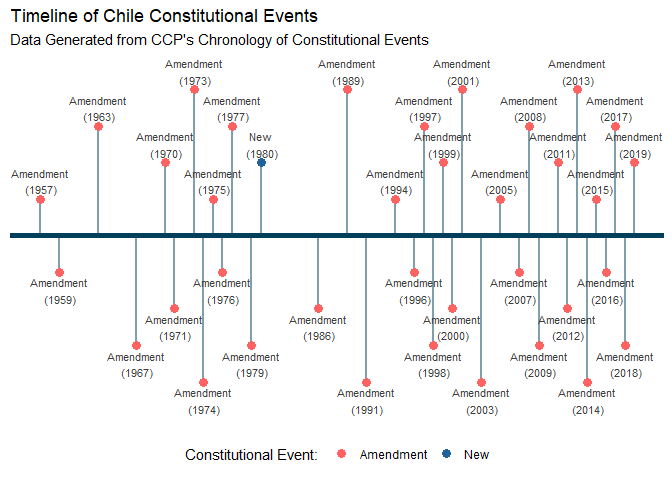
demcon can help you visualize political datasets. In this example we plot we plot constitutional changes in Chile from 1950 to present day.
cce<-demcon::get_cce()

cce<-demcon::prep_cce(cce, evnttype_fix = TRUE)

plot(cce, cntry = "Chile", years = c(1950, 2022))