SLOPE
Sorted L1 Penalized Estimation
Efficient implementations for Sorted L-One Penalized Estimation (SLOPE): generalized linear models regularized with the sorted L1-norm (Bogdan et al. 2015). Supported models include ordinary least-squares regression, binomial regression, multinomial regression, and Poisson regression. Both dense and sparse predictor matrices are supported. In addition, the package features predictor screening rules that enable fast and efficient solutions to high-dimensional problems.
SLOPE 



Efficient implementations for Sorted L-One Penalized Estimation (SLOPE): generalized linear models regularized with the sorted L1-norm.
Features
- Gaussian (quadratic), binomial (logistic), multinomial logistic, and Poisson regression
- Sparse and dense input matrices
- Efficient hybrid coordinate descent algorithm
- Predictor (feature) screening rules that speed up fitting in high-dimensional settings
- Cross-validation
- Parallelized routines
- Duality-based stopping criteria for robust control of suboptimality
Installation
You can install the current stable release from CRAN with the following command:
install.packages("SLOPE")
Alternatively, you can install the development version from GitHub with the following command:
# install.packages("pak")
pak::pak("jolars/SLOPE")
Getting Started
By default, SLOPE fits a full regularization path to the given data.
Here is an example of fitting a logistic SLOPE model to the built-in
heart dataset.
library(SLOPE)

fit <- SLOPE(heart$x, heart$y, family = "binomial")
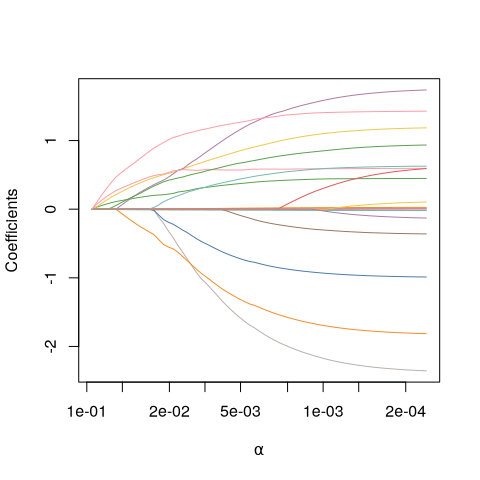
We can plot the resulting regularization path:
plot(fit)
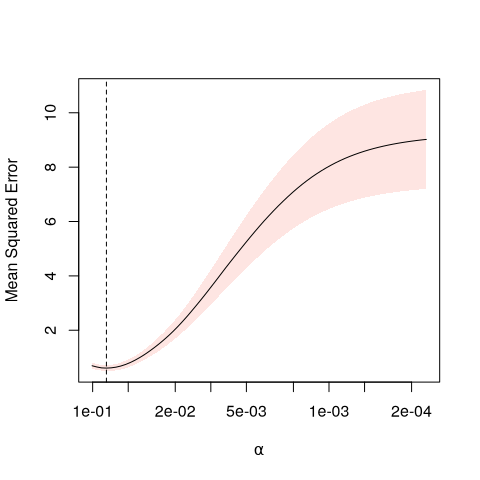
We can also perform cross-validation to select optimal scaling of the regularization sequence:
set.seed(18)

cvfit <- cvSLOPE(heart$x, heart$y, family = "binomial")
plot(cvfit)
Ecosystem
SLOPE is also available as a
Citation
If you use SLOPE in your research, please cite Efficient Solvers for SLOPE in R, Python, Julia, and C++.
For reproducibility, also cite the software release you used. Select
that release in the Zenodo
archive and export its
citation. The concept DOI 10.5281/zenodo.17475844 identifies SLOPE
across all releases.
Machine-readable software metadata and the preferred paper citation are available in CITATION.cff.
Versioning
SLOPE uses semantic versioning.
Code of conduct
Please note that the ‘SLOPE’ project is released with a Contributor Code of Conduct. By contributing to this project, you agree to abide by its terms.