DTEAssurance
Assurance Methods for Clinical Trials with a Delayed Treatment Effect
Provides functions for planning clinical trials subject to a delayed
treatment effect using assurance-based methods. Includes two 'shiny'
applications for interactive exploration, simulation, and visualisation of
trial designs and outcomes. The methodology is described in:
Salsbury JA, Oakley JE, Julious SA, Hampson LV (2024)
"Assurance methods for designing a clinical trial with a delayed treatment
effect"
README
DTEAssurance

DTEAssurance is an R package for implementing assurance methodology
in the design of clinical trials with an anticipated delayed treatment
effect (DTE).
It uses elicited prior distributions—via the
SHELF framework—for the
delay duration and post-delay hazard ratio, and simulates operating
characteristics to inform trial design.
The methodology is based on the following papers:
-
Salsbury JA, Oakley JE, Julious SA, Hampson LV.
Assurance methods for designing a clinical trial with a delayed treatment effect.
Statistics in Medicine, 2024; 43(19): 3595–3612. doi:10.1002/sim.10136 -
Salsbury JA, Oakley JE, Julious SA, Hampson LV.
Adaptive clinical trial design with delayed treatment effects using elicited prior distributions.
arXiv preprint, 2025; arXiv:2509.07602 [under revision at Pharmaceutical Statistics]
Installation
You can install DTEAssurance from GitHub using:
# Install from GitHub
devtools::install_github("jamesalsbury/DTEAssurance")
#> Using GitHub PAT from the git credential store.
#> Skipping install of 'DTEAssurance' from a github remote, the SHA1 (da7dd954) has not changed since last install.
#>   Use `force = TRUE` to force installation
library(DTEAssurance)
Once accepted to CRAN, you’ll be able to install it with:
install.packages("DTEAssurance")
#> Warning: package 'DTEAssurance' is in use and will not be installed
Assurance Methods for Delayed Treatment Effects
Shiny App
Launch the interactive app to explore assurance under delayed treatment effects:
DTEAssurance::assurance_shiny_app()
Offline Example
You can also use the package offline via the main function:
DTEAssurance::calc_dte_assurance()
This function requires the following arguments:
n_c: Number of patients in the control groupn_t: Number of patients in the treatment groupcontrol_model: A named list specifying the control arm survival distributioneffect_model: A named list specifying beliefs about the treatment effectcensoring_model: A named list specifying the censoring mechanismrecruitment_model: A named list specifying the recruitment processanalysis_model: A named list specifying the statistical test and decision rulen_sims: Number of simulations to run
An example of this is shown:
control_model <- list(dist = "Exponential", parameter_mode = "Fixed", fixed_type = "Parameters", lambda = 0.1)
effect_model <- list(delay_SHELF = SHELF::fitdist(c(3, 4, 5), probs = c(0.25, 0.5, 0.75), lower = 0, upper = 10),
delay_dist = "gamma",
HR_SHELF = SHELF::fitdist(c(0.55, 0.6, 0.7), probs = c(0.25, 0.5, 0.75), lower = 0, upper = 1.5),
HR_dist = "gamma",
P_S = 1, P_DTE = 0)
censoring_model <- list(method = "Time", time = 12)
recruitment_model <- list(method = "power", period = 12, power = 1)
analysis_model <- list(method = "LRT", alpha = 0.025, alternative_hypothesis = "one.sided")
result <- calc_dte_assurance(n_c = 300, n_t = 300,
                             control_model = control_model,
                             effect_model = effect_model,
                             censoring_model = censoring_model,
                             recruitment_model = recruitment_model,
                             analysis_model = analysis_model,
                             n_sims = 100)

str(result)
#> List of 4
#>  $ assurance  : num 0.83
#>  $ CI         : num [1, 1:2] 0.742 0.898
#>  $ duration   : num 12
#>  $ sample_size: num 600
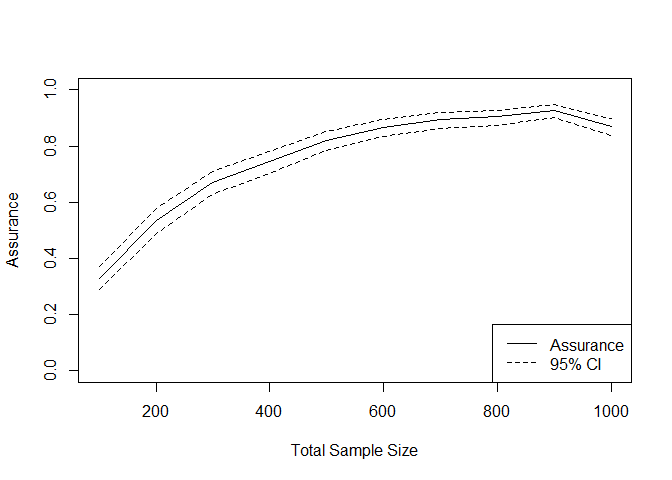
We can vary the sample sizes and plot the resulting output:
result <- calc_dte_assurance(n_c = seq(50, 500, by = 50),
                             n_t = seq(50, 500, by = 50),
                             control_model = control_model,
                             effect_model = effect_model,
                             censoring_model = censoring_model,
                             recruitment_model = recruitment_model,
                             analysis_model = analysis_model,
                             n_sims = 500)
Assurance for DTE - With Group Sequential Designs
Shiny App
Launch the interactive shiny app to explore assurance under delayed
treatment effects using group sequential designs:
DTEAssurance::assurance_GSD_shiny_app()
Offline Example
You can also use the package offline via the main function:
DTEAssurance::calc_dte_assurance_interim()
This function requires the following arguments:
n_c: Number of patients in the control groupn_t: Number of patients in the treatment groupcontrol_model: A named list specifying the control arm survival distributioneffect_model: A named list specifying beliefs about the treatment effectrecruitment_model: A named list specifying the recruitment processGSD_model: A named list specifying the group sequential designn_sims: Number of simulations to run
An example of this is shown:
control_model <- list(dist = "Exponential", parameter_mode = "Fixed", fixed_type = "Parameters", lambda = 0.08)
effect_model <- list(delay_SHELF = SHELF::fitdist(c(3, 4, 5), probs = c(0.25, 0.5, 0.75), lower = 0, upper = 10),
delay_dist = "gamma",
HR_SHELF = SHELF::fitdist(c(0.55, 0.6, 0.7), probs = c(0.25, 0.5, 0.75), lower = 0, upper = 1.5),
HR_dist = "gamma",
P_S = 0.9, P_DTE = 0.7)
recruitment_model <- list(method = "power", period = 12, power = 1)
GSD_model <- list(events = 450, alpha_spending = c("0.01, 0.025"),
                  beta_spending = c("0.05, 0.1"), IF_vec = c("0.5, 1"))
result <- calc_dte_assurance_interim(n_c = 300, n_t = 300,
                             control_model = control_model,
                             effect_model = effect_model,
                             recruitment_model = recruitment_model,
                             GSD_model = GSD_model,
                             n_sims = 500)

str(result)
#> 'data.frame':    500 obs. of  6 variables:
#>  $ Trial         : int  1 2 3 4 5 6 7 8 9 10 ...
#>  $ IF            : chr  "0.5, 1" "0.5, 1" "0.5, 1" "0.5, 1" ...
#>  $ Decision      : chr  "Successful at final" "Stop for efficacy" "Stop for futility" "Stop for futility" ...
#>  $ StopTime      : num  27.1 13.6 12.5 12.9 13.7 ...
#>  $ SampleSize    : int  600 600 600 600 600 600 600 600 600 600 ...
#>  $ Final_Decision: chr  "Successful" "Successful" "Successful" "Successful" ...
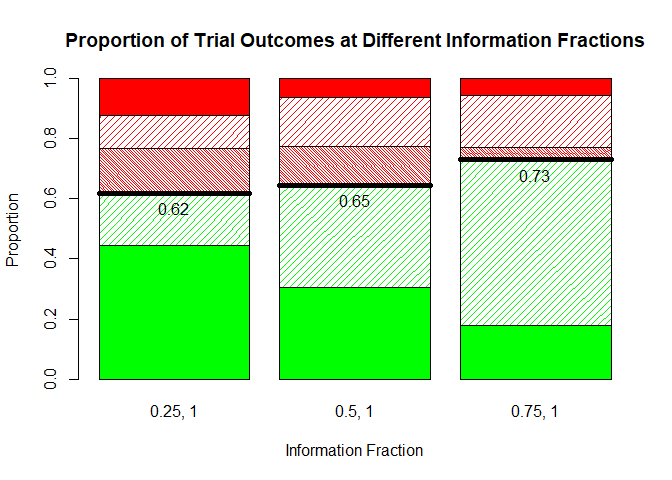
If we wish to compare the operating characteristics we can do so by
changing the GSD_model and plotting the proportion of outcomes:
GSD_model <- list(events = 450,
                  alpha_spending = c("0.01, 0.025", "0.01, 0.025", "0.01, 0.025"),
                  beta_spending = c("0.05, 0.1", "0.05, 0.1", "0.05, 0.1"),
                  IF_vec = c("0.25, 1", "0.5, 1", "0.75, 1"))

result <- calc_dte_assurance_interim(n_c = 300, n_t = 300,
                             control_model = control_model,
                             effect_model = effect_model,
                             recruitment_model = recruitment_model,
                             GSD_model = GSD_model,
                             n_sims = 500)