graphonmix
Generates Dense and Sparse Graphs using Graphon Extensions
Generates dense or sparse graphs using graphon mixtures and graphettes. Graphon mixtures uses two graphons U and W to generate graphs. Sparse graphs are generated in this case using the inverse line graph (root) operation. Graphettes have 3 components, the graphon W, a real-valued sequence and a graph edit function. Both techniques can generate dense or sparse graphs. Kandanaarachchi and Ong (2026)
graphonmix 

The goal of graphonmix is to generate dense or sparse graphs via different techniques. We explore $(U,W)$-mixture graphs and graphettes. $(U,W)$-mixture graphs are generated from a standard dense graphon $W$ and a disjoint clique graphon $U$, which acts as the sparse graph generator. Graphettes are a triple consisting of a graphon $W$, a sparsifing sequence ${\rho_n}_n$ with $\rho_n \to 0$ and graph edit function $f$. $(U,W)$-mixture graphs are discussed in (Kandanaarachchi and Ong 2026) and graphettes are discussed in (Wijesinghe et al. 2026).
Installation
You can install the development version of graphonmix from GitHub with:
# install.packages("pak")
pak::pak("sevvandi/graphonmix")
$(U,W)$ Mixture Example
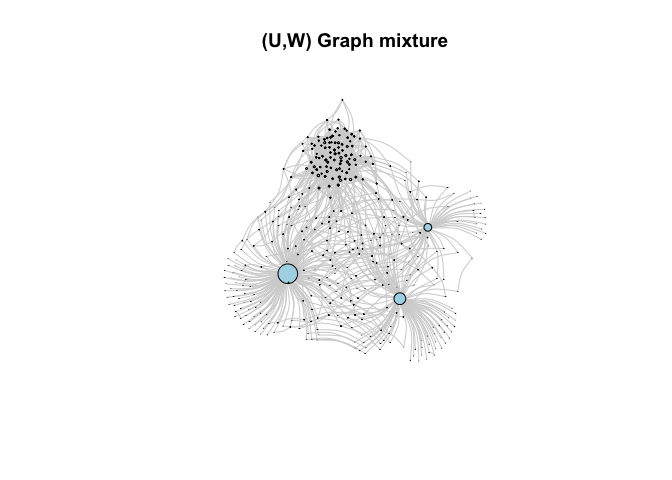
This is a basic example on how to sample a $(U,W)$-mixture graph.
library(graphonmix)
library(igraph)
#>
#> Attaching package: 'igraph'
#> The following objects are masked from 'package:stats':
#>
#>     decompose, spectrum
#> The following object is masked from 'package:base':
#>
#>     union
# create the dense graphon W(x,y) = 0.1
W <- matrix(0.1, nrow = 100, ncol = 100)
# create the sparse part - a disjoint set of stars
wts <- c(0.5, 0.3, 0.2)
# single function to generate a graph mixture
gr1 <- sample_mixed_graph(W, wts, nd = 100, ns = 300, p = 0.5, option = 2)
plot(gr1,
     edge.curved = 0.3,
     vertex.size = degree(gr1)*0.1,
     edge.color = "lightgray",     # Light colored edges
     vertex.label = NA,
     vertex.color = "lightblue",
     main = "(U,W) Graph mixture"
)
Graphette example
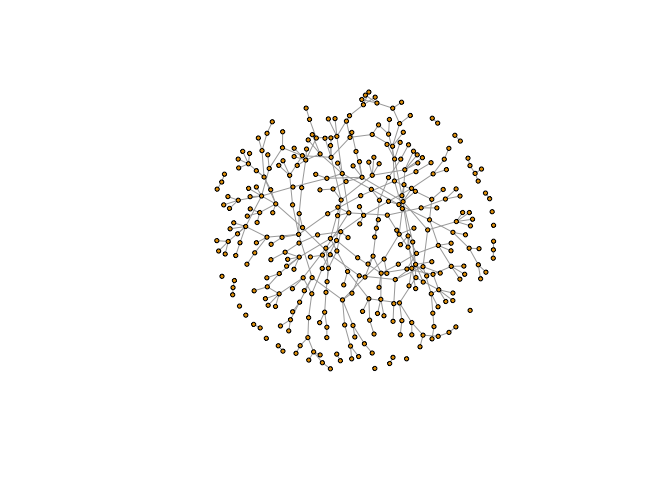
This is an example with $\rho_n = 10/n$ and $f = \text{star_f1}$. The graph edit function $\text{star_f1}$ adds stars using a Poisson process.
rho <- function(n) 20/n
gr <- sample_graphette(W,
                       rho_n = rho,
                       graph_edit_f = 'star_f1',
                       n = 200,
                       t_or_p = 2)

plot(gr, vertex.label = NA, vertex.size = 3)
Acknowledgements
A big thank you to Sashenka Fernando for helping me with the hex sticker.
References
Kandanaarachchi, Sevvandi, and Cheng Soon Ong. 2026. “Graphon Mixtures.” AISTATS.
Wijesinghe, Asiri, Sevvandi Kandanaarachchi, Daniel M Steinberg, and Cheng Soon Ong. 2026. “Flowette: Flow Matching with Graphette Priors for Graph Generation.” arXiv Preprint arXiv:2602.23566.