ICtest
Estimating and Testing the Number of Interesting Components in Linear Dimension Reduction
For different linear dimension reduction methods like principal components analysis (PCA), independent components analysis (ICA) and supervised linear dimension reduction tests and estimates for the number of interesting components (ICs) are provided.
ICtest

In linear dimension reduction the data are transformed into components of which only a few are assumed to carry the information of interest, while the remaining ones are considered noise. What makes a component interesting depends on the method. In principal component analysis (PCA) these are the components with large variances, in independent component analysis (ICA) and non-Gaussian component analysis (NGCA) the non-Gaussian components, and in supervised dimension reduction such as sliced inverse regression (SIR) the components which carry information about the response. The package ICtest provides tests and estimates for the number of these interesting, or informative, components, which also explains its name.
Main features
- Asymptotic tests for PCA (
PCAasymp(),PCAlrt()andPCAschott(), the latter also for p > n), for NGCA and ICA (FOBIasymp()) and for SIR (SIRasymp()). - Bootstrap tests for the same models (
PCAboot(),FOBIboot(),ICSboot()andSIRboot()) and a simulation-based test using non-Gaussian projection pursuit (NGPPsim()). kSearch(), which turns any of the tests into an estimate of the dimension using a forward, backward or binary search.- Ladle estimators (
PCAladle(),FOBIladle(),SIRladle()and the generalladle()) and predictor augmentation estimators (PCAaug(),FOBIaug()andSIRaug()), including the high-dimensional versionPCAaugHD(). - Plotting methods based on graphics and ggplot2, and the
function
rorth()for random orthogonal matrices that are uniformly distributed with respect to the Haar measure.
Note that PCAlrt(), PCAaugHD(), FOBIaug() and SIRaug() are so
far available only in the development version.
Installation
The released version can be installed from CRAN:
install.packages("ICtest")
The development version can be installed from GitHub:
# install.packages("remotes")
remotes::install_github("klauschN/ICtest")
Example
As an example we consider simulated data with three components whose variances are larger than those of the remaining seven, rotated by a random orthogonal matrix.
library(ICtest)
set.seed(1)
n <- 200
p <- 10
Z <- matrix(rnorm(n * p), ncol = p) %*% diag(c(3, 2.5, 2, rep(1, 7)))
X <- Z %*% t(rorth(p))
A forward search with the asymptotic test for subsphericity estimates the number of interesting components.
kSearch(X, PCAasymp)
#> Results for estimated k = 3:
#>
#>  PCA subsphericity test using cov
#>
#> data:  X
#> T = 27.921, df = 27, p-value = 0.415
#> alternative hypothesis: the last 7 eigenvalues are not equal
#>
#> Tested k values and respective p-values:
#> k = 0, p-value = < 2.2e-16
#> k = 1, p-value = < 2.2e-16
#> k = 2, p-value = < 2.2e-16
#> k = 3, p-value = 0.415
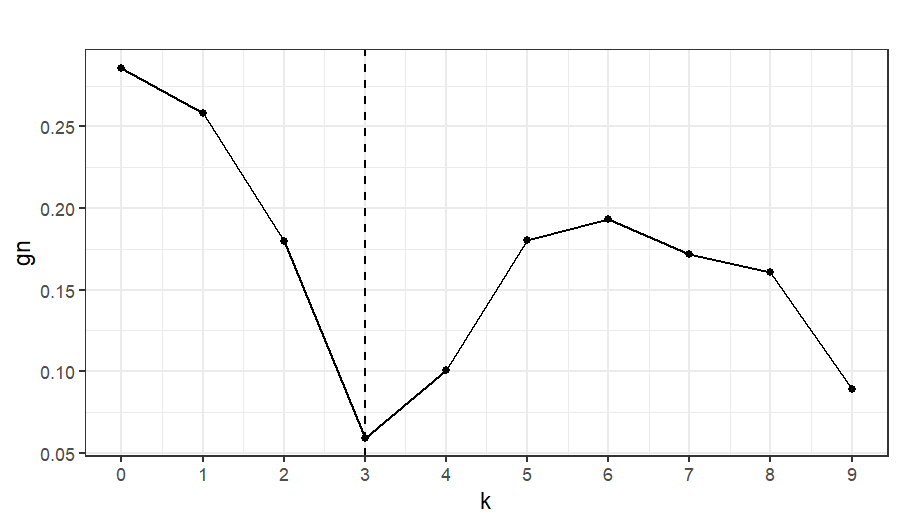
The ladle estimator gives the same answer, and its criterion can be plotted with ggplot2.
pcaLadle <- PCAladle(X)
pcaLadle$k
#> [1] 3
ggladleplot(pcaLadle, main = "", xlab = "k") +
  geom_vline(xintercept = pcaLadle$k, linetype = "dashed") +
  scale_x_continuous(breaks = 0:(p - 1)) + theme_bw()
More examples are given in the vignettes, see
vignette(package = "ICtest").
References
The methods are described in the following papers, among others:
- Nordhausen, K., Oja, H. and Tyler, D.E. (2022). Asymptotic and bootstrap tests for subspace dimension. Journal of Multivariate Analysis, 188, 104830. doi:10.1016/j.jmva.2021.104830
- Nordhausen, K., Oja, H., Tyler, D.E. and Virta, J. (2017). Asymptotic and bootstrap tests for the dimension of the non-Gaussian subspace. IEEE Signal Processing Letters, 24, 887–891. doi:10.1109/LSP.2017.2696880
- Luo, W. and Li, B. (2016). Combining eigenvalues and variation of eigenvectors for order determination. Biometrika, 103, 875–887. doi:10.1093/biomet/asw051
- Luo, W. and Li, B. (2021). On order determination by predictor augmentation. Biometrika, 108, 557–574. doi:10.1093/biomet/asaa077
- Radojičić, U. and Virta, J. (2025). Dimension estimation in a spiked covariance model using high-dimensional data augmentation. Biometrika, 112, asaf052. doi:10.1093/biomet/asaf052
To cite the package itself, see citation("ICtest"). Bug reports and
suggestions are welcome as
issues.