rsvd
Randomized Singular Value Decomposition
Low-rank matrix decompositions are fundamental tools and widely used for data analysis, dimension reduction, and data compression. Classically, highly accurate deterministic matrix algorithms are used for this task. However, the emergence of large-scale data has severely challenged our computational ability to analyze big data. The concept of randomness has been demonstrated as an effective strategy to quickly produce approximate answers to familiar problems such as the singular value decomposition (SVD). The rsvd package provides several randomized matrix algorithms such as the randomized singular value decomposition (rsvd), randomized principal component analysis (rpca), randomized robust principal component analysis (rrpca), randomized interpolative decomposition (rid), and the randomized CUR decomposition (rcur). In addition several plot functions are provided.


Fast Randomized Singular Value Decomposition using R
Randomized singular value decomposition (rsvd) is a fast probabilistic algorithm that can
be used to compute the near optimal low-rank singular value decomposition of massive data sets with high accuracy.
The key idea is to compute a compressed representation
of the data to capture the essential information. This compressed representation can then be used to obtain
the low-rank singular value decomposition decomposition. The rsvd package provides one of the fastest routines for low-rank matrix approximations in R, as far as we know.
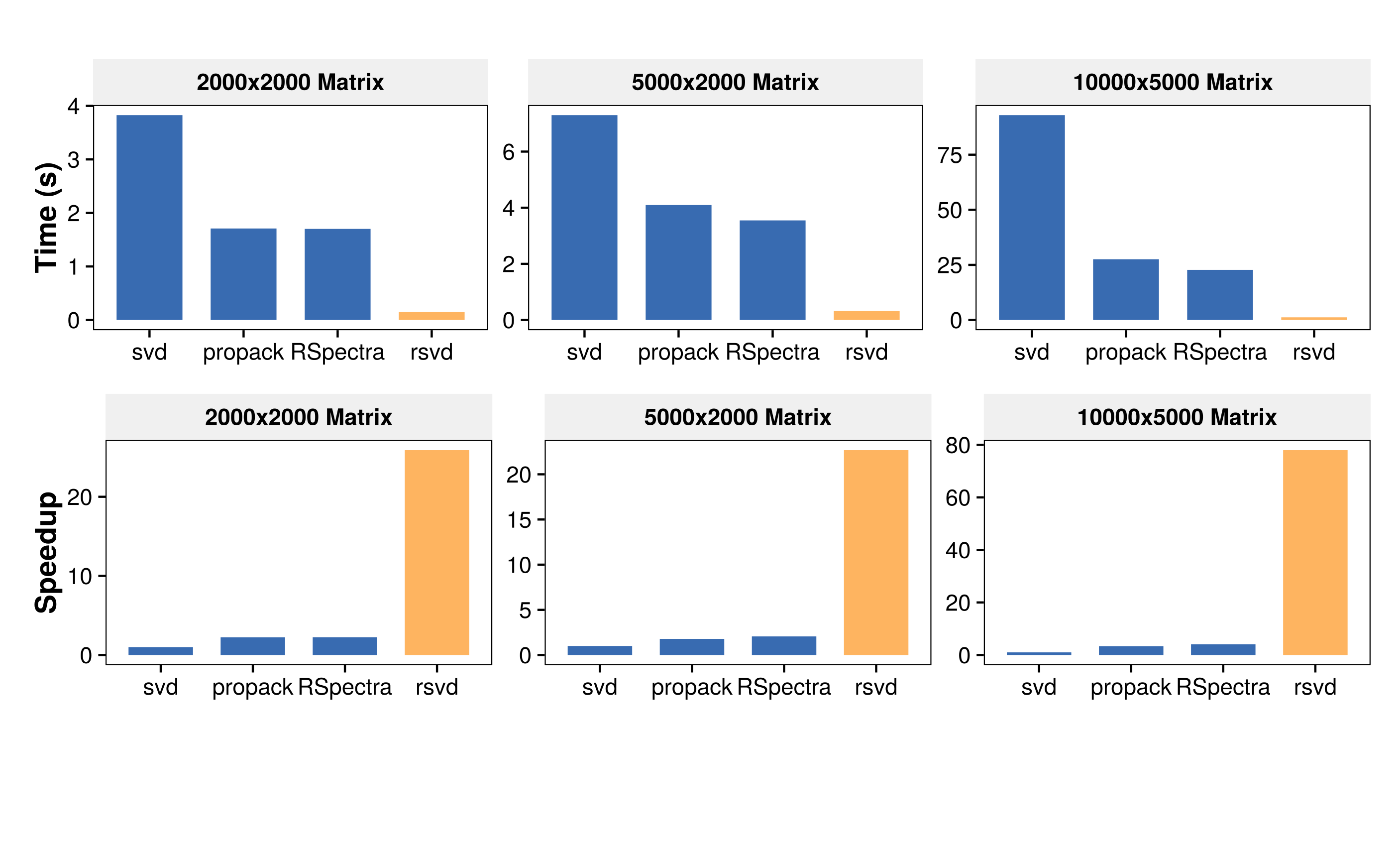
The computational advantage becomes pronounced with an increasing matrix dimension (here target-rank k=50):
The singular value decomposition plays a central role in data analysis and scientific computing. The SVD is also widely used for computing (randomized) principal component analysis (PCA), a linear dimensionality reduction technique. Randomized PCA (rpca) uses the approximated singular value decomposition to compute the most significant principal components. This package also includes a function to compute (randomized) robust principal component analysis (RPCA). In addition several plot functions are provided. See for further details: Randomized Matrix Decompositions using R.
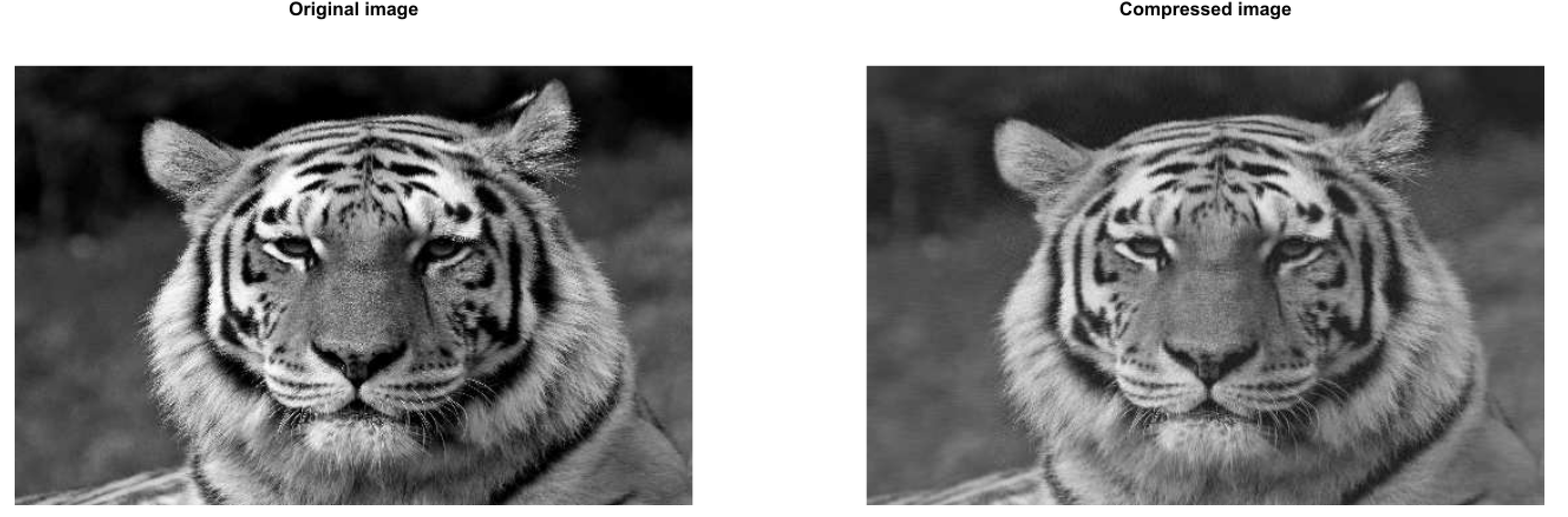
SVD example: Image compression
library(rsvd)
data(tiger)

# Image compression using randomized SVD
s <- rsvd(tiger, k=150)
tiger.re = s$u %*% diag(s$d) %*% t(s$v) # reconstruct image

# Display orginal and reconstrucuted image
par(mfrow=c(1,2))
image(tiger, col = gray((0:255)/255))
image(tiger.re, col = gray((0:255)/255))
Here are the results:
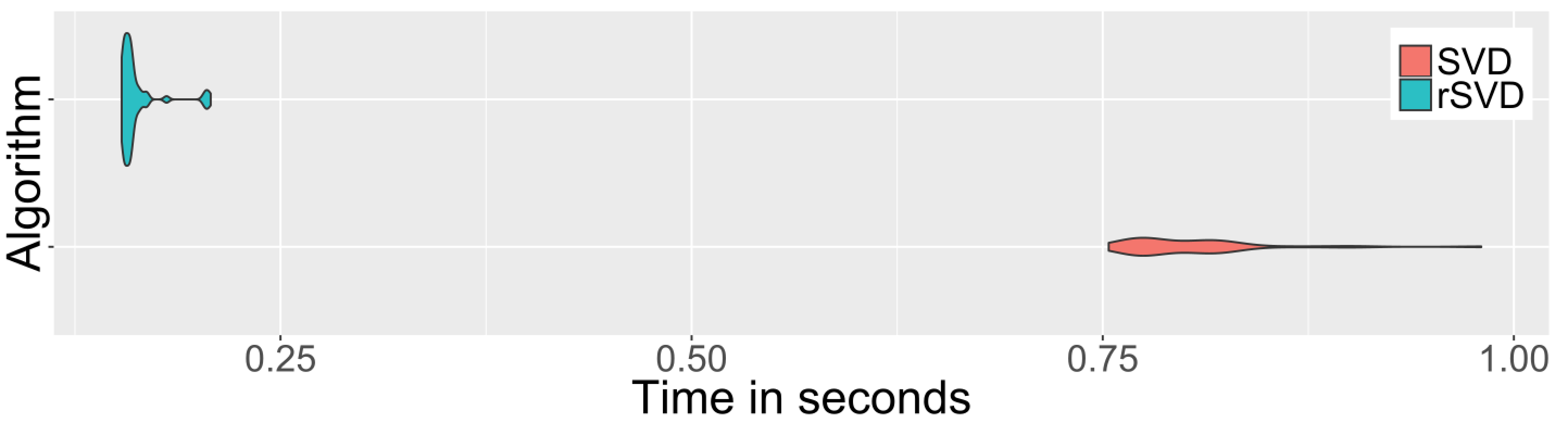
and the speedup gained over the base SVD function:
library(microbenchmark)

timing_svd <- microbenchmark(
  'SVD' = svd(tiger, nu=150, nv=150),
  'rSVD' = rsvd(tiger, k=150),
  times=50)

print(timing_svd, unit='s')
Installation
Install the rsvd package via CRAN
install.packages("rsvd")
You can also install the development version from GitHub using devtools:
devtools::install_github("erichson/rsvd")
The source packge can be obtained here: CRAN: rsvd.
New in Version 1.0.2
- Several small issues are fixed.
- Thanks to Aaron Lun, who has fixed a bug in the rsvd function that occured when nu=0 or nv=0.
New in Version 1.0.0
- Support for non-default matrix types to deal with large-scale matrices that are held on file, added by Aaron Lun.
- Fixed a bug which occured runninig rpca with k=1 and retx=TRUE, discovered by Will.
References
- Erichson NB, Voronin S, Brunton SL, Kutz JN (2019). Randomized Matrix Decompositions Using R. Journal of Statistical Software, 89(11), 1–48. doi: 10.18637/jss.v089.i11.
- Sergey Voronin, Per-Gunnar Martinsson. RSVDPACK: Subroutines for computing partial singular value decompositions via randomized sampling on single core, multi core, and GPU architectures. (2015)
- Nathan Halko, et al. Finding structure with randomness: Probabilistic algorithms for constructing approximate matrix decompositions. (2011)
Cite as
@Article{,
    title = {Randomized Matrix Decompositions Using {R}},
    author = {N. Benjamin Erichson and Sergey Voronin and Steven L.
      Brunton and J. Nathan Kutz},
    journal = {Journal of Statistical Software},
    year = {2019},
    volume = {89},
    number = {11},
    pages = {1--48},
    doi = {10.18637/jss.v089.i11},
}