parafac4microbiome
Parallel Factor Analysis Modelling of Longitudinal Microbiome Data
Creation and selection of PARAllel FACtor Analysis (PARAFAC)
models of longitudinal microbiome data. You can import your own data with
our import functions or use one of the example datasets to create your own
PARAFAC models. Selection of the optimal number of components can be done
using assessModelQuality() and assessModelStability(). The selected model can
then be plotted using plotPARAFACmodel(). The Parallel Factor
Analysis method was originally described by Caroll and Chang (1970)
parafac4microbiome 



Overview
The parafac4microbiome package enables R users with an easy way to
create Parallel Factor Analysis (PARAFAC) models for longitudinal
microbiome data.
processDataCube()can be used to process the microbiome count data appropriately for a multi-way data array.parafac()allows the user to create a Parallel Factor Analysis model of the multi-way data array.assessModelQuality()helps the user select the appropriate number of components by randomly initializing many PARAFAC models and inspecting various metrics of interest.assessModelStability()helps the user select the appropriate number of components by bootstrapping or jack-knifing samples and inspecting if the model outcome is similar.plotPARAFACmodel()helps visually inspect the PARAFAC model.
This package also comes with three example datasets.
Fujita2023: an in-vitro experiment of ocean inocula on peptide medium, sampled every day for 110 days (doi:10.1186/s40168-023-01474-5).Shao2019: a large cohort dataset of vaginally and caesarean-section born infants from London (doi:10.1038/s41586-019-1560-1).vanderPloeg2024: a small gingivitis intervention dataset with response groups (doi:10.1101/2024.03.18.585469).
Documentation
A basic introduction to the package is given in
vignette("Introduction") and modelling the example datasets are
elaborated in their respective vignettes vignette("Fujita2023"),
vignette("Shao2019") and vignette("vanderPloeg2024").
These vignettes and all function documentation can be found here.
Installation
The parafac4microbiome package can be installed from CRAN using:
install.packages("parafac4microbiome")
Development version
You can install the development version of parafac4microbiome from
GitHub with:
# install.packages("devtools")
devtools::install_github("GRvanderPloeg/parafac4microbiome")
Citation
Please use the following citation when using this package:
- van der Ploeg, G. R., Westerhuis, J., Heintz-Buschart, A., & Smilde, A. (2025). parafac4microbiome: Exploratory analysis of longitudinal microbiome data using Parallel Factor Analysis. mSystems 10:e00472-25. https://doi.org/10.1128/msystems.00472-25
Usage
library(parafac4microbiome)
set.seed(123)

# Process the data cube
processedFujita = processDataCube(Fujita2023,
                                  sparsityThreshold=0.99,
                                  CLR=TRUE,
                                  centerMode=1,
                                  scaleMode=2)

# Make a PARAFAC model
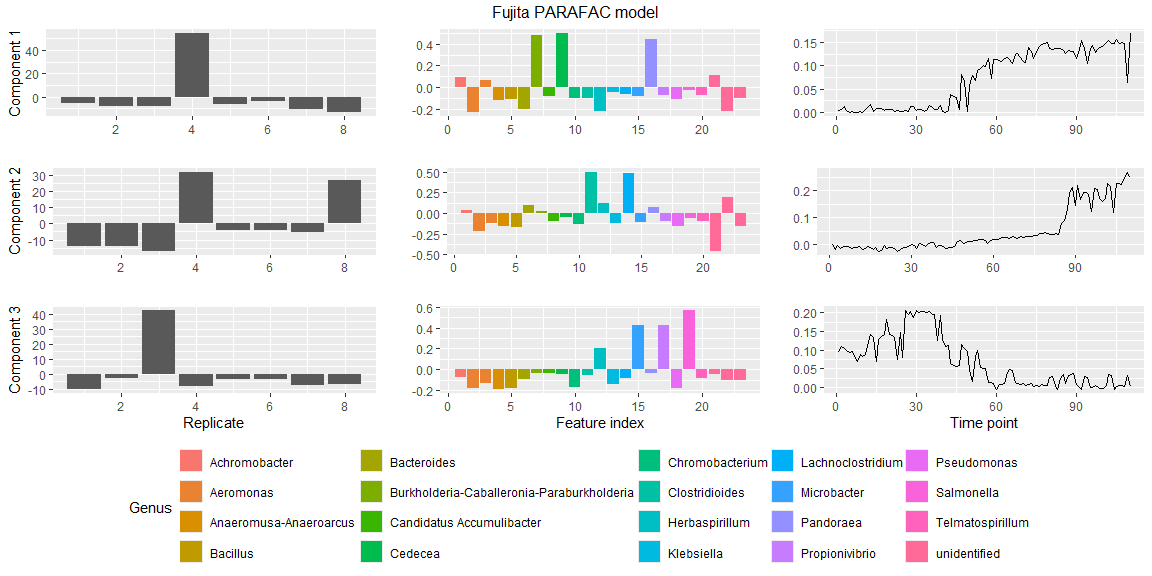
model = parafac(processedFujita$data, nfac=3, nstart=10, output="best")

# Sign flip components to make figure interpretable and comparable to the paper.
# This has no effect on the model or the fit.
model$Fac[[1]][,2] = -1 * model$Fac[[1]][,2] # sign flip mode 1 component 2
model$Fac[[2]][,1] = -1 * model$Fac[[2]][,1] # sign flip mode 2 component 1
model$Fac[[2]][,3] = -1 * model$Fac[[2]][,3] # sign flip mode 2 component 3
model$Fac[[3]] = -1 * model$Fac[[3]]         # sign flip all of mode 3

# Plot the PARAFAC model using some metadata
plotPARAFACmodel(model$Fac, processedFujita,
                 numComponents = 3,
                 colourCols = c("", "Genus", ""),
                 legendTitles = c("", "Genus", ""),
                 xLabels = c("Replicate", "Feature index", "Time point"),
                 legendColNums = c(0,5,0),
                 arrangeModes = c(FALSE, TRUE, FALSE),
                 continuousModes = c(FALSE,FALSE,TRUE),
                 overallTitle = "Fujita PARAFAC model")
Getting help
If you encounter an unexpected error or a clear bug, please file an issue with a minimal reproducible example here on Github. For questions or other types of feedback, feel free to send an email.