missknn
Fast Masked K-Nearest Neighbor Imputation
Fast masked KNN imputation for tabular data with support for single and multiple imputation.
missknn

missknn is an R package for fast masked k-nearest neighbor imputation of missing values in tabular data.
Installation
Install the development version from GitHub with:
install.packages("remotes")
remotes::install_github("ielbadisy/missknn")
It is fast by design:
- distance computation, donor ranking, and aggregation are done in C++, with partial (not full)
top-
kselection and a batched per-column API that avoids per-cell R/C++ round trips - each column's
kand estimator (distance-weighted mean vs. a local weighted-regression fit) are chosen automatically from a holdout evaluation, rather than fixed globally - columns with no locally exploitable signal are detected and filled directly from the global mean/mode, skipping neighbor search entirely
- a
donor_capbounds the neighbor-search candidate pool so cost stays roughly linear inninstead of quadratic, which matters at largen data.tableis used for lightweight tabular orchestration- multiple imputation (
m > 1) can run multicore by default on Unix-like systems viaparallel::mclapply - within a single imputation, the per-column holdout
k/estimator tuning and the deterministic (non-stochastic) neighbor search are parallelized across columns/receivers withRcppParallel, on all platforms including Windows
It supports:
- single imputation
- multiple imputation
- numeric and mixed tabular data
data.table-friendly workflows
About
missknn is developed and maintained by Imad El Badisy ([email protected]), released
under the MIT license.
Latest Implementation
The current implementation parallelizes the per-column k/estimator tuning and the deterministic
single-imputation path with RcppParallel, including on Windows. The m > 1 stochastic path still
uses process-level parallelism via parallel::mclapply on Unix-like systems.
Parallel computing
missknn parallelizes at two independent levels:
- Across imputations (
m > 1): each of themcompleted datasets is generated in a separate process viaparallel::mclapply, controlled byparallel_cores(defaults todetectCores() - 1). This only applies on Unix-like systems; it falls back to serial on Windows. - Within a single imputation: the per-column holdout search that picks each column's
kand estimator, and the deterministic (m = 1) neighbor search/aggregation, are split across threads withRcppParallel::parallelFor- across target columns for tuning, across receiver rows for imputation. This runs on every platform, including Windows, and benefitsm = 1runs that get no benefit fromparallel_cores. The stochastic sampling path used whenm > 1stays single-threaded per process, since R's RNG isn't thread-safe; that case still parallelizes across themprocesses instead.
Thread count for the RcppParallel layer follows the usual RcppParallel::setThreadOptions() /
RCPP_PARALLEL_NUM_THREADS conventions.
Progress reporting
imp <- missknn(big_data, k = 5, progress = TRUE)
With progress = TRUE, missknn() shows a live, self-contained (base R only, no extra
dependency) progress bar for each tuning stage (Tuning numeric columns,
Tuning categorical columns) and for each column that goes through the neighbor search
(Imputing <column>), updating in place with a percentage and an ETA, e.g.:
Imputing x2 [===========>------------------] 38% ETA: 4s
Columns with no locally exploitable signal (filled directly from the global mean/mode, see the
missknn() API entry above) don't get a bar, since they skip the neighbor search entirely.
Because RcppParallel worker threads can't safely drive a progress display, requesting
progress = TRUE runs that column's search on a single thread instead of in parallel - an
explicit, visible-vs-fast tradeoff, not a bug. Leave progress = FALSE (the default) for the
fastest run. progress is also automatically disabled whenever m > 1 with parallel_cores > 1,
since console output from parallel::mclapply's forked worker processes can't be shown live.
Benchmark
Two benchmark scripts write reports, plots, and CSV tables to inst/benchmark/output/:
# accuracy/runtime vs. missForest, missMDA, VIM::kNN at n = 200, 30 simulations
Rscript inst/benchmark/benchmark_30.R

# runtime/accuracy vs. missMDA and missForest as n scales from 1,000 to 100,000
Rscript inst/benchmark/benchmark_bigdata.R
API
missknn(data, k = 5L, m = 1L, scale = TRUE, add_indicator = FALSE, seed = NULL, weights = c("distance", "uniform"), numeric_estimator = c("regression", "mean"), ridge = 1e-4, donor_cap = 2000L, max_iter = 1L, parallel_cores = missknn_default_cores(), progress = FALSE)
Fits masked KNN imputation and returns a missknn object.
| Argument | Description |
|---|---|
data |
A data.frame or matrix. |
k |
Number of nearest donors used per target column. |
m |
Number of completed datasets. m = 1 is single (deterministic) imputation; m > 1 is multiple (stochastic donor-sampling) imputation. |
scale |
Standardize numeric variables before computing distances. |
add_indicator |
Append TRUE/FALSE missingness-indicator columns to the completed output. |
seed |
Integer seed for reproducible multiple imputation. |
weights |
"distance" (inverse-distance weighted aggregation) or "uniform" (equal weights) over the k donors. |
numeric_estimator |
"regression" fits a distance-weighted local linear regression of the target on the receiver's observed numeric predictors over the k donors, falling back to the weighted mean when the local design is degenerate; "mean" always uses the weighted mean. |
ridge |
Ridge penalty added to the predictor covariance under numeric_estimator = "regression". |
donor_cap |
Caps the donor pool searched per target column, subsampling once per column when exceeded, so search cost stays roughly linear in n. Does not affect the global mean/mode fallback, which always uses every donor. |
max_iter |
Number of single-pass refinement iterations over the whole dataset. |
parallel_cores |
Cores used across the m completed datasets when m > 1 (via parallel::mclapply, Unix-like only). Defaults to detectCores() - 1. Independent of the RcppParallel threading used within a single imputation (see Parallel computing). |
progress |
Show a live cli progress bar per tuning stage and per imputed column (see Progress reporting). Default FALSE. |
Columns with no locally exploitable signal are detected during fitting and filled from the global mean/mode directly, without a neighbor search.
Returns a missknn object: a list with data (input as a data.table), completed (one
completed data.table, or a list of m when m > 1), imputations (always a list of m),
plus the arguments used to fit (k, m, scale, weights, etc.) and internal meta.
complete(object, action = c("all", "single"), index = 1L, ...)
S3 generic (complete.missknn) that extracts completed data from a missknn object.
action = "all"(default): returns every completed dataset (a single data.table whenm = 1, a list ofmdata.tables whenm > 1).action = "single": returns one completed data.table, selected byindex(ignored whenm = 1, since there is only one).
print(x) / summary(object)
print.missknn reports n, p, k, m, scale, and add_indicator. summary.missknn
additionally reports per-variable and total missing counts (missing_by_variable,
missing_total) and has its own print.summary.missknn method.
Example
library(missknn)

x <- data.frame(
  a = c(1, 2, NA, 4),
  b = c(2, NA, 3, 5),
  g = factor(c("x", "x", "y", NA))
)

imp <- missknn(x, k = 2, m = 1)
imp
summary(imp)
complete(imp)

# multiple imputation
mi <- missknn(x, k = 2, m = 5, seed = 1)
complete(mi, action = "single", index = 2)
Execution time vs. sample size
Runtime and NRMSE from n = 1,000 up to n = 100,000 (5 numeric columns, 20% MCAR per column).
missForest and VIM::kNN are only run up to n = 5,000 (per-tree cost and O(n^2) distance
search respectively make larger n impractical); missknn and missRanger run across the full
grid. Reproduce with:
Rscript inst/benchmark/benchmark_bigdata.R
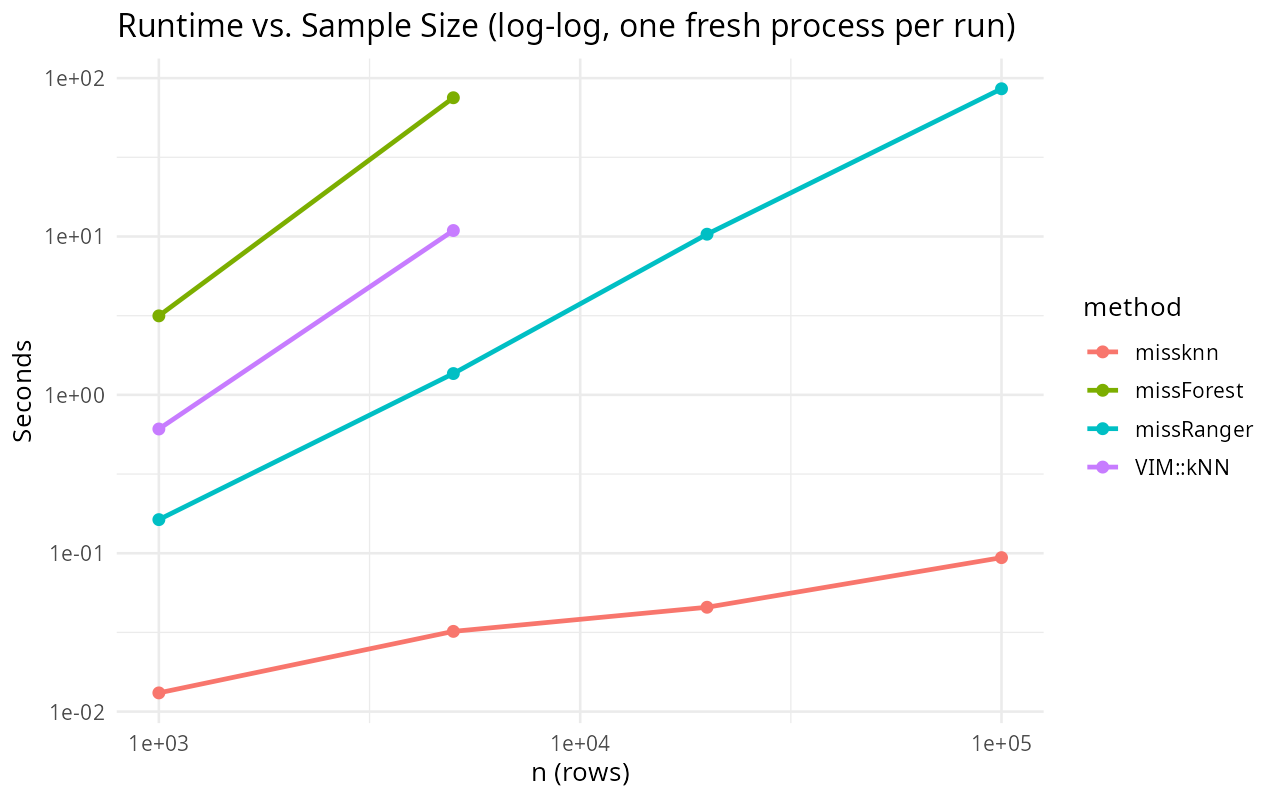
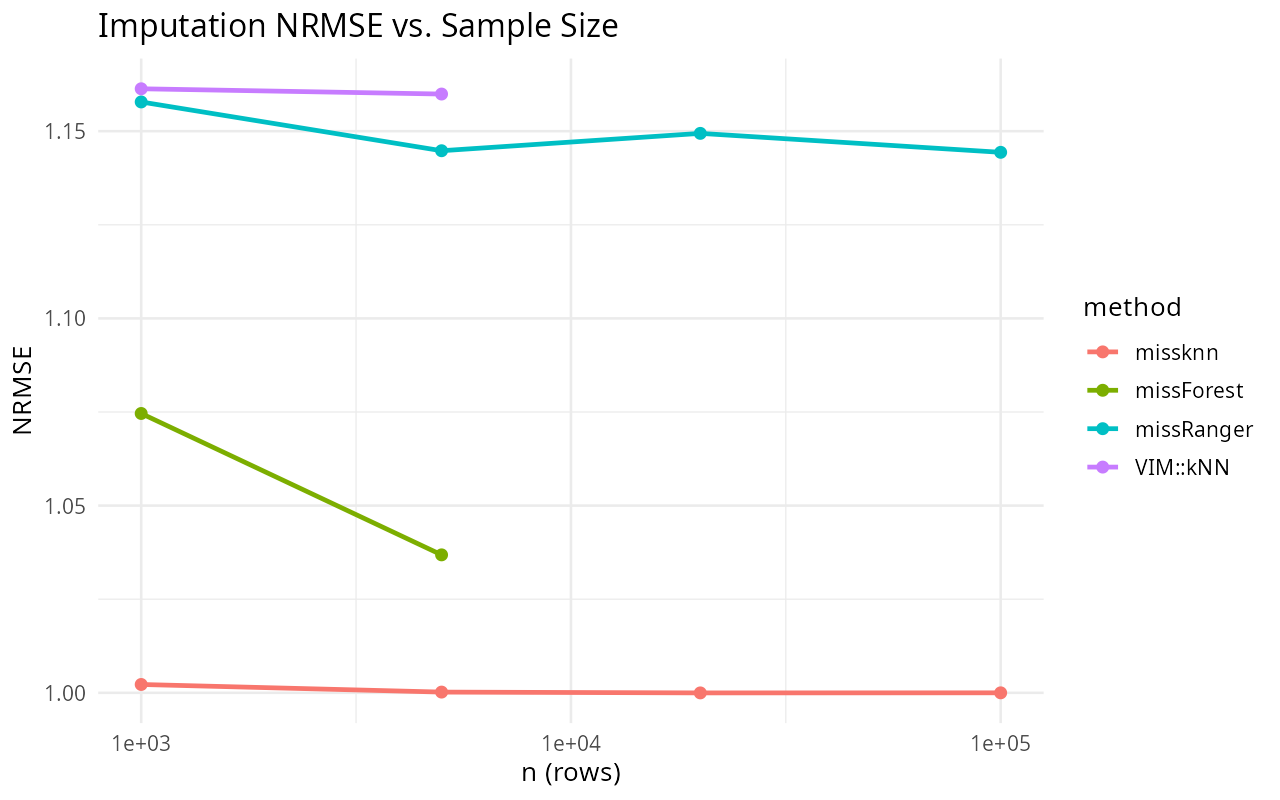
Table: Runtime and NRMSE by method and sample size
| n | method | runtime_sec | nrmse |
|---|---|---|---|
| 1,000 | missknn | 0.0131 | 1.00223 |
| 1,000 | missRanger | 0.1630 | 1.15781 |
| 1,000 | missForest | 3.1537 | 1.07461 |
| 1,000 | VIM::kNN | 0.6088 | 1.16132 |
| 5,000 | missknn | 0.0321 | 1.00020 |
| 5,000 | missRanger | 1.3632 | 1.14478 |
| 5,000 | missForest | 75.1881 | 1.03685 |
| 5,000 | VIM::kNN | 10.9076 | 1.15992 |
| 20,000 | missknn | 0.0456 | 0.99998 |
| 20,000 | missRanger | 10.3372 | 1.14941 |
| 100,000 | missknn | 0.0938 | 1.00000 |
| 100,000 | missRanger | 85.6539 | 1.14435 |
missForest's runtime already becomes impractical at n = 5,000 (over a minute) and would take
hours at n = 100,000; VIM::kNN's distance search is similarly infeasible past a few thousand
rows. missknn's capped-donor masked-KNN search stays close to linear in n and keeps running
in well under a second even at n = 100,000. missRanger also scales to n = 100,000 but at
substantially higher runtime.