caretMultimodal
Multimodal Late Fusion with 'caret'
Extends the 'caret' framework to support late fusion workflows,
enabling users to train models independently across multiple data modalities and combine their
predictions into a single meta-model. Designed for developers, data scientists, and
biomedical researchers alike, 'caretMultimodal' aims to make late fusion ensemble modelling
as accessible and flexible as single-dataset workflows in 'caret'. Late fusion methods are based on Wolpert (1992)



caretMultimodal
caretMultimodal extends the caret framework to support
late fusion workflows in R, enabling users to train models independently across multiple data
modalities and combine their predictions into a single meta-model. Designed for R developers,
data scientists, and biomedical researchers, caretMultimodal makes late fusion ensemble
modelling as accessible and flexible as single-dataset workflows in caret.
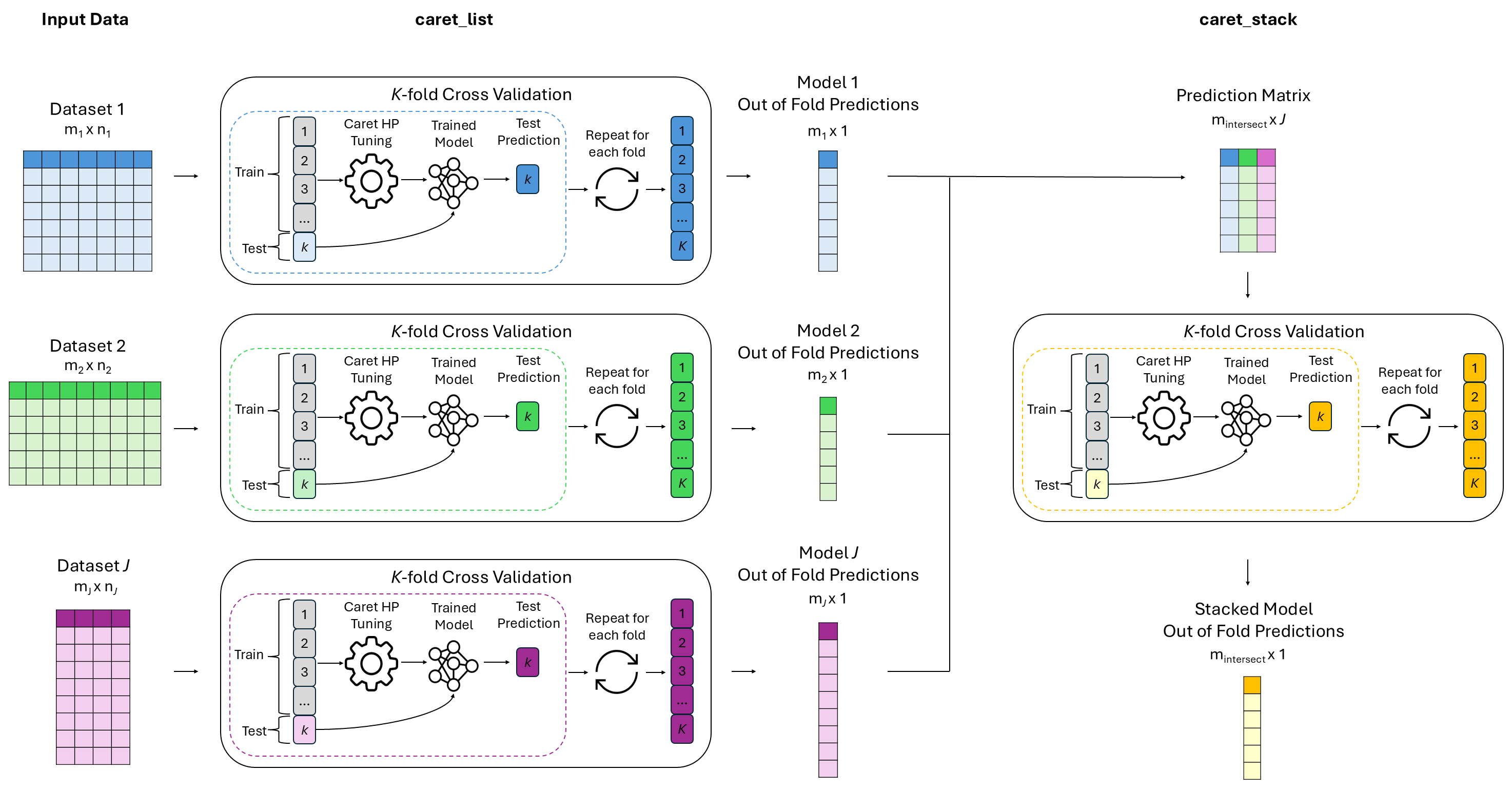
Example late fusion workflow using cross-validation
Key Features
- Includes all the functionality of
caret, giving users full control over sampling strategies, training methods, hyperparameter tuning, and more - Default cross-validation structure with careful handling to prevent data leakage across modalities
- Late fusion ensembling using stacked generalization
- Parallelization for faster training across models and datasets
- Model trimming to reduce memory usage for large ensembles
- Built-in evaluation tools for performance assessment, ROC curves, and variable importance
- Detailed error messages to simplify debugging
Documentation
Full API documentation is available at compbio-lab.github.io/caretMultimodal
Installation
The package can be installed using devtools
devtools::install_github("CompBio-Lab/caretMultimodal")
Acknowledgements
The project structure is inspired by Zach Mayer's caretEnsemble package,
which is used for stacking multiple models on a single dataset.