audubon
Japanese Text Processing Tools
A collection of Japanese text processing tools for filling Japanese iteration marks, Japanese character type conversions, segmentation by phrase, and text normalization which is based on rules for the 'Sudachi' morphological analyzer and the 'NEologd' (Neologism dictionary for 'MeCab'). These features are specific to Japanese and are not implemented in 'ICU' (International Components for Unicode).
audubon 


audubon is Japanese text processing tools for:
- hiraganization, katakanization and romanization with hakatashi/japanese.js
- segmentation by phrase with google/budoux and ‘TinySegmenter.js’
- text normalization which is based on rules for the ‘Sudachi’ morphological analyzer and the ‘NEologd’ (Neologism dictionary for ‘MeCab’)
Installation
remotes::install_github("paithiov909/audubon")
Usage
Japanese text normalization
strj_normalize normalizes text following the rule based on
NEologd
style.
strj_normalize("――南アルプスの 天然水- Sparking* Lemon+ レモン一絞り")
#> [1] "ー南アルプスの天然水-Sparking* Lemon+レモン一絞り"
strj_rewrite_as_def is an R port of
SudachiCharNormalizer
that typically normalizes characters following a ’*.def’ file.
audubon package contains several ’*.def’ files, so you can use them or write a ‘rewrite.def’ file by yourself as follows.
# single characters will **never** be normalized.
…
# if two characters are separated with a tab,
# left side forms are always rewritten to right side forms
# before normalized.
斎   斉
齋   斉
齊   斉
# supports rewriting a single character to a single character,
# i.e., this cannot work.
アッ  ア
This feature is more powerful than stringi::stri_trans_* because it
allows users to control which characters are normalized. For instance,
this function can be used to convert kyuji-tai characters to
shinji-tai characters.
stringi::stri_trans_nfkc("Ⅹⅳ")
#> [1] "Xiv"
strj_rewrite_as_def("Ⅹⅳ")
#> [1] "Ⅹⅳ"
strj_rewrite_as_def("惡と假面のルール", read_rewrite_def(system.file("def/kyuji.def", package = "audubon")))
#> [1] "悪と仮面のルール"
Japanese label helpers for ggplot2
audubon provides small helper functions designed to work with ggplot2 labellers, making it easier to format Japanese text and dates in plots. These labellers are intended for cases where default wrapping or formatting is insufficient for Japanese text, and where ICU-based locale handling can be leveraged without manual preprocessing.
Japanese word wrapping
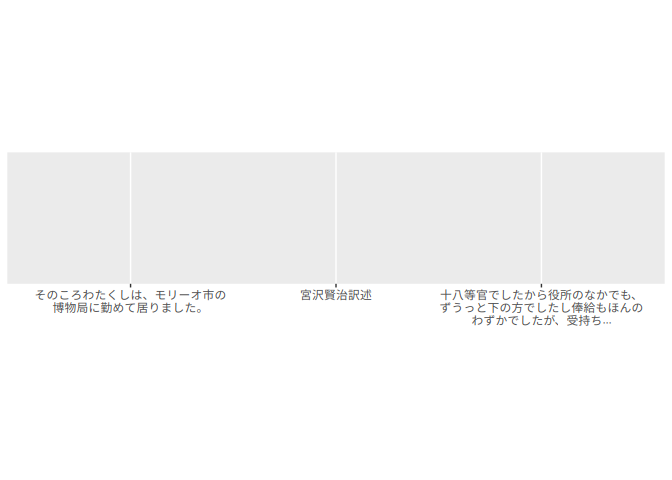
label_wrap_jp() and label_wrap_jp_gen() wrap labels at natural
Japanese phrase boundaries rather than fixed character widths. This is
useful for discrete scales with long Japanese labels, such as titles,
phrases, or excerpts.
scales::demo_discrete(polano[4:6], labels = label_wrap_jp_gen())
#> scale_x_discrete(labels = label_wrap_jp_gen())
Japanese date labels
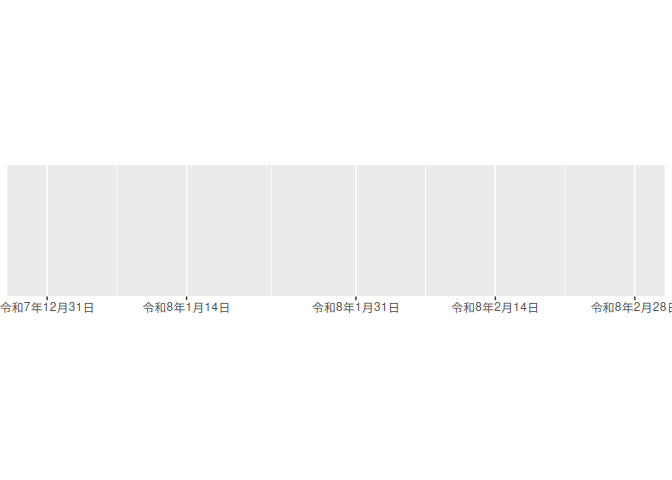
label_date_jp() and label_date_jp_gen() format date labels using the
Japanese calendar system, including era-based representations. They can
be used with date or datetime scales to produce locale-aware Japanese
date labels without manual formatting.
date_range <- function(start, days) {
  start <- as.POSIXct(start)
  c(start, start + days * 24 * 60 * 60)
}
two_months <- date_range("2025-12-31", 60)
scales::demo_datetime(two_months, labels = label_date_jp_gen())
#> scale_x_datetime(labels = label_date_jp_gen())
License
© 2025 Akiru Kato
Licensed under the Apache License, Version 2.0.
Icons made by iconixar from flaticon.