PRISMA2020
Make Interactive 'PRISMA' Flow Diagrams
Systematic reviews should be described in a high degree of methodological detail. The 'PRISMA' Statement calls for a high level of reporting detail in systematic reviews and meta-analyses. An integral part of the methodological description of a review is a flow diagram. This package produces an interactive flow diagram that conforms to the 'PRISMA2020' preprint. When made interactive, the reader/user can click on each box and be directed to another website or file online (e.g. a detailed description of the screening methods, or a list of excluded full texts), with a mouse-over tool tip that describes the information linked to in more detail. Interactive versions can be saved as HTML files, whilst static versions for inclusion in manuscripts can be saved as HTML, PDF, PNG, SVG, PS or WEBP files.






PRISMA2020 Flow Diagram 
You can use this package to produce a flow diagram that conforms to the PRISMA 2020 standards using the PRISMA_flowdiagram() function. The data can be manually entered into the function, or loaded up using the template CSV file provided in 'INST/EXTDATA/'. The function, (if 'interactive = TRUE') produces an interactive HTML ouput with each box linking to a specific page (e.g. of search results or methods details), and hover-over tooltips for further information.
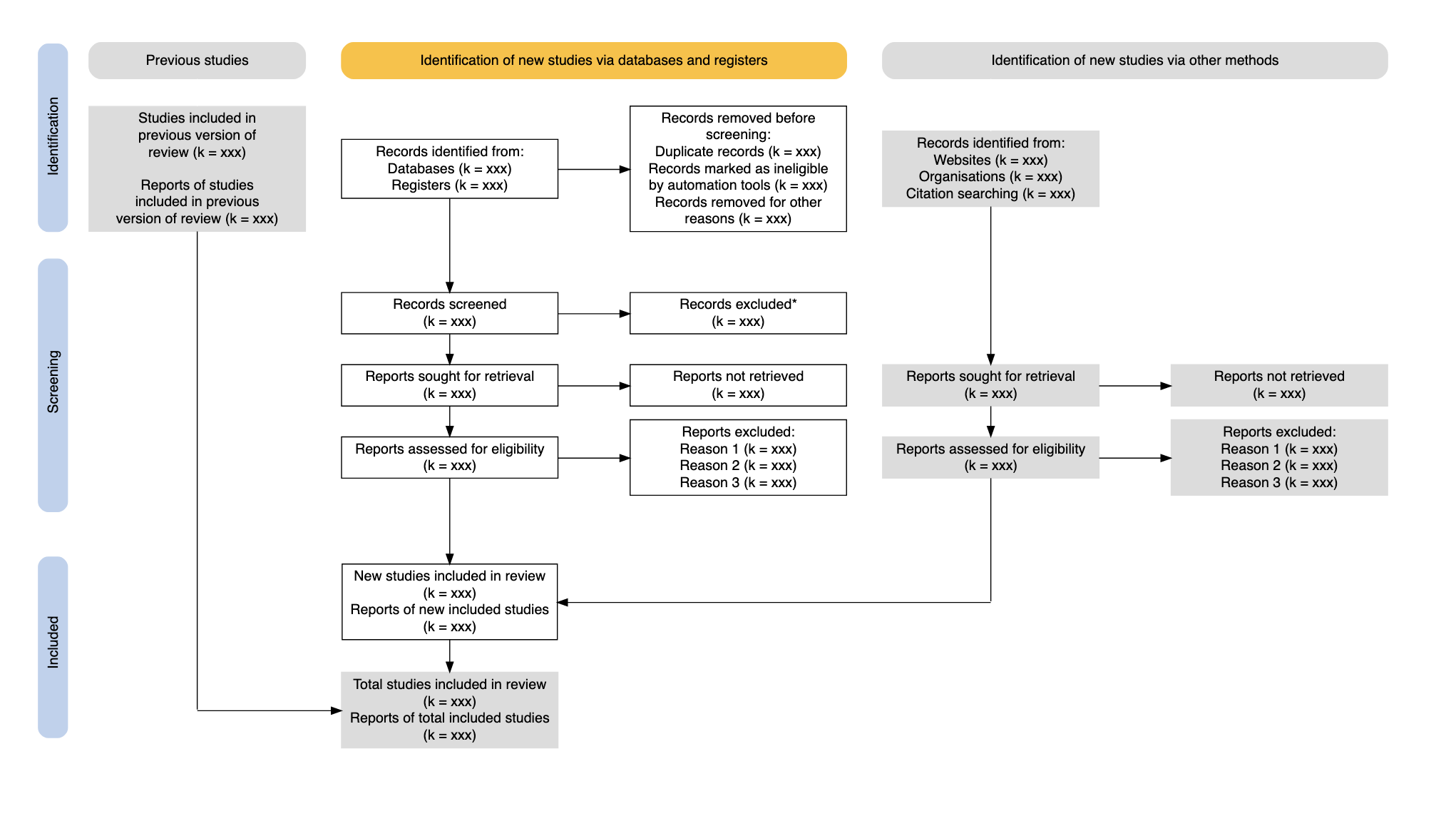
The 'Previous' and 'Other' study arms of the flowchart can be toggled on and off and removed or added to the diagram by specifying this in the function inputs.
A static version is produced otherwise.
See the interactive template here.
Visit the web-based Shiny app for a point-and-click user interface here.
Docker Installation
You can quickly install the PRISMA2020 package and run the included example shinyapp using Docker.
docker build . -t prisma-shiny:1
docker run -it --rm -p 3838:3838 prisma-shiny:1
Then visit http://localhost:3838/app in your web browser.
To stop the app, press Ctrl+C in the terminal.
Please cite as:
Haddaway, N. R., Page, M. J., Pritchard, C. C., & McGuinness, L. A. (2022). PRISMA2020: An R package and Shiny app for producing PRISMA 2020-compliant flow diagrams, with interactivity for optimised digital transparency and Open Synthesis. Campbell Systematic Reviews, 18, e1230. https://doi.org/10.1002/cl2.1230
Citation in .ris format (right click 'Save Link As')