xpose4
Diagnostics for Nonlinear Mixed-Effect Models
A model building aid for nonlinear mixed-effects
(population) model analysis using NONMEM, facilitating data set
checkout, exploration and visualization, model diagnostics, candidate
covariate identification and model comparison. The methods are described
in Keizer et al. (2013)
Xpose 4 


by Andrew C. Hooker, Mats O. Karlsson and E. Niclas Jonsson
Introduction
Xpose 4 is a collection of functions to be used as a model building aid for nonlinear mixed-effects (population) analysis using NONMEM. It facilitates data set checkout, exploration and visualization, model diagnostics, candidate covariate identification and model comparison.
Installation
To install xpose you will need R (>= version 2.2.0).
To install Xpose in R use one of the following methods:
-
latest stable release – From CRAN. Write at the R command line:
install.packages("xpose4") -
Latest development version – from Github. Note that the command below installs the “master” (development) branch; if you want the release branch from Github add
ref="release"to theinstall_github()call.# install.packages("devtools") devtools::install_github("UUPharmacometrics/xpose4")
Running Xpose 4
Start R and load xpose:
library(xpose4)
#> Loading required package: lattice
To use the classic menu system, type at the R command prompt:
xpose4()
Each function is independently available from the command line, once the Xpose library is loaded.
First we create a set of files from a NONMEM run
cur.files <- dir() # current files in temp directory

simprazExample() # write files from an example NONMEM run
new.files <- dir()[!(dir() %in% cur.files)]  # the new files created by simprazExample
Then we can import our files to Xpose
xpdb <- xpose.data(1)
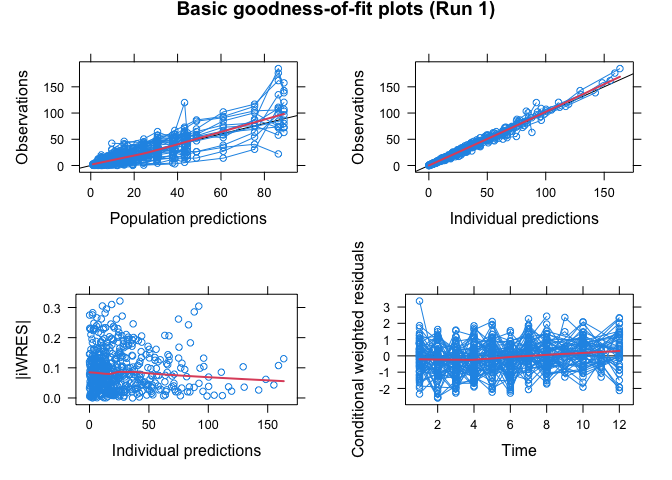
Display goodness-of-fit plots:
basic.gof(xpdb)
Clean up files that were created to show these examples:
unlink(new.files)
More help is available in the online documentation, which can be found
by typing (for example) ?xpose4 at the R command line.
Don’t Panic
Andrew Hooker (andrew.hooker at farmaci.uu.se) should be able to get you an answer if you run into trouble. The website https://uupharmacometrics.github.io/xpose4/ should also be of help.
Release Schedule
Bugfix releases will be released regularly, fixing any problems that are found.
License
Xpose 4 is free software: you can redistribute it and/or modify it under the terms of the GNU Lesser General Public License as published by the Free Software Foundation, either version 3 of the License, or (at your option) any later version.
This program is distributed in the hope that it will be useful, but WITHOUT ANY WARRANTY; without even the implied warranty of MERCHANTABILITY or FITNESS FOR A PARTICULAR PURPOSE. See the GNU Lesser General Public License for more details https://www.gnu.org/licenses/.
Known Bugs
None at present, but there will certainly be a few. Report them at https://github.com/UUPharmacometrics/xpose4/issues.