wideRhino
High-Dimensional Methods via Generalised Singular Decomposition
Construct a Canonical Variate Analysis Biplot via the Generalised Singular Value Decomposition, for cases when the number of samples is less than the number of variables. For more information on these biplots, see Ganey, R., & Gardner-Lubbe, S. (2026)
wideRhino 
The goal of wideRhino is to enable the construction of canonical
variate analysis (CVA) biplots for high-dimensional data settings,
specifically where the number of variables ($p$) exceeds the number of
observations ($n$). The package addresses the singularity limitation of
the within-group scatter matrix by leveraging the generalised singular
value decomposition (GSVD).
Installation
You can install the development version of wideRhino from GitHub with:
library(devtools)
install_github("RaeesaGaney91/wideRhino")
Example
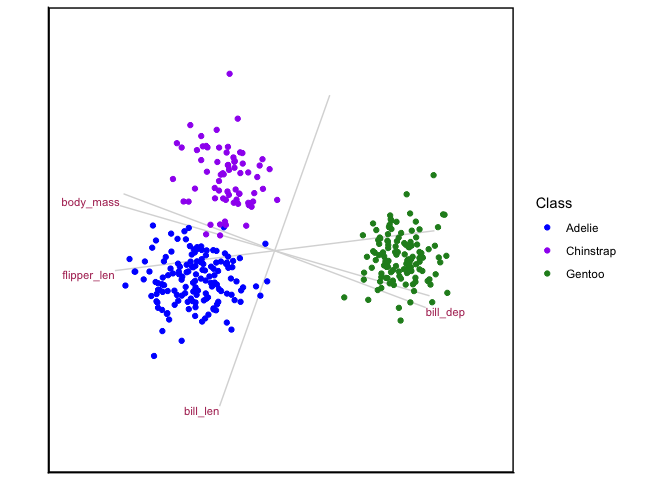
When $p < n$, then the CVA-GSVD biplot will result to the standard CVA
biplot. Here is an example using the penguins data:
library(wideRhino)
Penguins <- datasets::penguins[stats::complete.cases(penguins),]
CVAgsvd(X=Penguins[,3:6],group = Penguins[,1]) |>
  CVAbiplot(group.col=c("blue","purple","forestgreen"))
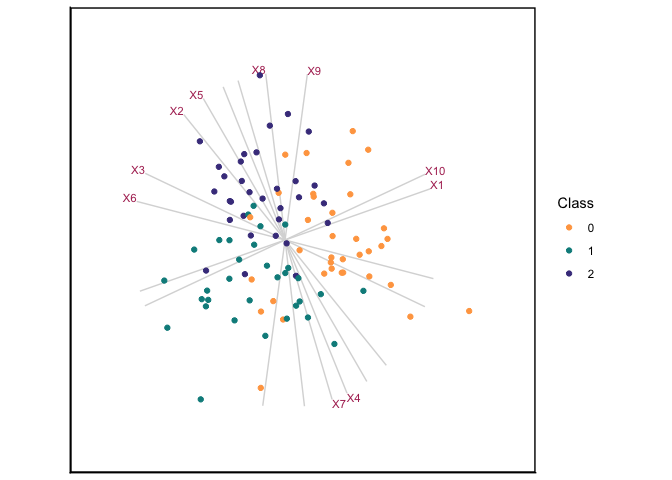
When $p > n$, then the standard CVA biplot will not work due to the singularity of the within-scatter matrix, and this is when the GSVD becomes useful. Using a simulated data set with 3 groups, 100 observations and 300 variables, a CVA-GSVD biplot can be constructed:
data(sim_data)
CVAgsvd(X=sim_data[,2:301],group = sim_data[,1]) |>
  CVAbiplot(group.col=c("tan1","darkcyan","darkslateblue"),which.var = 1:10)
About the name 🦏
The name wideRhino is inspired by the white rhinoceros, a species
distinguished by its wide mouth and short legs. This physical structure
reflects the statistical characteristics of the data the package is
designed for: wide data with a large number of variables ($p$) and a
small number of observations ($n$) - a setting often described as “large
$p$, small $n$”.
Just as the white rhino’s wide frame is well-adapted to its environment, wideRhino is purpose-built for the challenges of high-dimensional multivariate analysis. By leveraging the generalised singular value decomposition (GSVD), it allows users to construct canonical variate analysis (CVA) biplots even when classical assumptions break down.
Acknowledgments
The CVA-GSVD methodology and the package as a whole are the author’s
own work. One implementation detail is not: wideRhino originally
relied on the geigen package for its GSVD computation, and after
geigen was archived on CRAN, its internal gsvd() replacement (see
R/gsvd.R) was written with the assistance of Claude
Code (Anthropic).