visPedigree
Tidying, Analysis, and Fast Visualization of Animal and Plant Pedigrees
Provides tools for the analysis and visualization of animal and plant pedigrees. Analytical methods include equivalent complete generations, generation intervals, effective population size (via inbreeding, coancestry, and demographic approaches), founder and ancestor contributions, partial inbreeding, genetic diversity indices, and additive (A), dominance (D), and epistatic (AA) relationship matrices. Core algorithms — ancestry tracing, topological sorting, inbreeding coefficients, and matrix construction — are implemented in C++ ('Rcpp', 'RcppArmadillo') and 'data.table', scaling to pedigrees with over one million individuals. Matrix-free pedigree traversals apply additive relationship matrices or their inverses to vectors and matrices without materializing dense square matrices. Pedigree graphs are rendered via 'igraph' with support for compact full-sib family display; relationship matrices can be visualized as heatmaps. Supports complex mating systems, including selfing and pedigrees in which the same individual can appear as both sire and dam.
visPedigree: Tidying, Analysis, and Fast Visualization of Animal and Plant Pedigrees 
visPedigree provides tools for the analysis and visualization of animal and plant pedigrees. Analytical methods cover equivalent complete generations, generation intervals, effective population size, founder and ancestor contributions, partial inbreeding, genetic diversity indices, and relationship matrices (A, D, AA). Core algorithms — ancestry tracing, topological sorting, inbreeding coefficients, and matrix construction — are implemented in C++ (Rcpp/RcppArmadillo) and data.table, scaling to pedigrees with over one million individuals. Pedigree graphs are rendered via igraph; relationship matrices can be visualized as heatmaps. Complex mating systems are supported, including selfing and pedigrees in which the same individual can appear as both sire and dam.
Key Features
- Pedigree Standardization: Standardizes pedigree records, handles selfing and pedigrees in which the same individual can appear as both sire and dam, detects pedigree loops, prepares pedigrees for downstream analysis, and efficiently splits disconnected sub-populations.
- Comprehensive Pedigree Analysis: Computes pedigree summaries, equivalent complete generations, generation intervals, effective population size, founder and ancestor contributions, partial inbreeding, relationship matrices, and inbreeding coefficients.
- High-Throughput Matrix Calculation: Calculates Additive (A), Dominance (D), and Additive-by-Additive (AA) relationship matrices and their inverses.
- Matrix-Free Relationship Products: Computes $Ax$, $AX$, $A^{-1}x$, and $A^{-1}X$ directly from an ordered pedigree with
pedprod(), avoiding construction of the dense additive relationship matrix. - Advanced Visualization: Renders scalable pedigree graphs via
igraphwith compact representations for large full-sib families, plus heatmap displays for relationship matrices. - High Performance: Core algorithms — ancestry tracing, topological sorting, inbreeding calculation, and matrix construction — are implemented in C++ (Rcpp/RcppArmadillo) with
data.tablefor tabular operations, scaling to pedigrees with over one million individuals.
Installation
Stable version from CRAN
install.packages("visPedigree")
Development version from GitHub
# install.packages("devtools")
devtools::install_github("luansheng/visPedigree", build_vignettes = TRUE)
Documentation
Standard workflows
Recommended reading order:
- How to tidy a pedigree
- Efficient visPedigree Workflows
- Pedigree Visualization in R
- Pedigree Analysis and Genetic Diversity in R
- Pedigree Relationship Matrices and Matrix-Free Products in R
Developer documentation
Quick Start
library(visPedigree)

# Example 1: Tidy and visualize a small pedigree
# Use compact = TRUE to condense eligible full-sib groups into a green-grey
# family-summary rectangle labelled FS×N.
cands <- c("Y", "Z1", "Z2")
small_ped |>
  tidyped(cand = cands) |>
  visped(compact = TRUE)

# Example 2: Relationship Matrices (v1.0.0+)
# Compute the additive relationship matrix (A) using high-performance C++ algorithms.
# Use compact = TRUE to accelerate calculation for pedigrees with large full-sib families.
mat_a <- simple_ped |> tidyped() |> pedmat(method = "A", compact = TRUE)
# Visualize the relationship matrix as a heatmap with histograms
vismat(mat_a)

# Apply A to candidate contribution weights without constructing A
tp_simple <- tidyped(simple_ped)
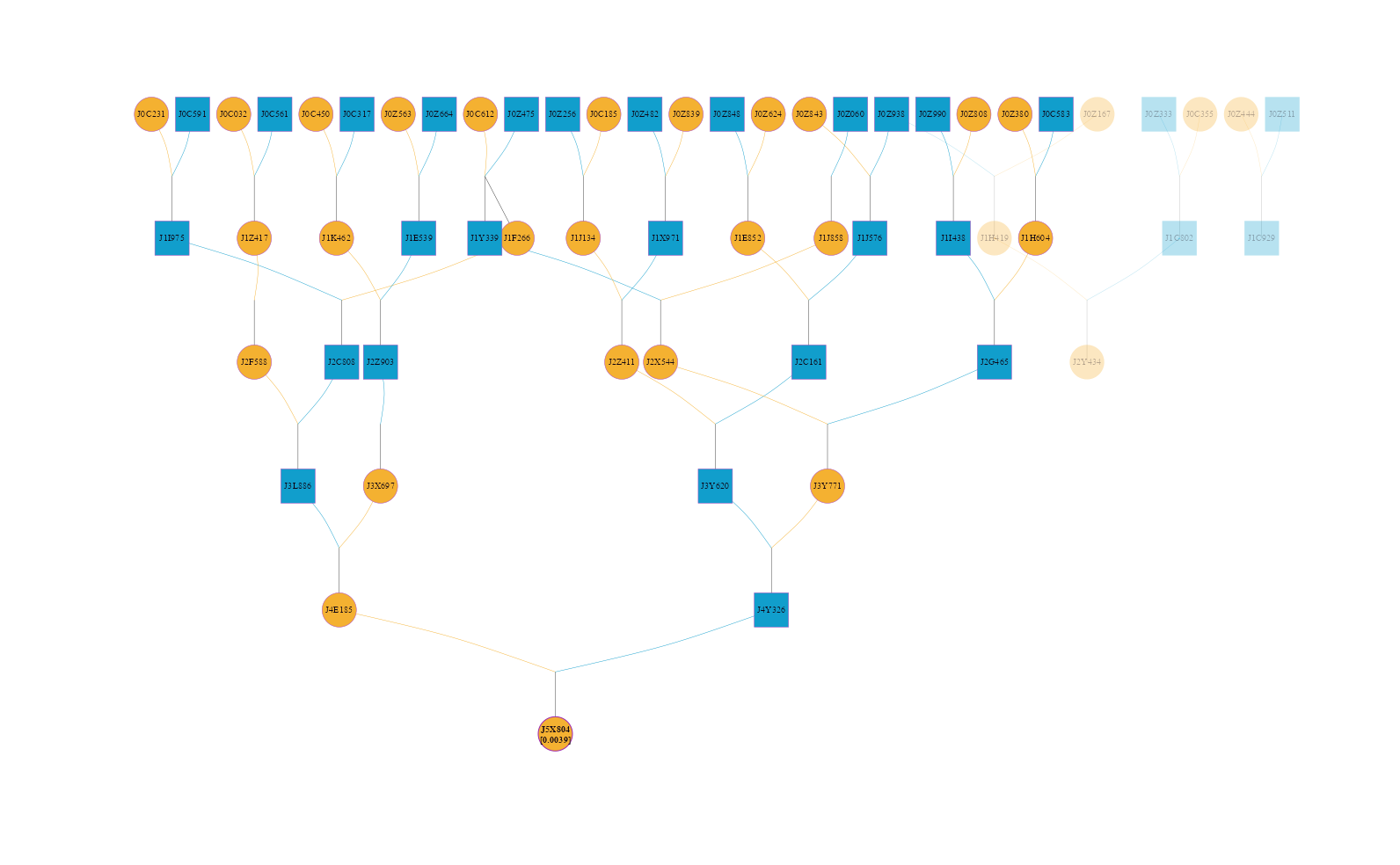
candidate_weights <- c(J5X804 = 0.5, J3Y620 = 0.5)
weighted_relationship <- pedprod(tp_simple, candidate_weights)

# Example 3: Inbreeding & Highlighting
# Calculate inbreeding coefficients (f) and display them on the graph (e.g., "ID (0.05)").
# Specific individuals can be highlighted to track their inheritance paths.
simple_ped |>
  tidyped(inbreed = TRUE) |>
  visped(highlight = "J5X804", trace = "up", showf = TRUE, compact = TRUE)

# Example 4: Pedigree Analysis (v1.4.0+)
# Summarize pedigree structure
tp <- tidyped(big_family_size_ped)
tp |>
  pedstats(timevar="Year")

# Summarize diversity-related indicators
ref_ind <- tp[Gen == max(Gen), Ind]
tp |>
  pediv(reference = ref_ind)

# Example 5: Pedigree Splitting
# Automatically split the pedigree into independent sub-populations (connected groups).
# Each group is returned as a standalone tidyped object for separate analysis.
split_list <- simple_ped |> tidyped() |> splitped()
summary(split_list[[1]])
Citation
If you use visPedigree in published work, please cite:
Luan S, Kong J, Xia Z, Kang Z, Qiang G, Luo K, Sui J. 2026. visPedigree: a comprehensive R package for tidying, analyzing, and visualizing breeding pedigrees. Bioinformatics Advances. DOI: 10.1093/bioadv/vbag210.