tout
Optimal Sample Size and Progression Criteria for Three-Outcome Trials
Find the optimal decision rules (AKA progression criteria)
and sample size for clinical trials with three (stop/pause/go)
outcomes. Both binary and continuous endpoints can be accommodated,
as can cases where an adjustment is planned following a pause outcome.
For more details see Wilson et al. (2024)
tout 


The goal of tout is to optimise the design of three-outcome clinical trials by determining their sample size and progression criteria.
Installation
Install the released version of tout from CRAN:
install.packages("tout")
Or you can install the development version of tout from GitHub with:
# install.packages("devtools")
devtools::install_github("DTWilson/tout")
Example
Consider a pilot trial which will measure the proportion of patients, in the intervention arm, who adhere to the intervention. We want to use this estimate of the probability of adherence (denoted $\rho$) in a statistical test with three possible outcomes: stop, go, or pause (where a pause outcome allows us to make the progression decision outwith the testing framework, based on other information and/or stakeholders).
Let the null and alternative hypotheses be $\rho_0 = 0.5$ and
$\rho_1 = 0.7$, and suppose we wish to control error rates at
$\alpha \leq 0.05, \beta \leq 0.2$ and $\gamma \leq 0.6$. We can find
the smallest possible design satisfying these constraints using the
tout_design() function:
library(tout)

design <- tout_design(rho_0 = 0.5, rho_1 = 0.7, alpha_nom = 0.05, beta_nom = 0.2, gamma_nom = 0.6)

design
#> Three-outcome design
#>
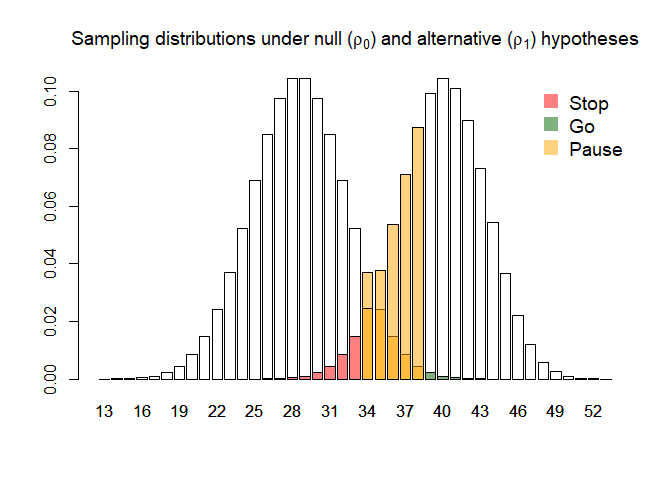
#> Sample size: 57
#> Decision thresholds: 33 38
#>
#> alpha = 0.04808966
#> beta = 0.186012
#> gamma = 0.5433195
#>
#> Hypotheses: 0.5 (null), 0.7 (alternative)
#> Modification effect range: 0 0
#> Error probability following an intermediate result: 0.5 0.5
Plotting the returned object gives an illustration of the sampling distribution of the estimated adherence probability under each hypothesis, alongside the optimal progression criteria and the decisions they will lead to:
plot(design)
The same function can be used when we anticipate making some adjustments
following a pause outcome (see the tau argument); when assuming
particular probabilities of making correct decisions following a pause
outcome (see the eta argument); and when the outcome is continuous
rather than binary (see the sigma argument). Further details can be
found in the vignette and in the associated manuscript.