sigPCA
Statistical Significance Testing for Principal Components
Identifies principal components whose eigenvalues exceed those
expected under noise. Implements analytical thresholds derived from the
Marchenko-Pastur distribution (Marchenko and Pastur, 1967)
sigPCA 
The sigPCA package provides tools to assess the statistical
significance of principal components using methods from random matrix
theory, particularly the Marchenko–Pastur (MP) distribution. It also
includes an optional permutation-based method for empirical validation.
Installation
#
install.packages("pak")
pak::pak("guillermodeandajauregui/sigPCA")
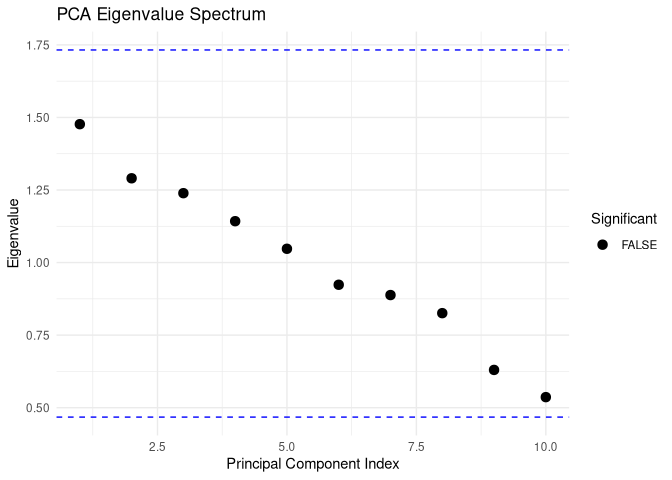
Example 1: White Noise (No Signal Expected)
set.seed(123)
X_white <- matrix(rnorm(1000), nrow = 100, ncol = 10)
result_white <- sigPCA(X_white, method = "both", num_permutations = 100)
result_white$mp$significant_components
#> integer(0)
plot_sigPCA(result_white$mp$eigenvalues, result_white$mp$mp_bounds)
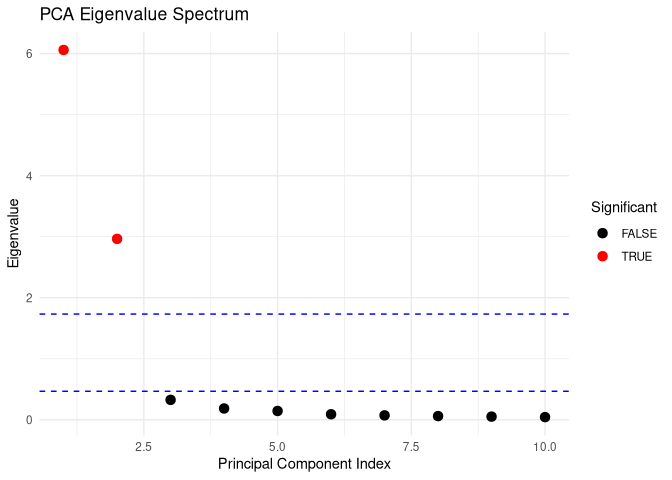
Example 2: Latent Structure (Signal Expected)
set.seed(456)
{
  n <- 100
  p <- 10
  k <- 2
  latent <- matrix(rnorm(n * k, mean = 3), nrow = n, ncol = k)
  loadings <- matrix(rnorm(p * k), nrow = k, ncol = p)
  noise <- matrix(rnorm(n * p, sd = 0.3), nrow = n, ncol = p)
  X_signal <- latent %*% loadings + noise
  result_signal <- sigPCA(X_signal, method = "both", num_permutations = 100)
}
result_signal$mp$significant_components
#> [1] 1 2
plot_sigPCA(result_signal$mp$eigenvalues, result_signal$mp$mp_bounds)
Interpretation
Components with eigenvalues beyond the theoretical Marchenko–Pastur upper bound are considered statistically significant. This method is particularly effective for high-dimensional datasets where traditional heuristics like scree plots may be misleading.
The permutation-based method provides empirical p-values and is useful as a secondary or confirmatory approach.
References
- Marchenko, V.A. and Pastur, L.A. (1967). Distribution of eigenvalues for some sets of random matrices. Mathematics of the USSR-Sbornik, 1(4), 457–483.
- Hernández-Lemus, E. (in preparation).