rnnmf
Regularized Non-Negative Matrix Factorization
A proof of concept implementation of regularized non-negative matrix factorization optimization.
A non-negative matrix factorization factors non-negative matrix Y approximately as L R, for non-negative
matrices L and R of reduced rank. This package supports such factorizations with weighted objective and
regularization penalties. Allowable regularization penalties include L1 and L2 penalties on L and R,
as well as non-orthogonality penalties. This package provides multiplicative update algorithms, which are
a modification of the algorithm of Lee and Seung (2001)
< http://papers.nips.cc/paper/1861-algorithms-for-non-negative-matrix-factorization.pdf>, as well
as an additive update derived from that multiplicative update. See also Pav (2024)
rnnmf


Implements regularized non-negative matrix factorization by a method similar to Lee & Seung, "Algorithms for Non-negative Matrix Factorization," 2001.
-- Steven E. Pav, [email protected]
Installation
This package may be installed from CRAN; the latest version may be found on github via devtools, or installed via drat:
# CRAN
install.packages(c("rnnmf"))
# devtools
if (require(devtools)) {
    # latest greatest
    install_github("shabbychef/rnnmf")
}
# via drat:
if (require(drat)) {
    drat:::add("shabbychef")
    # not yet: install.packages('rnnmf')
}
What is it?
Non-negative matrix factorization is a tool for decomposing a non-negative matrix $Y$ approximately as $Y \approx L R$ for non-negative matrices $L, R$ of pre-specified rank. This package provides code for non-negative matrix factorization with penalty terms for the $\ell_1$ and $\ell_2$ norms of the two factors, as well as for non-orthogonality of the factors. The code is based on the conceptually simple multiplicative update of Lee & Seung. An additive update based on the same ideas is also given.
This code is provided mostly for research purposes, and no warranty is given regarding speed, or convergence.
Basic Usage
We demonstrate the usage of the multiplicative and additive updates in factoring a small matrix which we constructed to be the product of two reduced rank non-negative matrices.
library(dplyr)
library(rnnmf)
library(ggplot2)

frobenius_norm_err <- function(Y, L, R) {
    sqrt(sum(abs(Y - L %*% R)^2))
}
runifmat <- function(nr, nc, ...) {
    matrix(pmax(0, runif(nr * nc, ...)), nrow = nr)
}
test_a_bunch <- function(Y_t, L_0, R_0, niter = 10000L) {
    iter_hist <- new.env()
    iter_hist[["history"]] <- rep(NA_real_, niter)

    on_iteration_end <- function(iteration, Y, L, R,
        ...) {
        iter_hist[["history"]][iteration] <<- frobenius_norm_err(Y,
            L, R)
    }
    wuz <- aurnmf(Y_t, L_0, R_0, max_iterations = niter,
        on_iteration_end = on_iteration_end)
    df1 <- tibble(x = seq_along(iter_hist[["history"]]),
        y = iter_hist[["history"]]) %>%
        mutate(method = "additive, optimal step")

    iter_hist[["history"]] <- rep(NA_real_, niter)
    wuz <- murnmf(Y_t, L_0, R_0, max_iterations = niter,
        on_iteration_end = on_iteration_end)
    df2 <- tibble(x = seq_along(iter_hist[["history"]]),
        y = iter_hist[["history"]]) %>%
        mutate(method = "multiplicative")

    retv <- bind_rows(df1, df2) %>%
        mutate(nr = nrow(Y_t), nc = ncol(Y_t), nd = ncol(L_0),
            max_iter = niter)
    return(retv)
}

nr <- 30
nc <- 8
nd <- 3
set.seed(1234)
L_t <- runifmat(nr, nd)
R_t <- runifmat(nd, nc)
Y_t <- L_t %*% R_t

L_0 <- runifmat(nrow(Y_t), nd + 1)
R_0 <- runifmat(ncol(L_0), ncol(Y_t))

test_a_bunch(Y_t, L_0, R_0, niter = 10000L) %>%
    ggplot(aes(x, y, color = method)) + geom_line() +
    scale_x_log10(labels = scales::comma) + scale_y_log10() +
    labs(x = "Step", y = expression(L[2] ~ ~Error),
        title = "Frobenius Norm of Error vs Step",
        color = "Method", caption = paste0("Factoring ",
            nr, " x ", nc, " matrix down to ", nd,
            " dimensions."))
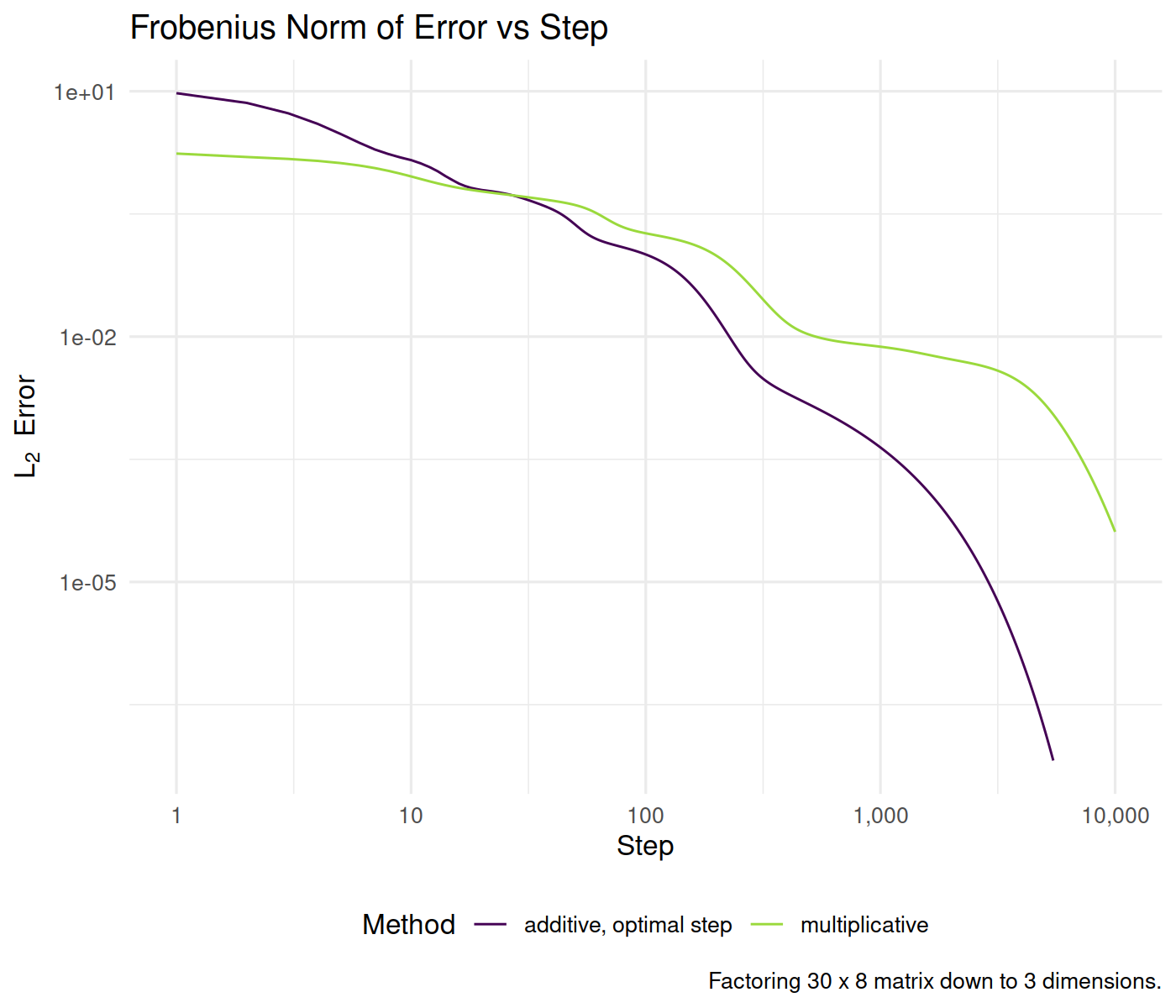
plot of chunk basic_simulations
See also
- Lee, Daniel D. and Seung, H. Sebastian. Algorithms for Non-negative Matrix Factorization, 2001.
- Pav, Steven E. System and method for unmixing spectroscopic observations with nonnegative matrix factorization, 2012.
- Pav, Steven E. An Iterative Algorithm for Regularized Non-negative Matrix Factorizations, 2024.