rSpectral
Spectral Modularity Clustering
Implements the network clustering algorithm described in
Newman (2006)
rSpectral
The goal of ‘rSpectral’ is to make Spectral Modularity graph clustering method available to most of R graph frameworks.
Installation
You can install the development version of rSpectral from GitHub with:
# install.packages("devtools")
devtools::install_github("cmclean5/rSpectral")
The stable version is available on CRAN:
install.packages("rSpectral")
Example
This is a basic example which shows you how to solve a common problem
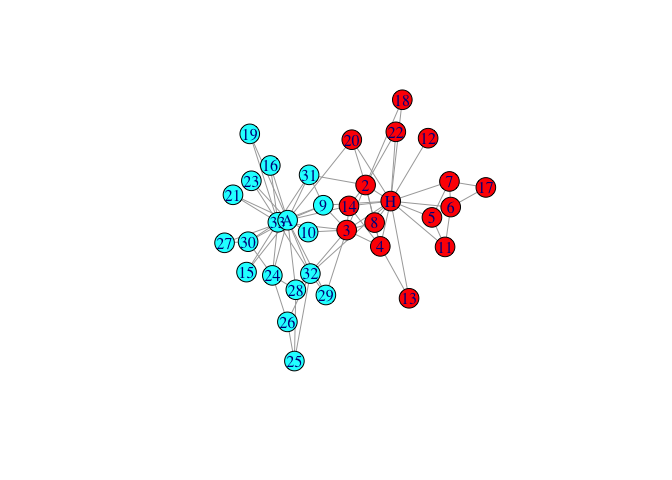
- load the karate club graph and plot Faction membership:
library(rSpectral)
library(igraph)
#>
#> Attaching package: 'igraph'
#> The following objects are masked from 'package:stats':
#>
#>     decompose, spectrum
#> The following object is masked from 'package:base':
#>
#>     union
data(karate, package="igraphdata")
l<-layout_nicely(karate)
memT<-V(karate)$Faction
palette <- rainbow(max(as.numeric(memT)))
plot(karate,vertex.color=palette[memT],layout=l)
- run spectral clustering on graph
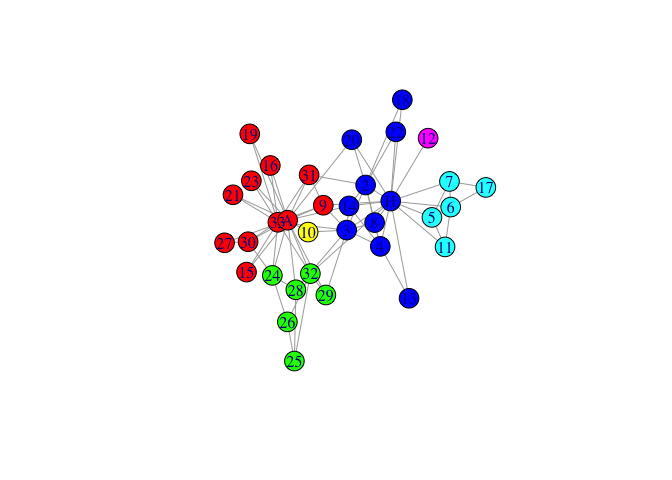
mem0<-igraph::membership(rSpectral::spectral_igraph_communities(karate))
- plot the graph with membership colors
palette <- rainbow(max(as.numeric(mem0)))
plot(karate,vertex.color=palette[mem0],layout=l)
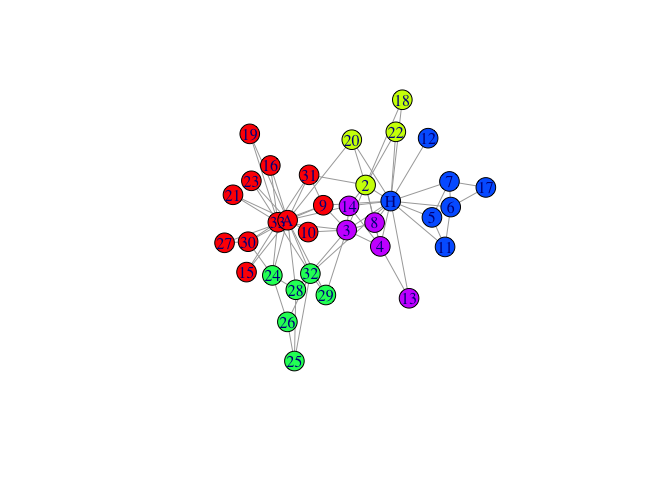
- run spectral clustering on graph, fixing neighbouring nodes found in same community
mem1<-igraph::membership(
  rSpectral::spectral_igraph_communities(karate, fix_neig=1))
- and plot again
palette <- rainbow(max(as.numeric(mem1)))
plot(karate,vertex.color=palette[mem1],layout=l)
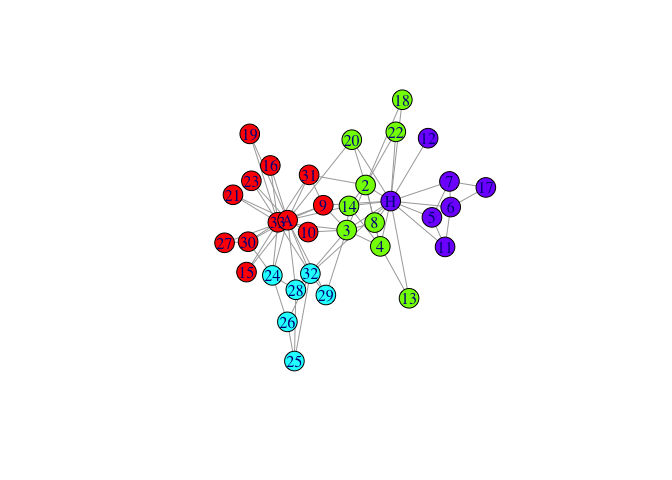
- run spectral clustering - fixing neighbouring nodes, Cnmin=5
mem1.5<-igraph::membership(
  rSpectral::spectral_igraph_communities(karate, fix_neig=1,Cn_min=5))
- and the last plot
palette <- rainbow(max(as.numeric(mem1.5)))
plot(karate,vertex.color=palette[mem1.5],layout=l)
GraphNEL objects could be processed similarily, all other graph types
could be converted either to igraph or to GraphNEL by packages such
as Intergraph.