logtree
Tree-Style Console Logger for Nested Processes
Render nested process execution as a live, colored tree in the console, with tree connectors, status glyphs, and elapsed time per step. Nesting depth is tracked via frame exit handlers so it never desynchronizes, even when a step errors. Builds on the 'cli' package for console rendering.
logtree 


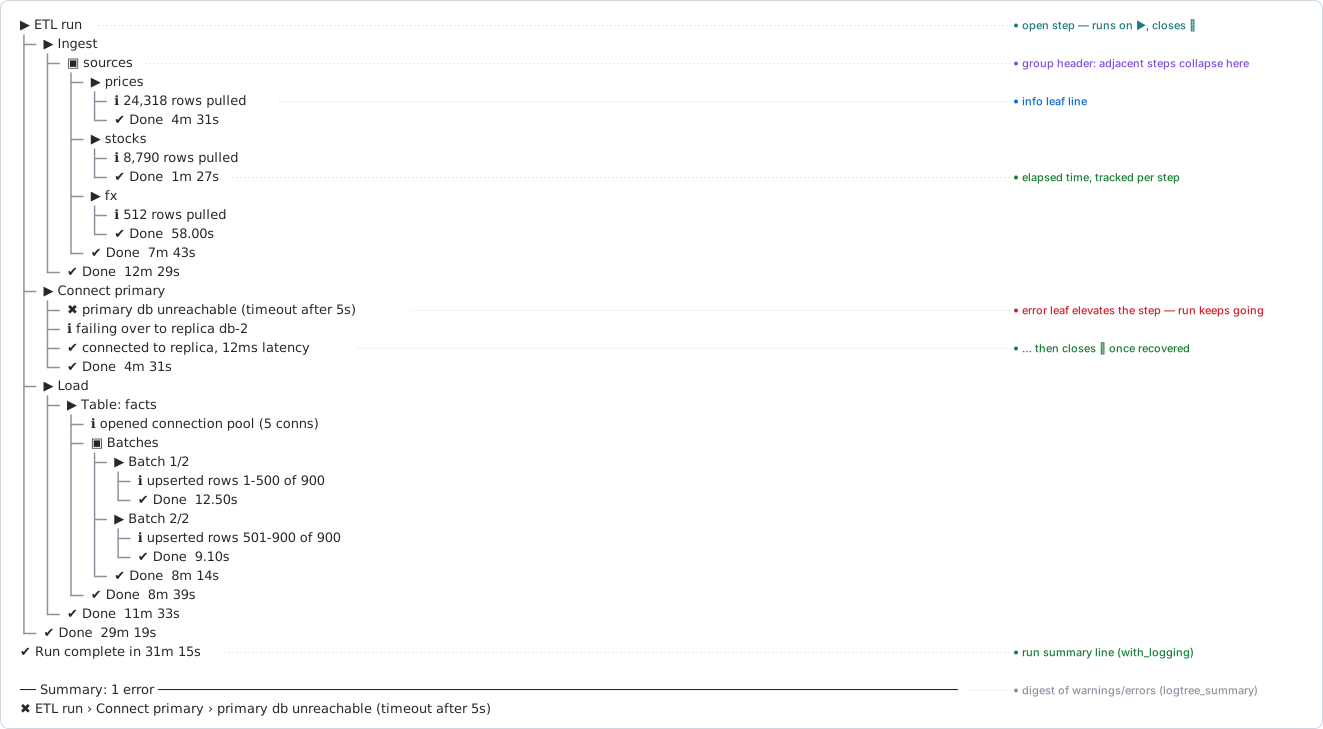
logtree renders nested process execution as a live, colored tree in the console – tree connectors, status glyphs, and elapsed time per step – while keeping nesting depth correct even when a step errors partway through.
Installation
install.packages("logtree")

# or the development version
# install.packages("pak")
pak::pak("IvanSortino/logtree")
Quick start
library(logtree)

load_config <- function() {
  log_step("Load config")
  log_info("reading config.yml")
  log_success("validated 12 parameters")
}

fetch_rows <- function() {
  log_step("Fetch rows")
  log_info("requesting from API")
  log_warn("rate limit at 80%")
  log_success("fetched 1,204 rows")
}

pipeline <- function() {
  log_step("Nightly pipeline")
  load_config()
  fetch_rows()
}

with_logging(pipeline())
#> ▶ Nightly pipeline
#> ├─ ▶ Load config
#> │  ├─ ℹ reading config.yml
#> │  ├─ ✔ validated 12 parameters
#> │  └─ ✔ Done  0.00s
#> ├─ ▶ Fetch rows
#> │  ├─ ℹ requesting from API
#> │  ├─ ⚠ rate limit at 80%
#> │  ├─ ✔ fetched 1,204 rows
#> │  └─ ⚠ Done  0.00s
#> └─ ✔ Done  0.01s
#> ✔ Run complete in 0.01s
logtree_summary()
#>
#> ── Summary: 1 warning ──────────────────────────────────────────────────────────
#> ⚠ Nightly pipeline › Fetch rows › rate limit at 80%
log_step() is meant to be called from inside a function: the step
auto-closes when the function that opened it returns – normally, early,
or via an uncaught error – so nesting depth never gets stuck out of
sync. (At top level, with no function frame to close on, reach for
log_open() / log_close() instead.)
The log_warn() line turned its own step’s close glyph yellow without
throwing anything, and logtree_summary() replayed it with the path it
happened on.
What else it does
- Five leaf levels and a threshold to filter them, globally or per sink.
- Error handling –
with_logging()marks every open step failed, logs the condition, and rethrows; it never swallows an error. - Routing R’s own conditions –
warning()andmessage()become leaves in the tree instead of stderr noise. - Grouping – adjacent steps sharing a value collapse under one header.
- Call sites and timestamps – opt-in columns telling you where a line came from and when it happened.
- Themes – five presets (unicode, ascii, emoji, minimal, ci), every glyph, colour and gap overridable.
- Sinks – mirror a run to a plain-text or NDJSON file, to a buffer you can assert on in tests, or to any function of your own.
- A
loggerbridge – route an existing logger codebase through logtree in one call.
Documentation
- Get started – the full guide, one section per feature, each with a runnable example.
- Examples – complete end-to-end runs.
- Themes cookbook – every slot and field, and recipes for your own preset.
- Recipes – top-level scripts, library authors, scheduled jobs.
- Reference – all exported functions.
- Design philosophy – why depth is tied to frames.