fCWTr
Fast Continuous Wavelet Transform
Enables the usage of the fast continuous wavelet transform,
originally implemented in the 'C++' library 'fCWT' by Lukas Arts.
See Arts, P.A. and Van den Broek, E.L. (2022)
fCWTr 


The R package fCWTr wraps the fCWT library, a library implementing a continuous wavelet transform with a Morlet wavelet, utilizing the power of fftw, a fast fourier transform implementation. It provides an R-like functional interface and implements common S3 methods for convenience.
See the original paper by Arts, L.P.A., van den Broek, E.L. The fast continuous wavelet transformation (fCWT) for real-time, high-quality, noise-resistant time–frequency analysis. Nat Comput Sci 2, 47–58 (2022). https://doi.org/10.1038/s43588-021-00183-z
System dependencies
- R >= 4.1
- fftw library with single-precision support enabled (used by fCWT)
- Optional: a CPU/compiler supporting the AVX instruction set
- Optional: OpenMP (and fftw built with OpenMP
support)
- On Windows, OpenMP support is disabled since rtools’ fftw is compiled without OpenMP support.
- On Linux and MacOS the build scripts should automatically detect whether OpenMP support is available.
By default, most compiler setups do not make use of AVX to increase
portability of the binary. If you are an R user that has a CPU
supporting AVX and want to make use of it, you might need to manually
enable compiler flags to let R know about it, and install the package
from source (so that it gets compiled on your machine). One way to
enable the flags is to create a file ~/.R/Makevars with the following
content:
CPPFLAGS = -mavx
CXXFLAGS = -mavx
Installation
You can install the latest CRAN release of fCWTr with:
install.packages("fCWTr")
Alternatively, you can install the development version of fCWTr like so (requiring installed devtools package):
devtools::install_github("lschneiderbauer/fCWTr")
Note that the installation process might fail if the package needs to be compiled from source and system requirements are not satisfied. The error message should give you hints, however, on what’s missing on your system.
- Common confusion: fftw is installed, but without single precision
support (
libfftw3f). Some distributions ship it as a separate package:- Debian/Ubuntu:
libfftw3-dev - Fedora/RHEL:
fftw-develandfftw-libs-single - macOS:
brew install fftw(or the CRAN macOS recipefftw-s) - If you build fftw yourself, configure it with
--enable-float. See fftw.org.
- Debian/Ubuntu:
Example
This is a basic example where the continuous wavelet transform of a sample signal is calculated. The result is inspected and plotted.
library(fCWTr)

# A signal encoded in a numeric vector.
# In this example we use some superimposed sin signals.
signal <- ts_sin_superpos

output <-
  fcwt(
    signal,
    x_sample_freq = u(44, "kHz"),
    sigma = 5,
    y_sample_freq = u(1, "kHz"),
    freq_begin = u(16, "Hz"),
    freq_end = u(2100, "Hz"),
    n_freqs = 200,
    freq_scale = "linear"
  )

# The result is a numeric matrix with time and frequency dimension
dim(output)
#> [1] 137 200

# Some meta data is recorded too
output
#> _Scalogram_
#> * (Time/Frequency) dimension:  ( 137 , 200 )
#> * Sampling rate: 1 [kHz]
#> * Frequency scale: 16 [Hz] - 2100 [Hz], linear
#> * Time offset: 0 [s]
#> * Sigma: 5
#>   o Time resolution at  16 [Hz] :  1.25 [s]
#>   o Time resolution at  2100 [Hz] :  9.52381 [ms]
#>   o Relative frequency resolution:  0.127324
#> * Time/frequency matrix summary
#>    Min. 1st Qu.  Median    Mean 3rd Qu.    Max.    NA's
#>  0.0000  0.0001  0.0011  0.1267  0.0339  2.8194    6671
The result can also be converted into a data frame:
as.data.frame(output) |>
  head(10)
#>    time_index   time      freq        value
#> 1           0 0 [ms] 2100 [Hz]           NA
#> 2           1 1 [ms] 2100 [Hz]           NA
#> 3           2 2 [ms] 2100 [Hz]           NA
#> 4           3 3 [ms] 2100 [Hz]           NA
#> 5           4 4 [ms] 2100 [Hz] 3.326482e-03
#> 6           5 5 [ms] 2100 [Hz] 1.388348e-03
#> 7           6 6 [ms] 2100 [Hz] 4.916695e-04
#> 8           7 7 [ms] 2100 [Hz] 1.552785e-04
#> 9           8 8 [ms] 2100 [Hz] 5.435228e-05
#> 10          9 9 [ms] 2100 [Hz] 3.173394e-05
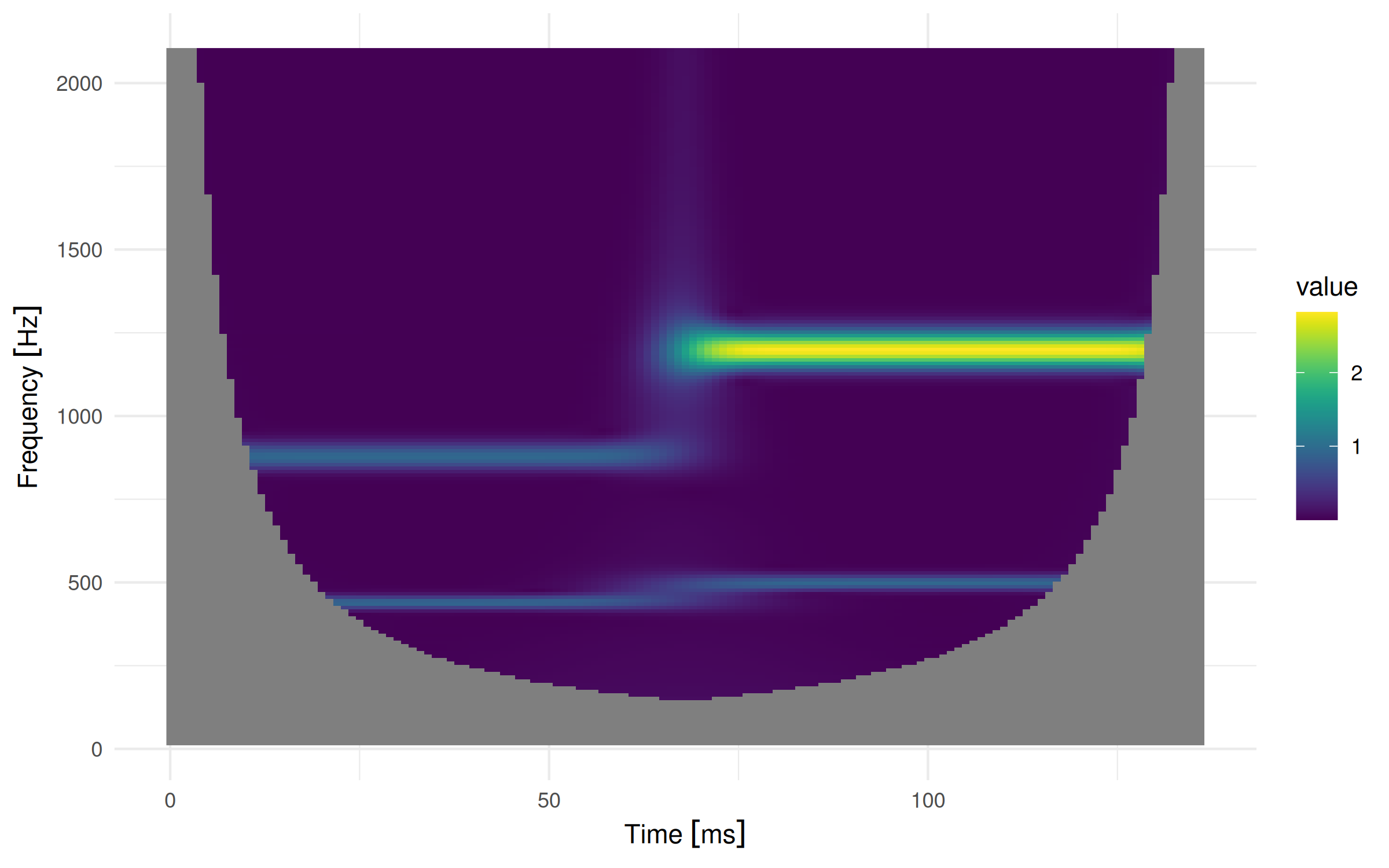
We can also directly plot the resulting scalogram:
plot(output)
For long sequences, the required memory can exceed your available local
memory. In this case it can be useful to reduce the time resolution of
the result and process the data in batches. This can be done with
fcwt_batch(). In case the batch size is not explicitly provided, some
heuristics are used to determine a batch size automatically:
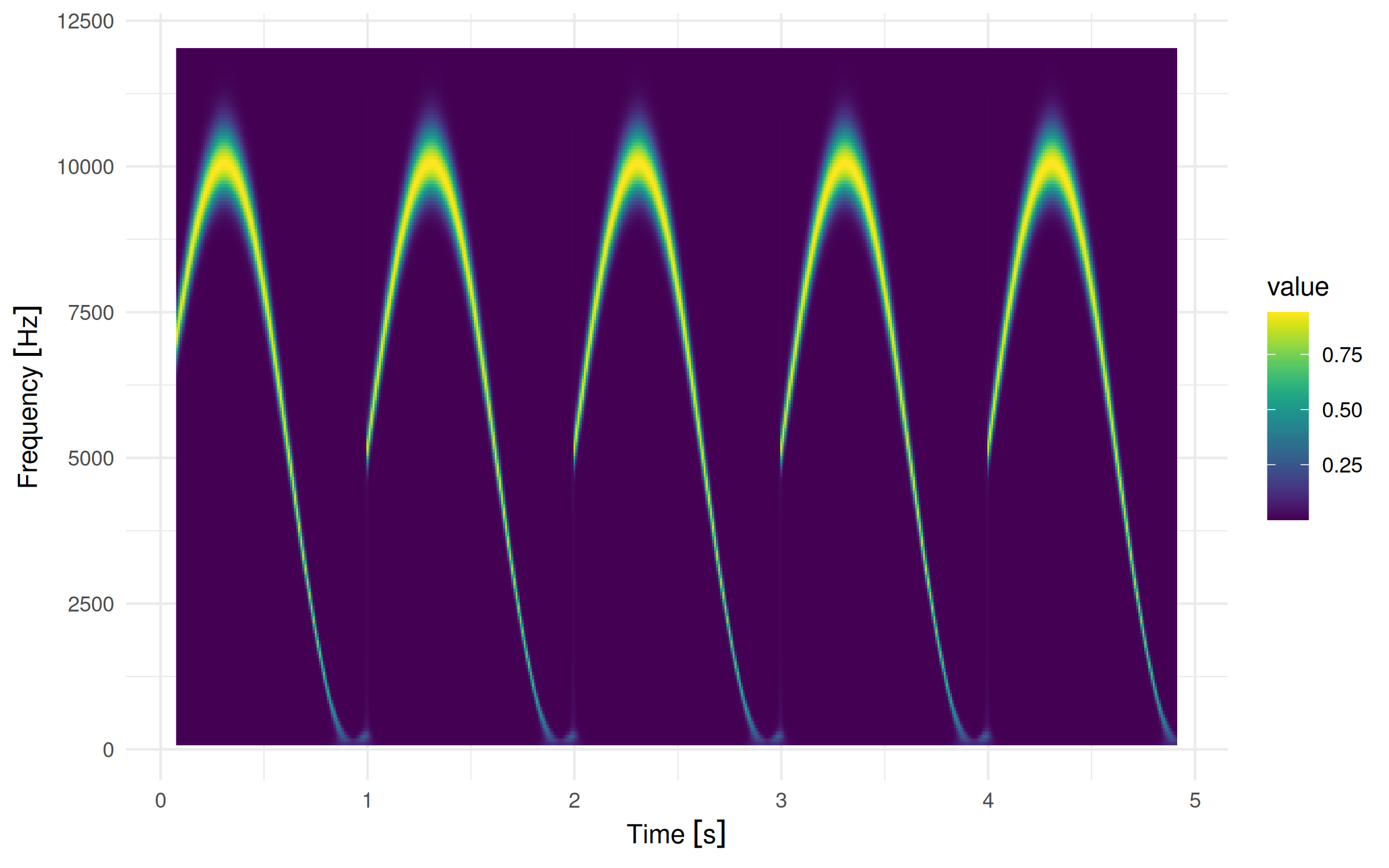
batch_result <-
  fcwt_batch(
    rep(ts_sin_sin, 5),
    x_sample_freq = u(44.1, "kHz"),
    y_sample_freq = u(100, "Hz"),
    freq_begin = u(100, "Hz"),
    freq_end = u(12, "kHz"),
    n_freqs = 200,
    freq_scale = "linear",
    sigma = 4
  )

plot(batch_result)