bewrs
Bayesian Early-Warning Risk Surveillance for Healthcare Performance Monitoring
Provides Bayesian early-warning surveillance methods for
monitoring healthcare performance and patient safety outcomes.
The package draws on risk-adjusted monitoring frameworks developed by
Steiner et al. (2000)
Overview
bewrs provides tools for Bayesian early-warning risk surveillance,
dynamic risk scoring, validation, calibration assessment,
decision-theoretic intervention optimisation, and Expected Value of
Intervention analysis for healthcare performance monitoring.
Example outputs
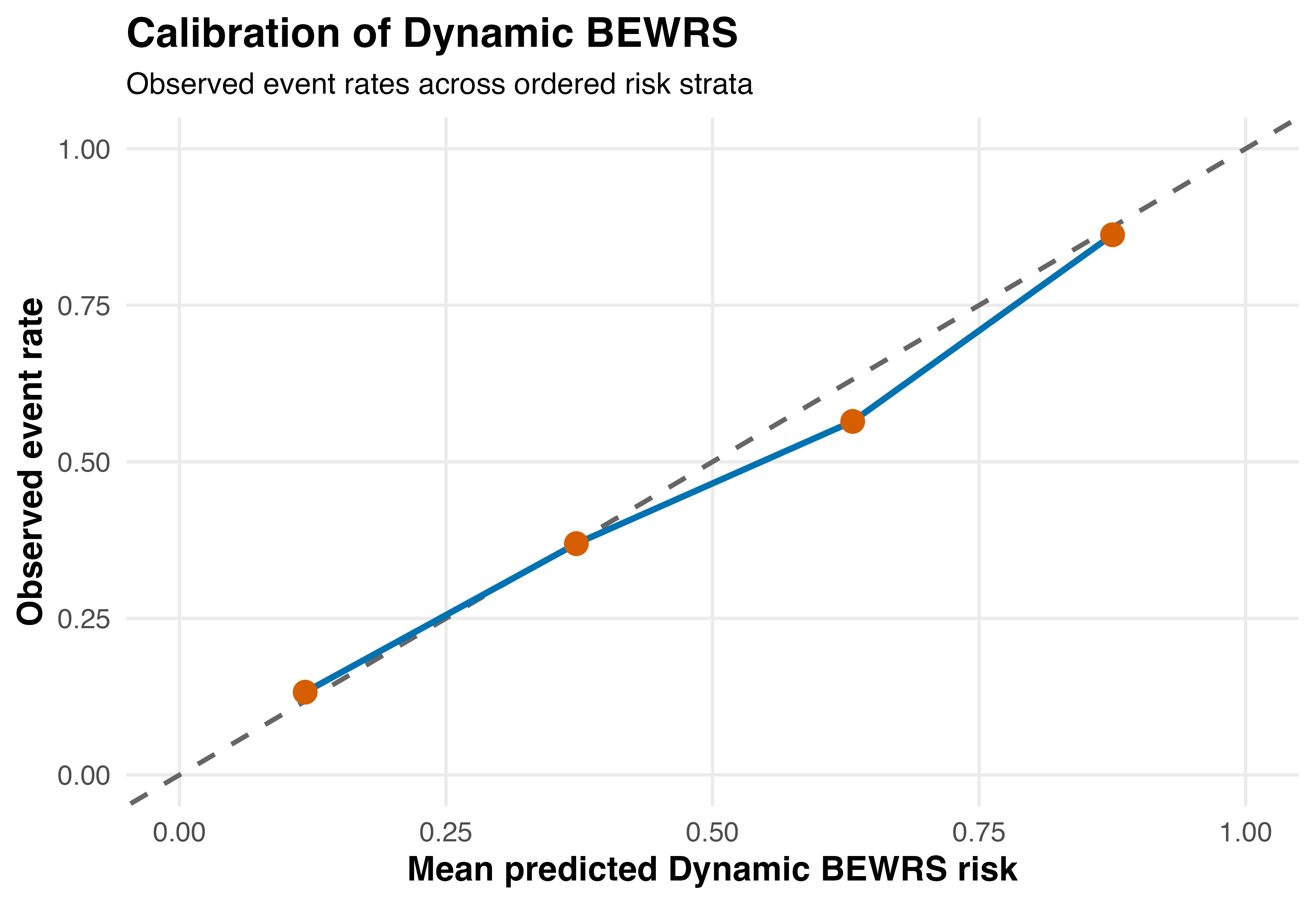
Calibration assessment
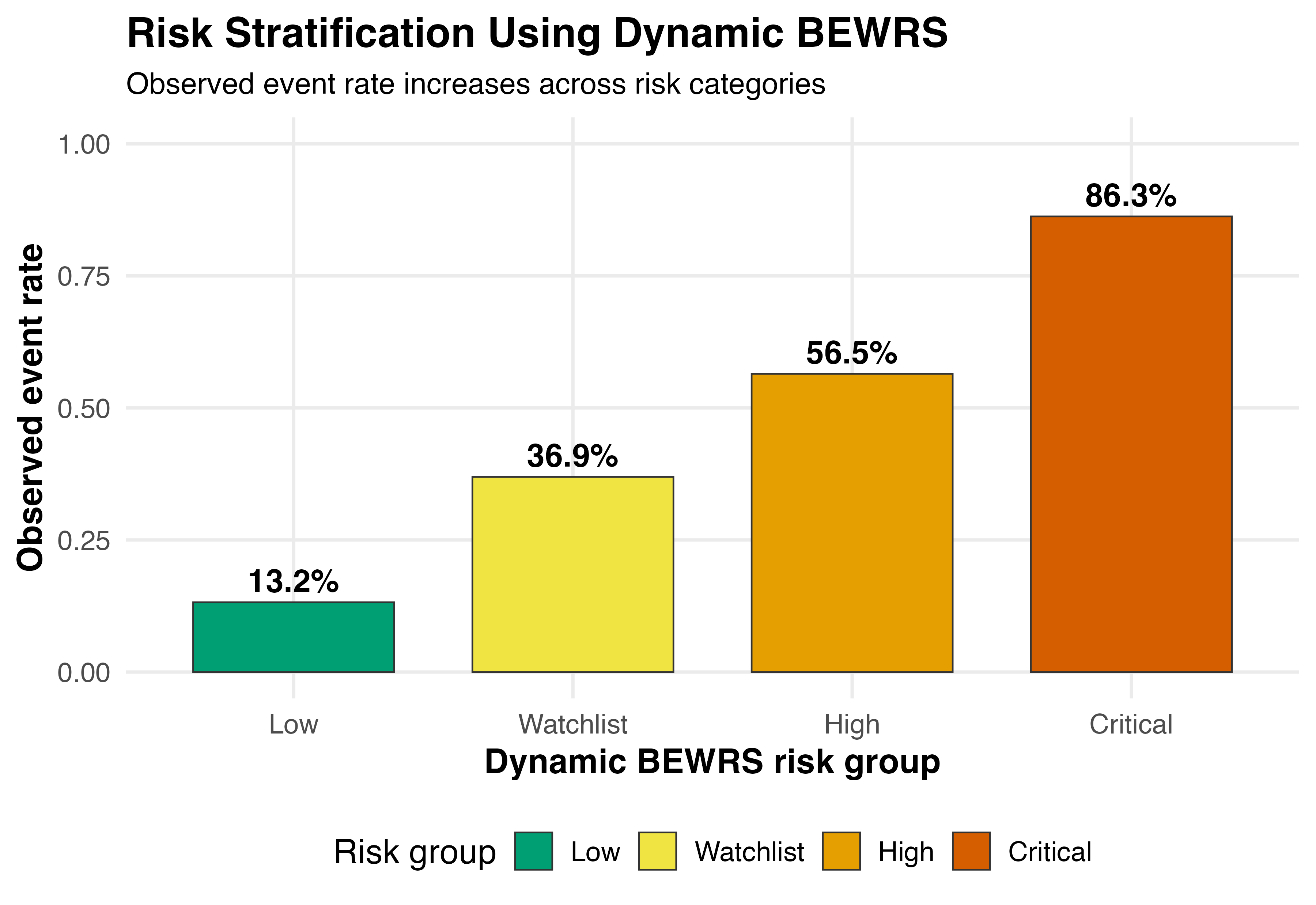
Risk stratification
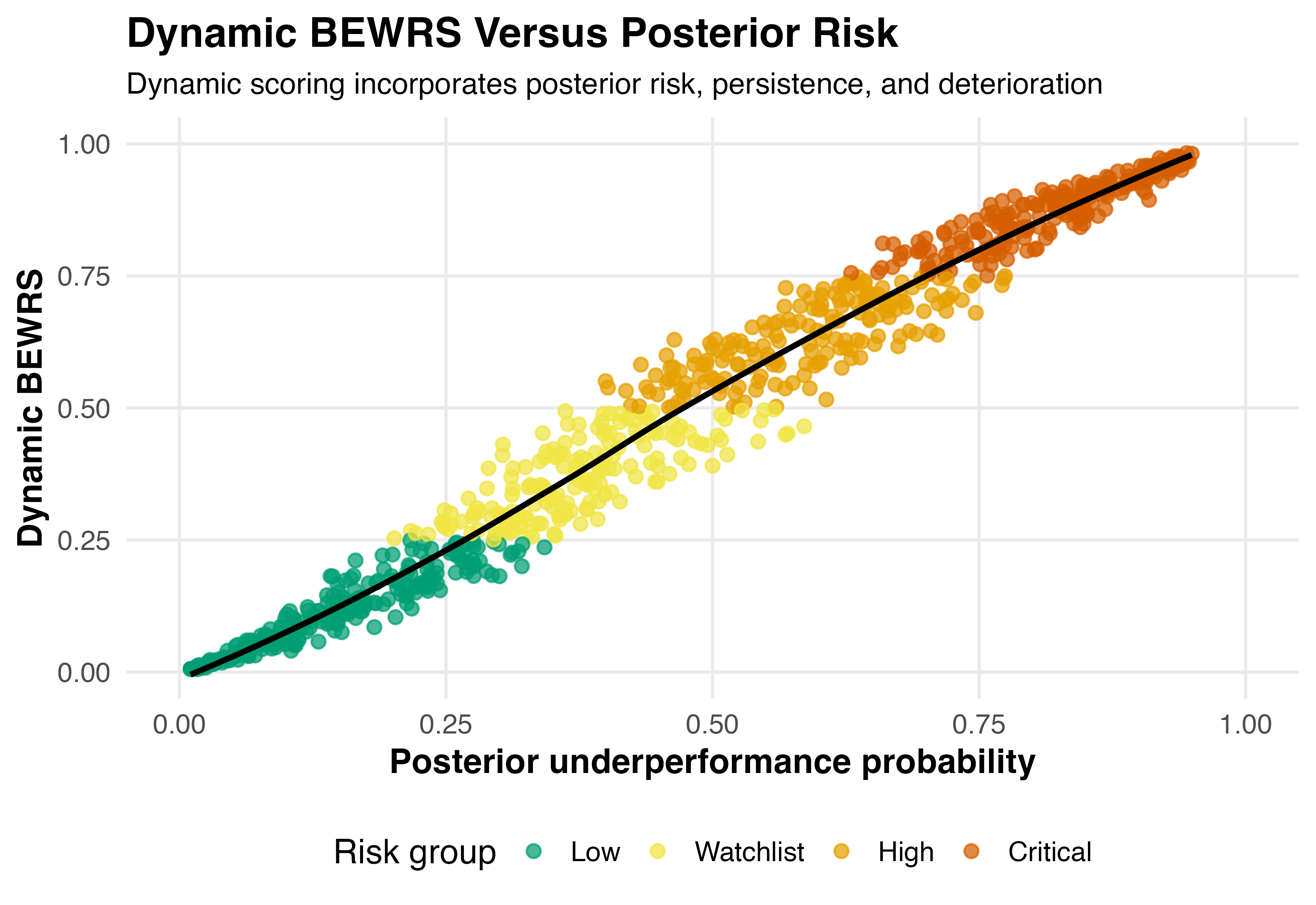
Dynamic BEWRS scoring
 ## Methodological references
The methods implemented in bewrs are motivated by work on Bayesian
hierarchical modelling, healthcare provider profiling, prediction model
validation, calibration assessment, decision curve analysis, and
Bayesian decision theory, including:
- Gelman A, Carlin JB, Stern HS, Dunson DB, Vehtari A, Rubin DB. Bayesian Data Analysis. 3rd ed. CRC Press; 2013.
- Spiegelhalter DJ. Funnel plots for comparing institutional performance. BMJ. 2005;331:302–305. doi:10.1136/bmj.331.7512.302
- Vickers AJ, Elkin EB. Decision curve analysis. Medical Decision Making. 2006;26(6):565–574. doi:10.1177/0272989X06295361
- Steyerberg EW, Vickers AJ, Cook NR, et al. Assessing the performance of prediction models. Epidemiology. 2010;21(1):128–138. doi:10.1097/EDE.0b013e3181c30fb2
- Van Calster B, McLernon DJ, van Smeden M, Wynants L, Steyerberg EW. Calibration: the Achilles heel of predictive analytics. BMC Medicine. 2019;17:230. doi:10.1186/s12916-019-1466-7