TrendLSW
Wavelet Methods for Analysing Locally Stationary Time Series
Fitting models for, and simulation of, trend locally stationary
wavelet (TLSW) time series models, which take account of time-varying
trend and dependence structure in a univariate time series. The TLSW model,
and its estimation, is described in McGonigle, Killick and Nunes (2022a)
TrendLSW


Implements wavelet methods for analysis of nonstationary time series. See
McGonigle, E. T., Killick, R., and Nunes, M. (2022). Trend locally stationary wavelet processes. Journal of Time Series Analysis, 43(6), 895-917.
McGonigle, E. T., Killick, R., and Nunes, M. (2022). Modelling time-varying first and second-order structure of time series via wavelets and differencing. Electronic Journal of Statistics, 6(2), 4398-4448.
for full details.
Installation
You can install the released version of TrendLSW from
CRAN with:
install.packages("TrendLSW")
You can install the development version of TrendLSW from
GitHub with:
devtools::install_github("https://github.com/EuanMcGonigle/TrendLSW")
Usage
For detailed examples, see the help files within the package. We can generate a small example for performing trend and spectrum estimation as follows:
library(TrendLSW)

set.seed(1)

noise <- rnorm(512) * c(seq(from = 1, to = 3, length = 256), seq(from = 3, to = 1, length = 256))
trend <- seq(from = 0, to = 5, length = 512)
x <- trend + noise
Apply the TLSW function:
x.TLSW <- TLSW(x)
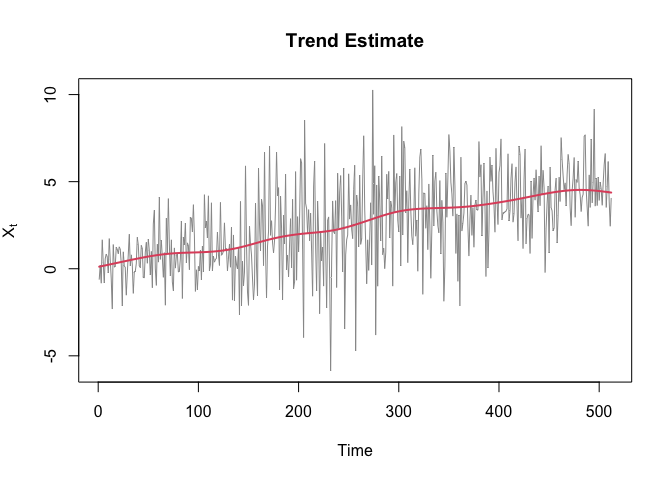
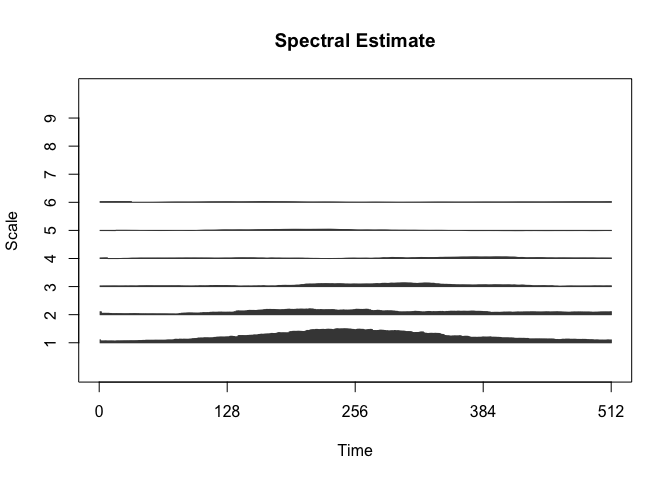
Visualise the estimated trend and spectrum:
plot(x.TLSW)