SIHR
Statistical Inference in High Dimensional Regression
The goal of SIHR is to provide inference procedures in the high-dimensional generalized linear regression setting for:
(1) linear functionals
SIHR

The package SIHR(Statistics Inference for High-dimensional Regression) facilitates statistical inference in high-dimensional generalized linear models (GLM) with continuous and binary outcomes. It offers tools to construct confidence intervals and to conduct hypothesis testing for low-dimensional objectives (e.g. $e_1^\intercal \beta$) in both one-sample and two-sample regression regimes.
Background
In numerous scenarios, regression problems often involve a number of dimensions $p$ surpassing the sample size $n$. Traditional estimators, derived through penalized maximum likelihood methods like Lasso and Ridge, are unsuitable for statistical inference due to significant estimation bias introduced by the penalty term. Our package leverages debiasing methods, addressing a broad spectrum of inference challenges in high-dimensional GLMs, applicable to both continuous and binary outcomes.
To demonstrate the effect of bias correction, we conducted 250 simulation rounds. The data generation process is defined with $n=p=200$: for $1\leq i\leq n$, the covariates follows $X_i\sim \mathcal{N}({0}p, \mathbf{I}p)$, the outcome follows $Y_i = X_i^\intercal \beta + \mathcal{N}(0,1)$, where $\beta= (0.5{5}, 0.2, 0.4, 0.6, 0.8, 1, {0}{p-10})$.
Our objective was to conduct inference on the first coefficient $e_1^\intercal \beta = 0.5$. However, as illustrated in the left subfigure, Lasso estimators from the glmnet package exhibit considerable bias. Conversely, our SIHR estimators, shown in the right subfigure, are unbiased and thus ready for valid statistical inference.
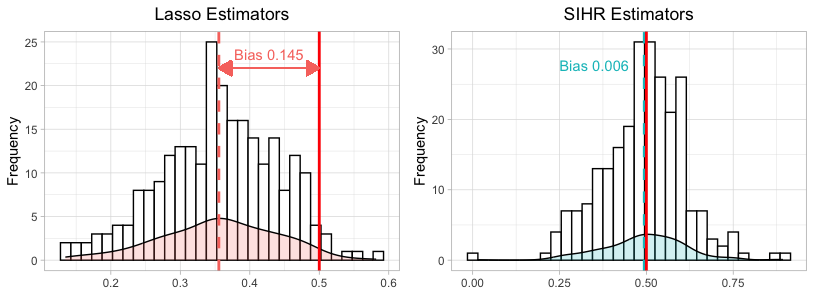
Illustration of Bias Correction
Installation
You can install the development version from GitHub with:
# install.packages("devtools")
devtools::install_github("zywang0701/SIHR")
Getting Started
The package consists of 5 main functions in one or two samples regime, with different low-dimensional objectives, respectively. Having fitted the model, it allows for two methods to report the result.
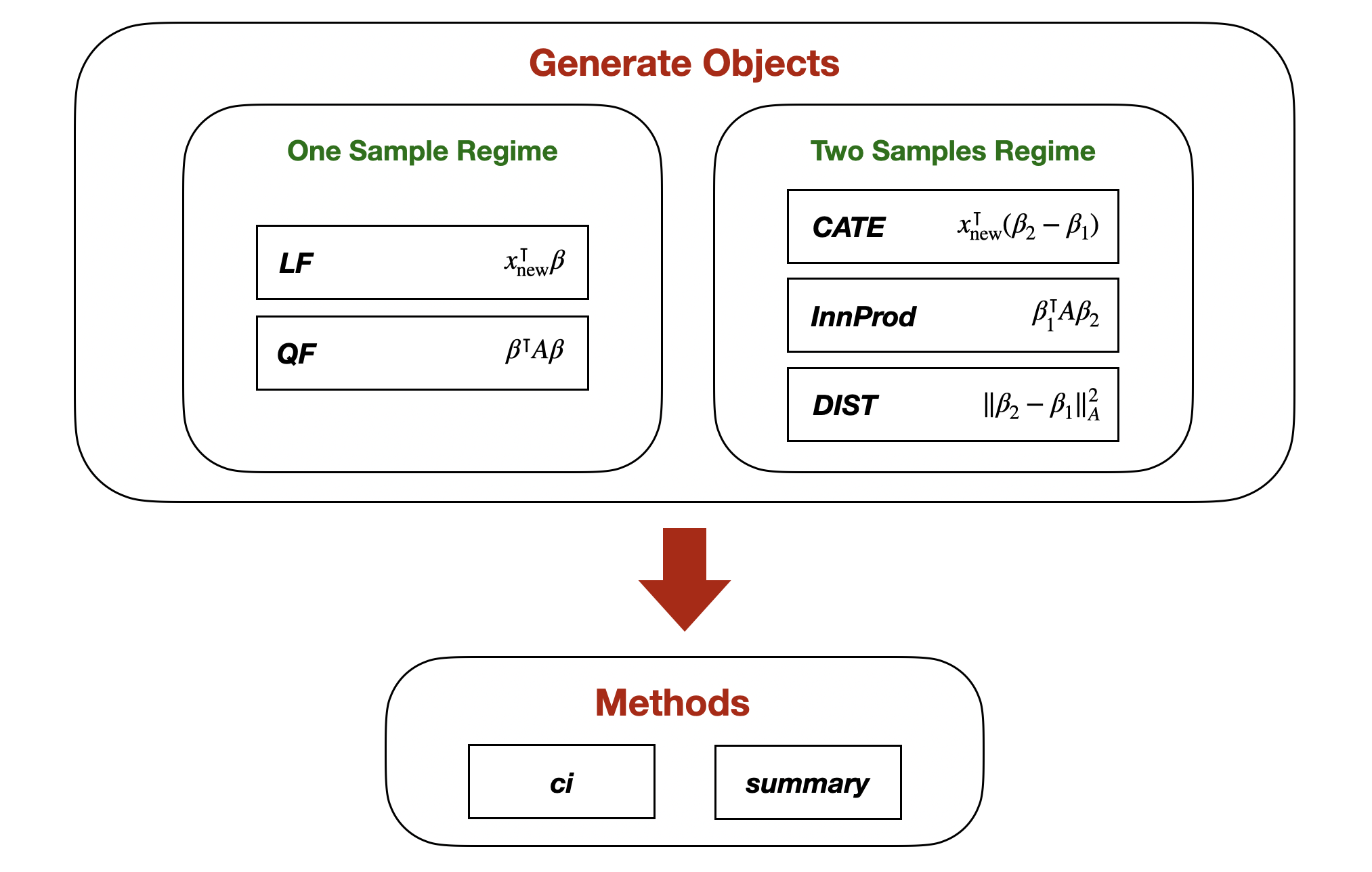
Outline of SIHR
We have prepared several vignettes to help users get ready with SIHR:
- Begin with the Get Started guide for an initial usage of the package.
- For an in-depth exploration of the package's functionality, consult the Intro of Usage.
- To gain insights into the debiasing methods incorporated within the package, refer to our Intro of Debiasing Methods.
Citation
If you use SIHR in your research, please cite our R Journal article:
Rakshit P, Wang Z, Cai T, Guo Z (2025). SIHR: Statistical Inference in High-Dimensional Linear and Logistic Regression Models. The R Journal, 16(3), 27-45. doi:10.32614/RJ-2024-028
In R, run citation("SIHR") for the full citation.