FusionForests
Bayesian Tree Ensembles for Data Fusion and Causal Inference
Bayesian tree ensemble models for data fusion and causal inference. The main model FusionForest() combines data from a randomised controlled trial and an observational study using separate tree forests, allowing for unmeasured confounding in the observational data. Continuous and (interval-)censored survival outcomes are supported. Posterior summaries of treatment effect estimates and interpretable linear projections are provided.
FusionForests 


FusionForests is an R package for Bayesian tree ensemble models for
data fusion and causal inference. The main model,
FusionForest(), combines data from a randomised controlled trial (RCT)
and an observational study (real-world data, RWD) in a single Bayesian
framework. Crucially, the observational data are not assumed to be
unconfounded.
The model targets heterogeneous treatment effects on continuous and (interval-)censored survival outcomes. The outcome is decomposed over separate tree forests:
$$Y = \mu(X) + (1-S)\ g(X) + A\ \tau(X) + (1-S)\ A\ c(X) + \varepsilon,$$
where $Y$ is the log survival time (accelerated failure time formulation) or a continuous outcome, $A$ is the treatment, $S$ indicates the source ($S = 1$ for the RCT, $S = 0$ for the RWD), and $\varepsilon$ is a mean-zero error term — Gaussian or a flexible Dirichlet-process mixture. Each term is modelled by its own forest:
- $\mu(X)$ — control forest: the prognostic surface under control;
- $g(X)$ — deconfounding forest: an RWD-only shift that absorbs confounding in the observational data;
- $\tau(X)$ — treatment forest: the heterogeneous treatment effect, identified by the RCT;
- $c(X)$ — deviation forest: how the RWD treatment effect deviates from the RCT one.
Because the RWD-specific terms $g(X)$ and $c(X)$ absorb confounding, the RCT anchors identification of $\tau(X)$ while the observational data add precision — without assuming the RWD is unconfounded.
Installation
The development version can be installed from GitHub:
# install.packages("remotes")
remotes::install_github("tijn-jacobs/FusionForests")
Quick example
A small RCT (n = 200) is combined with a larger RWD cohort (n = 800)
in which treatment assignment depends on an unobserved confounder
U that also affects survival:
library(FusionForests)

set.seed(42)
n_rct <- 200
n_rwd <- 800
n <- n_rct + n_rwd

X <- matrix(rnorm(n * 3), n, 3)
U <- rnorm(n)                        # unobserved confounder
s <- rep(c(1, 0), c(n_rct, n_rwd))   # 1 = RCT, 0 = RWD

# Treatment: randomised in the RCT, driven by U in the RWD
a <- ifelse(s == 1,
            rbinom(n, 1, 0.5),
            rbinom(n, 1, plogis(1.5 * U)))

# True heterogeneous effect on log survival time
tau <- 0.4 + 0.4 * X[, 1]

log_t <- 1 + X[, 1] + 0.5 * X[, 2] + a * tau + 0.7 * U + 0.3 * rnorm(n)
true_time <- exp(log_t)
cens_time <- rexp(n, rate = 1 / (2 * mean(true_time)))
time   <- pmin(true_time, cens_time)
status <- as.integer(true_time <= cens_time)

fit <- FusionForest(
  y = time, status = status,
  X_train_control = X, X_train_treat = X,
  treatment_indicator_train = a, source_indicator_train = s,
  X_test_control = X, X_test_treat = X,
  treatment_indicator_test = a, source_indicator_test = s,
  outcome_type = "right-censored",
  N_post = 2000, N_burn = 2000,
  store_posterior_sample = TRUE
)

# Posterior draws of the treatment effect (log-time scale) per subject
cate <- log(fusion_estimand(fit, estimand = "AF"))
cate_mean <- colMeans(cate)
cate_lo   <- apply(cate, 2, quantile, 0.025)
cate_hi   <- apply(cate, 2, quantile, 0.975)

plot(tau, cate_mean, pch = 19, cex = 0.45, col = "#2a78d6",
     xlab = "True treatment effect (log-time scale)",
     ylab = "Posterior treatment effect")
segments(tau, cate_lo, tau, cate_hi, col = adjustcolor("#2a78d6", 0.12))
abline(0, 1, lty = 2, col = "grey40")
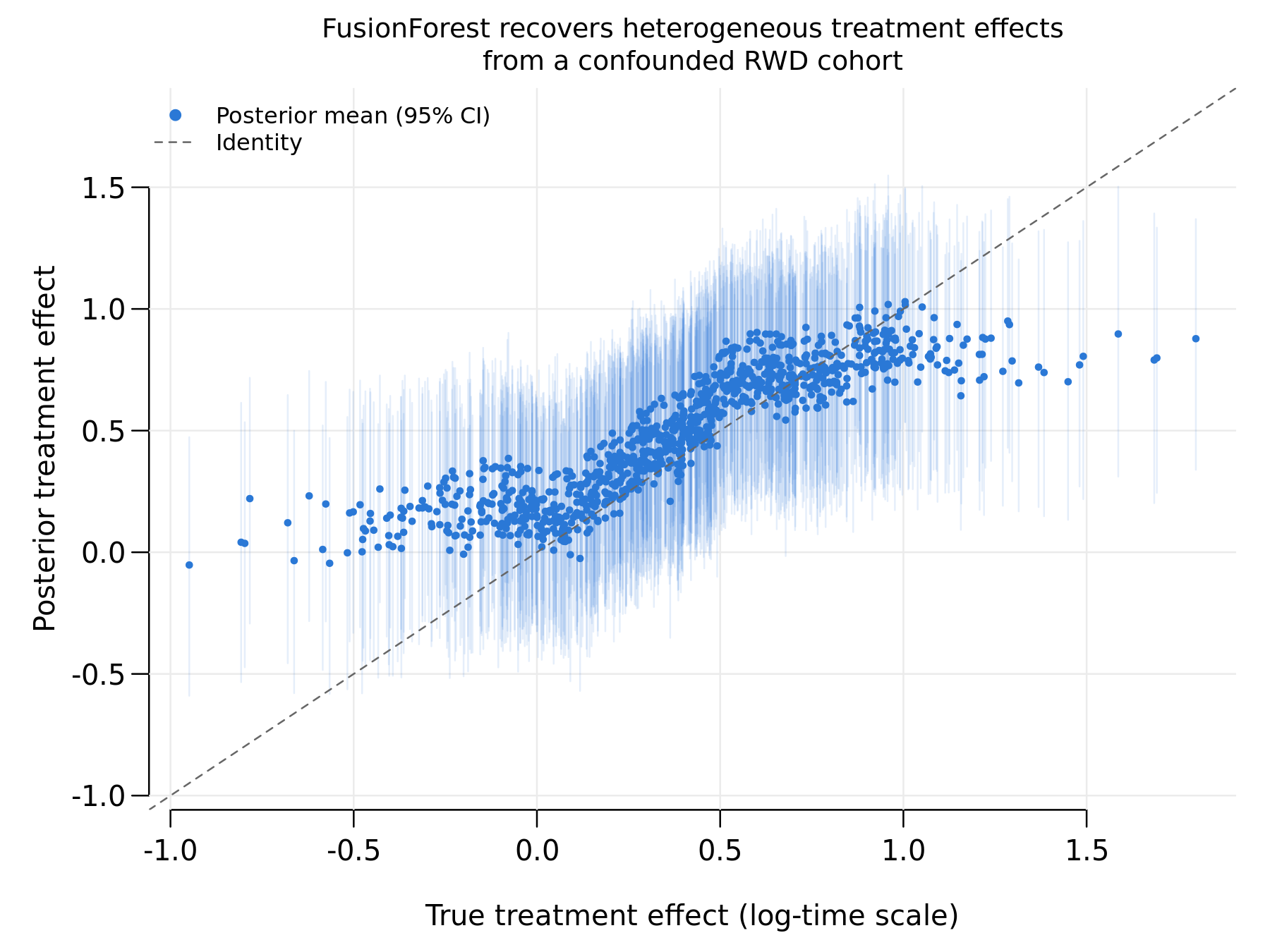
Even though treatment assignment in the RWD is driven by an unobserved confounder, the fitted treatment effects track the truth (correlation 0.89) and the 95% credible intervals cover the true effect for 94% of subjects.
The FusionForest model
FusionForest() is the heart of the package. It fits the decomposition
above with standard BART priors on each forest and returns posterior
draws of every component, so treatment effects, source deviations and
uncertainty are all available directly from one fit. Right-censored and
interval-censored survival outcomes are handled through data
augmentation, and the error distribution can be Gaussian or a
Dirichlet-process mixture (error_dist) for added robustness.
Two companion functions summarise a fit: fusion_estimand() returns
posterior draws of causal survival estimands (survival difference,
acceleration factor), and fusion_projection() projects the treatment
effect surface onto an interpretable linear basis.
The single-study causal and survival models from the
ShrinkageTrees
package are re-exported, so library(FusionForests) provides every
model from the accompanying paper in one namespace.
Reference
The methodology is described in:
Bayesian fusion forests for heterogeneous treatment effects on survival from randomised and real-world data T. Jacobs, S.L. van der Pas, W.N. van Wieringen arXiv preprint (2026)
License
Funding
This project has received funding from the European Research Council (ERC) under the European Union’s Horizon Europe program under Grant agreement No. 101074802. Views and opinions expressed are however those of the author(s) only and do not necessarily reflect those of the European Union or the European Research Council Executive Agency. Neither the European Union nor the granting authority can be held responsible for them. This work used the Dutch national e-infrastructure with the support of the SURF Cooperative using grant no. EINF-18803.