CRBHSF
Cyber-Resilient Bayesian Healthcare Surveillance Framework
Provides methods for healthcare performance surveillance
using Bayesian risk estimation, latent organisational trust
modelling, cyber-resilience assessment, external validation,
decision-theoretic optimisation, and digital-twin deployment
simulation. The package supports prospective deterioration
monitoring, uncertainty-aware risk assessment, intervention
prioritisation, ablation analysis, and operational evaluation for
healthcare performance management and health system resilience
research. The methodological framework is informed by contemporary
guidance on prediction model development and validation
(Efthimiou et al., 2024
CRBHSF
Cyber-Resilient Bayesian Healthcare Surveillance Framework
CRBHSF provides a comprehensive framework for prospective healthcare performance surveillance through the integration of Bayesian risk estimation, latent organisational trust modelling, cyber-resilience assessment, decision-theoretic optimisation, and digital-twin deployment simulation.
The package was developed to support uncertainty-aware healthcare surveillance and proactive operational risk management in complex, digitally dependent healthcare systems.
Highlights
- Bayesian healthcare surveillance
- Cyber-resilience risk assessment
- Latent organisational trust modelling
- Prospective deterioration prediction
- External validation framework
- Ablation and incremental-value analysis
- Decision-theoretic intervention prioritisation
- Digital-twin deployment simulation
- Publication-quality visualisations
- Reproducible healthcare analytics workflows
Framework Overview

The CRBHSF workflow integrates healthcare performance data, Bayesian surveillance modelling, organisational trust estimation, cyber-resilience assessment, risk stratification, intervention prioritisation, and digital-twin deployment evaluation within a unified analytical framework.
Why CRBHSF?
Traditional healthcare monitoring systems primarily identify performance issues after they occur. CRBHSF extends conventional surveillance by integrating:
- Bayesian uncertainty quantification
- Prospective deterioration monitoring
- Latent organisational trust estimation
- Cyber-resilience risk assessment
- External validation workflows
- Ablation and incremental-value analysis
- Decision-theoretic intervention prioritisation
- Capacity-constrained deployment simulation
- Digital-twin operational evaluation
Installation
install.packages("remotes")

remotes::install_github("zerish12/CRBHSF")
Core Workflow
library(CRBHSF)

df <- clean_health_data(
  data,
  provider_col = "provider",
  time_col = "month"
)

df <- fit_bayesian_surveillance(
  df,
  y_col = "y",
  n_col = "n"
)

df <- estimate_latent_trust(
  df,
  anomaly_col = "anomaly",
  corruption_col = "corruption",
  cyber_col = "cyber",
  missing_col = "missing"
)

df <- compute_crbhsf_risk(df)

df <- compute_crpr(df)

df <- create_deterioration_outcome(
  df,
  provider_col = "provider",
  time_col = "month",
  value_col = "risk_crbhsf",
  threshold = 0.04
)

validation_results <- validate_surveillance(
  df,
  outcome_col = "future_deterioration",
  score_col = "risk_crbhsf"
)

validation_results
Example Outputs
Cyber-Resilient Risk Distribution
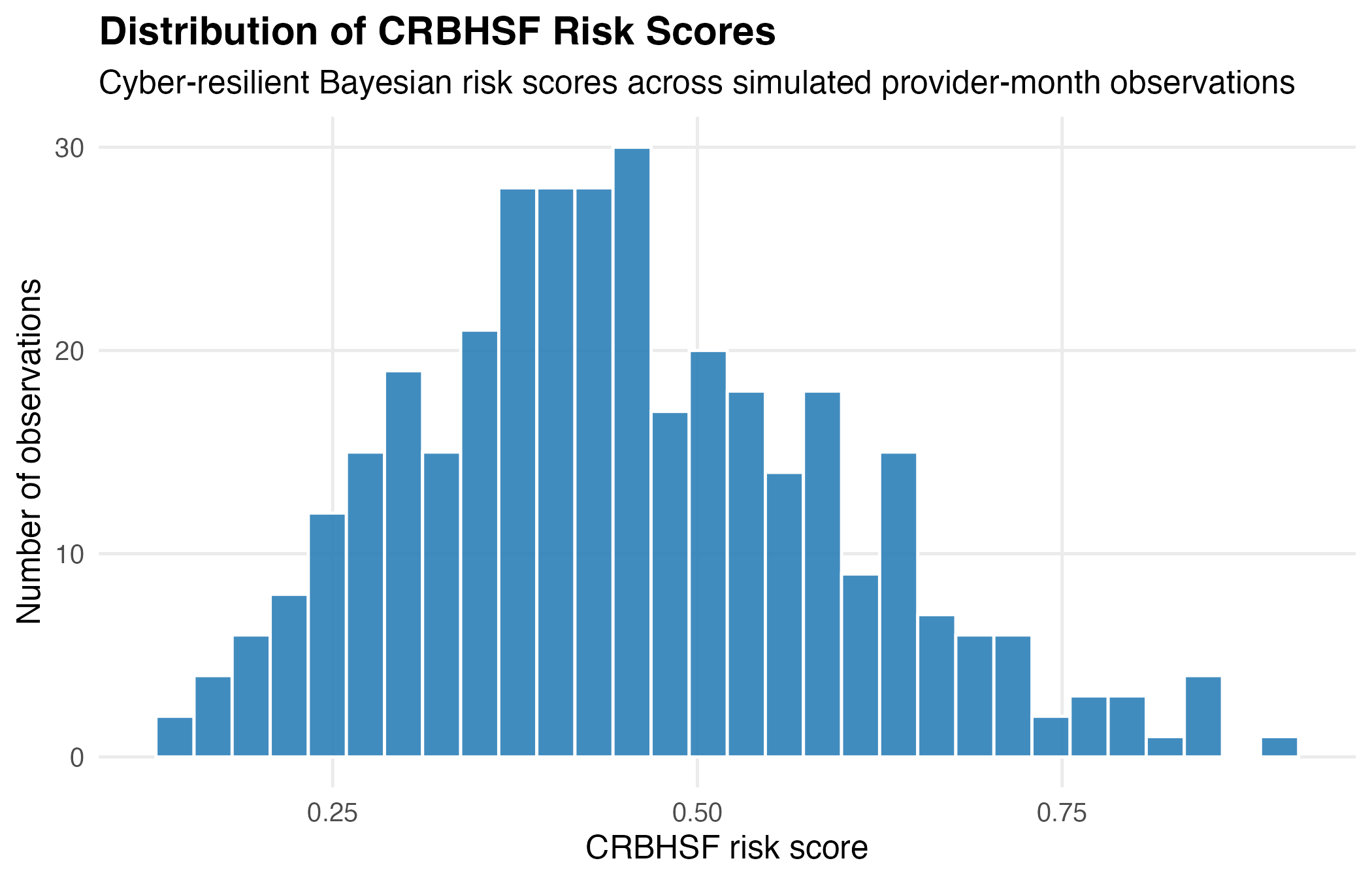
Distribution of cyber-resilient Bayesian surveillance risk scores across healthcare providers.
Incremental Predictive Value of Framework Components
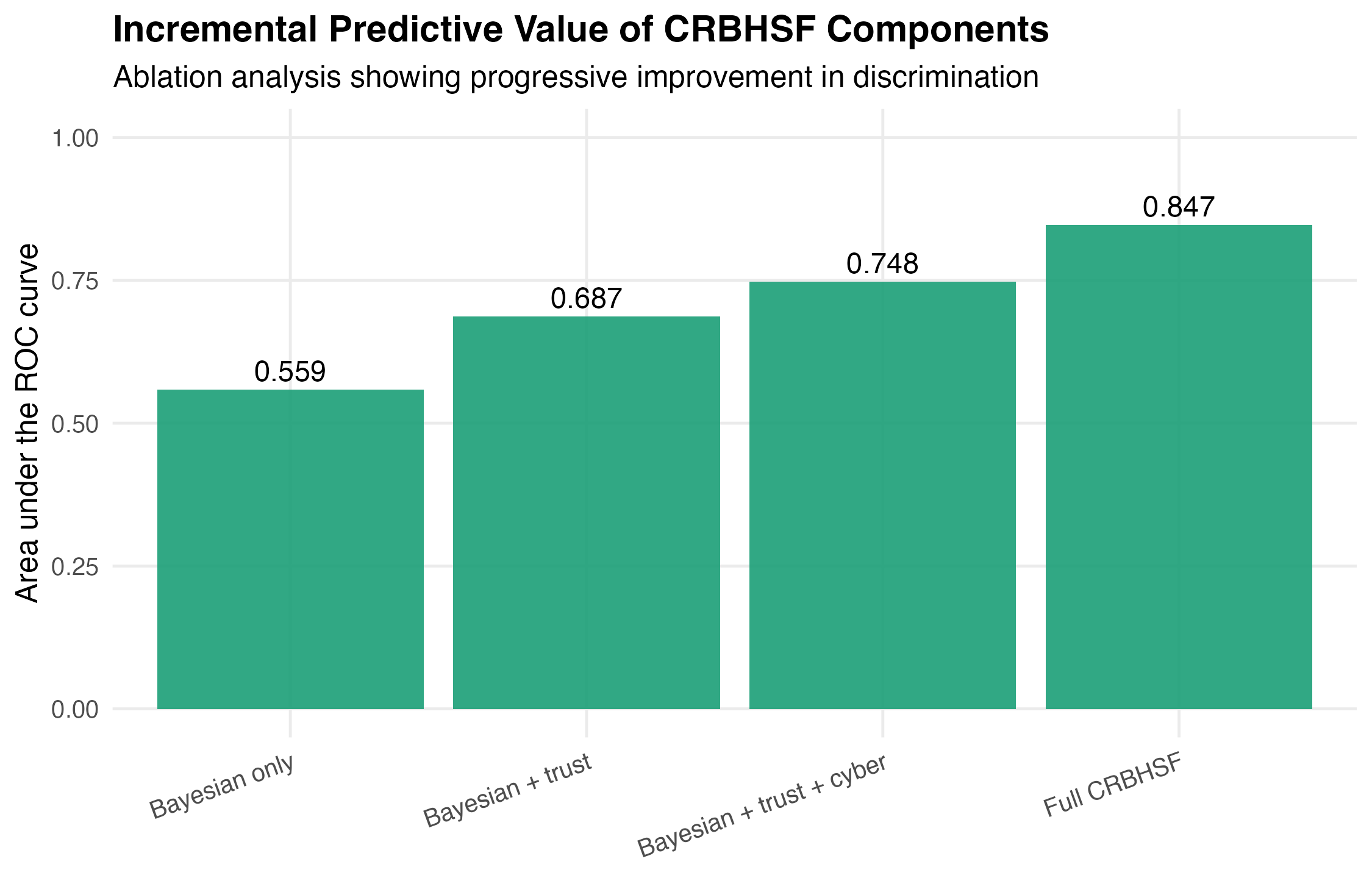
Ablation analysis illustrating the incremental contribution of Bayesian surveillance, latent trust modelling, and cyber-resilience assessment.
Digital-Twin Deployment Impact
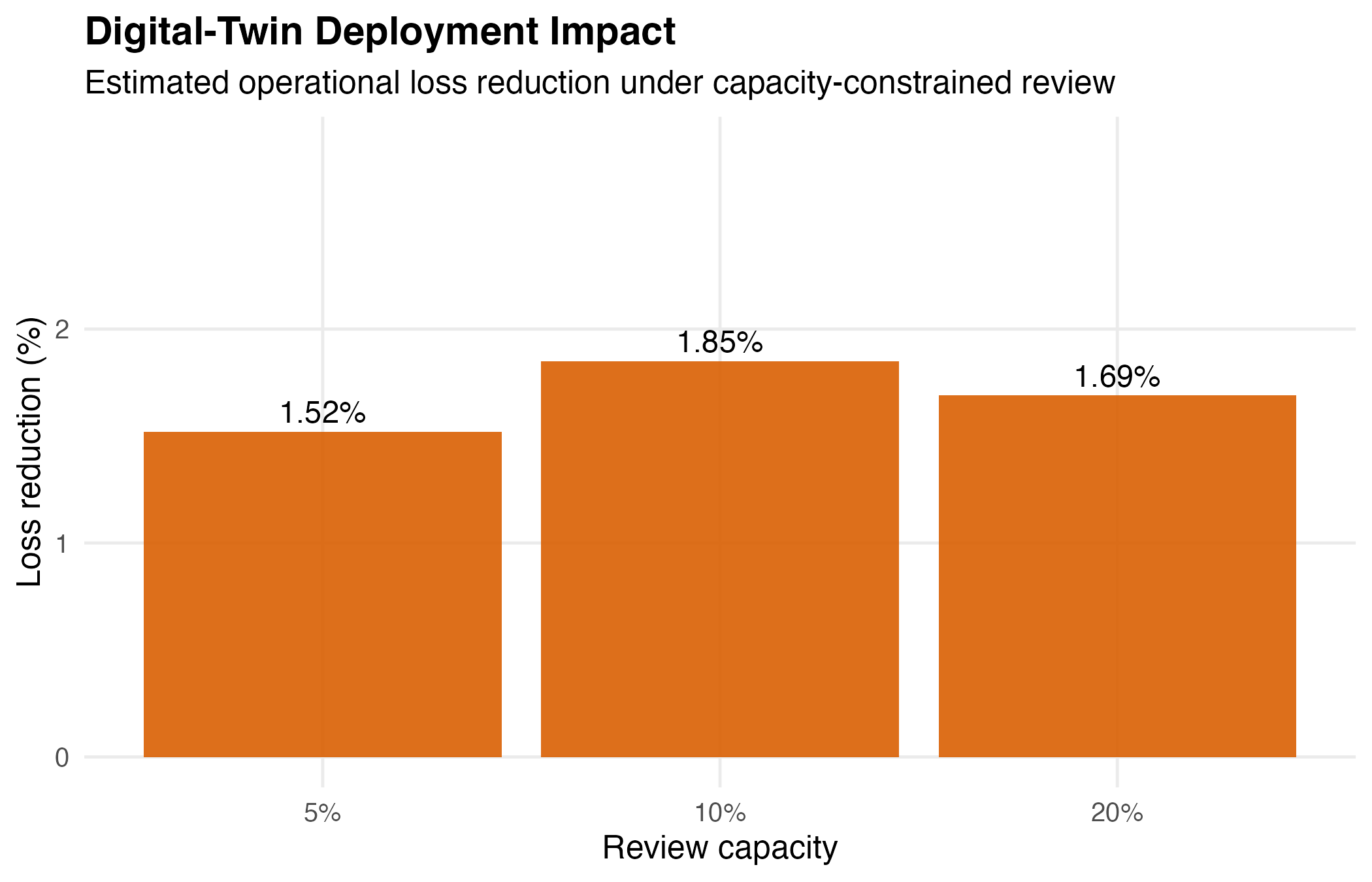
Estimated reduction in operational losses under alternative intervention-capacity scenarios.
Main Functions
| Function | Purpose |
|---|---|
clean_health_data() |
Healthcare data cleaning and preparation |
create_deterioration_outcome() |
Future deterioration outcome generation |
fit_bayesian_surveillance() |
Bayesian surveillance modelling |
estimate_latent_trust() |
Organisational trust estimation |
compute_crbhsf_risk() |
Cyber-resilient Bayesian risk computation |
compute_crpr() |
Cyber-Resilience Pressure Ratio |
validate_surveillance() |
Model validation and performance assessment |
run_ablation_study() |
Incremental-value evaluation |
compare_ml_benchmarks() |
Machine-learning benchmark comparison |
estimate_evib() |
Expected intervention benefit estimation |
simulate_digital_twin() |
Digital-twin deployment simulation |
plot_risk_distribution() |
Risk visualisation |
plot_ablation_auc() |
Ablation-analysis visualisation |
plot_deployment_impact() |
Deployment-impact visualisation |
generate_surveillance_report() |
Automated surveillance reporting |
Research Applications
CRBHSF is designed for:
- Healthcare performance surveillance
- NHS operational analytics
- Hospital performance monitoring
- Cyber-resilience assessment
- Health system resilience research
- Bayesian healthcare analytics
- Operational risk prediction
- Digital-twin deployment studies
- Decision-theoretic intervention planning
- Healthcare operations research
Methodological Foundations
The framework draws upon contemporary developments in:
- Bayesian healthcare surveillance
- Clinical prediction model development
- External validation methodology
- Decision-analytic model evaluation
- Cyber-resilience assessment
- Digital-twin healthcare simulation
Key references include:
- Efthimiou O, Seo M, Chalkou K, et al. (2024). Developing clinical prediction models: A step-by-step guide. BMJ.
- Collins GS, Moons KGM, Dhiman P, et al. (2024). TRIPOD+AI Statement. BMJ.
- Vickers AJ, Elkin EB (2006). Decision curve analysis: A novel method for evaluating prediction models. Medical Decision Making.
Package Status
Current version: 0.1.0
Status: Active development
Platform: R
License: MIT
Citation
If you use CRBHSF in research, please cite:
Khan MZ, Khan AW (2026).
CRBHSF: Cyber-Resilient Bayesian Healthcare Surveillance Framework.
R package version 0.1.0.
Authors
Muhammad Zahir Khan
Independent Researcher in Health Data Science and Statistical Methodology, United Kingdom
Email: [email protected]
Abdul Wahid Khan
BS Cyber Security Student
Email: [email protected]
Future Development
Planned extensions include:
- Fully Bayesian hierarchical trust estimation
- Real-time healthcare surveillance dashboards
- Advanced cyber-threat integration
- Interactive digital-twin environments
- NHS performance monitoring applications
- Shiny-based deployment tools
Project Vision
CRBHSF aims to advance healthcare surveillance beyond conventional retrospective monitoring by integrating uncertainty quantification, cyber resilience, organisational trust, operational risk assessment, and deployment-oriented decision support within a unified analytical framework. The package is intended to support researchers, healthcare organisations, policy analysts, and operational decision-makers seeking proactive and resilience-aware performance management strategies.
License
MIT License