ungroup
Penalized Composite Link Model for Efficient Estimation of Smooth Distributions from Coarsely Binned Data
Versatile method for ungrouping histograms (binned count data)
assuming that counts are Poisson distributed and that the underlying sequence
on a fine grid to be estimated is smooth. The method is based on the composite
link model and estimation is achieved by maximizing a penalized likelihood.
Smooth detailed sequences of counts and rates are so estimated from the binned
counts. Ungrouping binned data can be desirable for many reasons: Bins can be
too coarse to allow for accurate analysis; comparisons can be hindered when
different grouping approaches are used in different histograms; and the last
interval is often wide and open-ended and, thus, covers a lot of information
in the tail area. Age-at-death distributions grouped in age classes and
abridged life tables are examples of binned data. Because of modest assumptions,
the approach is suitable for many demographic and epidemiological applications.
For a detailed description of the method and applications see
Rizzi et al. (2015)
 ungroup: estimating smooth distributions from coarsely binned data







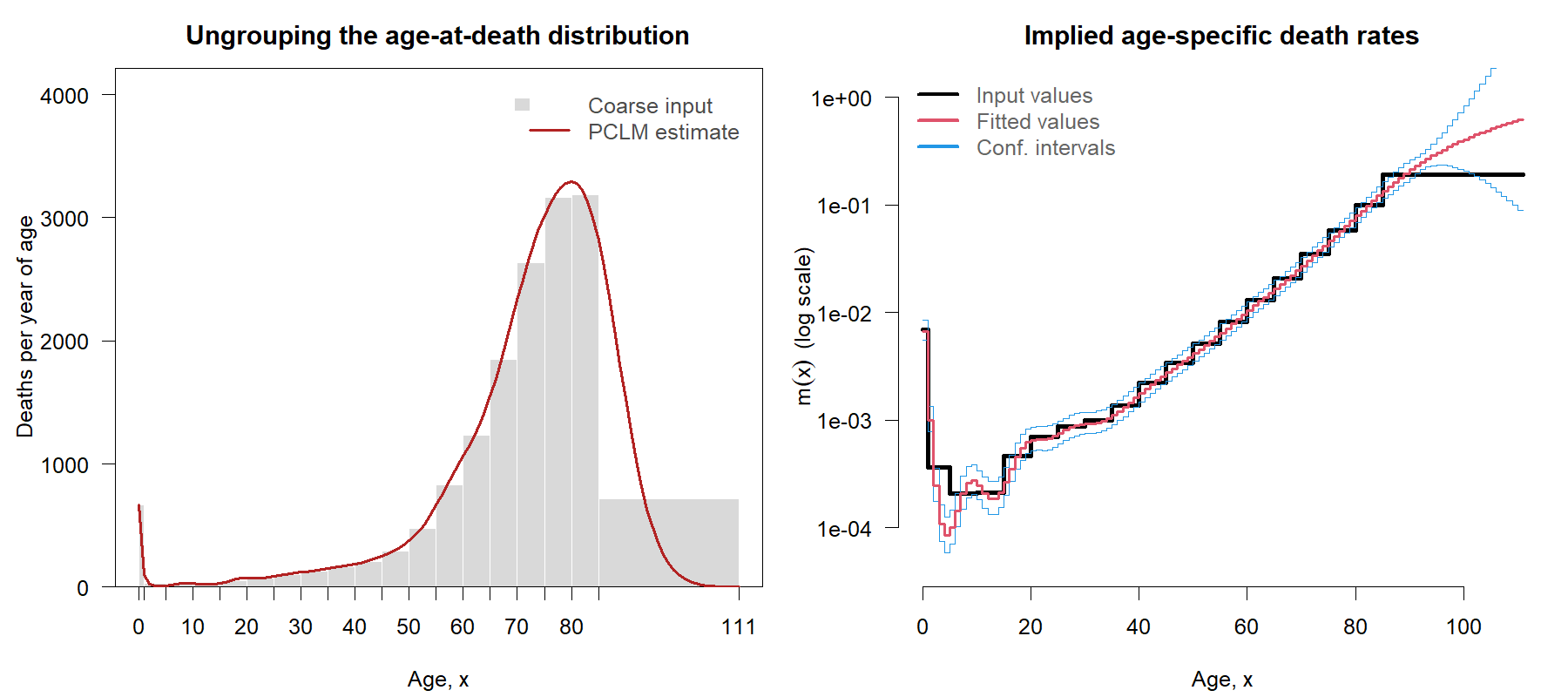
ungroup recovers a smooth, detailed distribution from counts that were
published in wide bins. It implements the penalized composite link model
(PCLM), which treats the coarse counts as indirect observations of a smooth
underlying sequence and estimates that sequence by penalized maximum
likelihood. It also extends the same idea to two dimensions, so a sequence of
coarsely grouped distributions can be ungrouped and smoothed across time at
once.
The problem it solves shows up wherever data arrive pre-aggregated. Hospitals publish deaths in five-year age groups. Registries report cases by ten-year cohort. Vital statistics close the oldest age group at 85+, sometimes at 90+, with a single wide interval holding a large share of the total. In every case the fine-grained distribution you need is inside the bins you were given, and taking the bins at face value is not good enough for the questions people actually ask of the data.
The naive alternative, spreading each bin's count evenly over its width, imposes a flat step on every interval. It is not merely inelegant, it is biased: in the Swedish data shipped with the package, that approach overstates life expectancy at birth by an average of 2.5 years. PCLM recovers the same distribution to within a tenth of a year, and it redistributes exactly the deaths it was given.
What it does
| capability | how |
|---|---|
| Ungroup counts onto a finer grid | pclm(), with any output width from 0.1 to 1 |
| Ungroup a surface over time | pclm2D(), for a matrix of years by age |
| Estimate rates instead of counts | pass an offset of exposures |
| State where the distribution closes | omega instead of the width of the last interval |
| Smooth over unobserved cells | na.action = "omit" |
| Quantify uncertainty | pointwise intervals, and mass-preserving scenarios for life tables |
Installation
install.packages("ungroup")
The development version comes from GitHub. pak is the recommended
installer, and it needs a working development environment: Rtools on Windows,
Xcode on macOS, a compiler on Linux.
# install.packages("pak")
pak::pak("mpascariu/ungroup")
pak::pak() also installs the compiled dependencies this package links
against, so it is the simplest route on a fresh machine.
Documentation
The tutorial is the place to start, and it works through the model, the smoothing parameter, missing data and how to read every part of the output:
- Tutorial: https://mpascariu.github.io/ungroup/articles/Intro.html
- Function reference: https://mpascariu.github.io/ungroup/reference/index.html
- Offline:
vignette("Intro", package = "ungroup")
The JOSS paper gives a short overview of the method and its motivation: Pascariu et al. (2018), Journal of Open Source Software, 3(29), 937, https://doi.org/10.21105/joss.00937.
Method
The estimator is the penalized composite link model of Eilers (2007), built on the composite link model of Thompson and Baker (1981). The one-dimensional case follows Rizzi, Gampe and Eilers (2015); the two-dimensional extension with smoothing across adjacent years follows Rizzi et al. (2019). Smoothing parameters are chosen by BIC or AIC.
Citation
citation("ungroup")
Pascariu, M. D., Dańko, M. J., Schöley, J., and Rizzi, S. (2018). ungroup: An R package for efficient estimation of smooth distributions from coarsely binned data. Journal of Open Source Software, 3(29), 937. https://doi.org/10.21105/joss.00937
Contributing
Issues and pull requests are welcome. If ungroup misbehaves, please open an
issue with a minimal reproducible example. See
CONTRIBUTING.md.
This project is released with a
Contributor Code of Conduct.
References
Eilers, P. H. C. (2007). Ill-posed problems with counts, the composite link model and penalized likelihood. Statistical Modelling, 7(3), 239-254. https://doi.org/10.1177/1471082X0700700302
Rizzi, S., Gampe, J., and Eilers, P. H. C. (2015). Efficient estimation of smooth distributions from coarsely grouped data. American Journal of Epidemiology, 182(2), 138-147. https://doi.org/10.1093/aje/kwv020
Rizzi, S., Halekoh, U., Thinggaard, M., Engholm, G., Christensen, N., Johannesen, T. B., and Lindahl-Jacobsen, R. (2019). How to estimate mortality trends from grouped vital statistics. International Journal of Epidemiology, 48(2), 571-582. https://doi.org/10.1093/ije/dyy183
Thompson, R. and Baker, R. J. (1981). Composite link functions in generalized linear models. Applied Statistics, 30(2), 125-131.