slasso
S-LASSO Estimator for the Function-on-Function Linear Regression
Implements the smooth LASSO estimator for the function-on-function linear regression model described in Centofanti et al. (2022)
slasso


The package slasso implements the smooth LASSO estimator (S-LASSO)
for the Function-on-Function linear regression model proposed by
Centofanti et al. (2022). The S-LASSO estimator is able to increase the
interpretability of the model, by better locating regions where the
coefficient function is zero, and to smoothly estimate non-zero values
of the coefficient function. The sparsity of the estimator is ensured by
a functional LASSO penalty, which pointwise shrinks toward zero the
coefficient function, while the smoothness is provided by two roughness
penalties that penalize the curvature of the final estimator. The
package comprises two main functions slasso.fr and slasso.fr_cv. The
former implements the S-LASSO estimator for fixed tuning parameters of
the smoothness penalties $\lambda_s$ and $\lambda_t$, and tuning
parameter of the functional LASSO penalty $\lambda_L$. The latter
executes the K-fold cross-validation procedure described in Centofanti
et al. (2022) to choose $\lambda_L$, $\lambda_s$, and $\lambda_t$.
Installation
The development version can be installed from GitHub with:
# install.packages("devtools")
devtools::install_github("unina-sfere/slasso")
Example
This is a basic example which shows you how to apply the two main
functions slasso.fr and slasso.fr_cv on a synthetic dataset
generated as described in the simulation study of Centofanti et
al. (2022).
We start by loading and attaching the slasso package.
library(slasso)
Then, we generate the synthetic dataset and build the basis function sets as follows.
data<-simulate_data("Scenario II",n_obs=500)
X_fd=data$X_fd
Y_fd=data$Y_fd
domain=c(0,1)
n_basis_s<-30
n_basis_t<-30
breaks_s<-seq(0,1,length.out = (n_basis_s-2))
breaks_t<-seq(0,1,length.out = (n_basis_t-2))
basis_s <- fda::create.bspline.basis(domain,breaks=breaks_s)
basis_t <- fda::create.bspline.basis(domain,breaks=breaks_t)
To apply slasso.fr_cv, sequences of $\lambda_L$, $\lambda_s$, and
$\lambda_t$ should be defined.
lambda_L_vec=10^seq(0,1,by=0.1)
lambda_s_vec=10^seq(-6,-5)
lambda_t_vec=10^seq(-5,-5)
And, then, slasso.fr_cv is executed.
mod_slasso_cv<-slasso.fr_cv(Y_fd = Y_fd,X_fd=X_fd,basis_s=basis_s,basis_t=basis_t,
lambda_L_vec = lambda_L_vec,lambda_s_vec = lambda_s_vec,lambda_t_vec =lambda_t_vec,
max_iterations=1000,K=10,invisible=1,ncores=12)
The results are plotted.
plot(mod_slasso_cv)
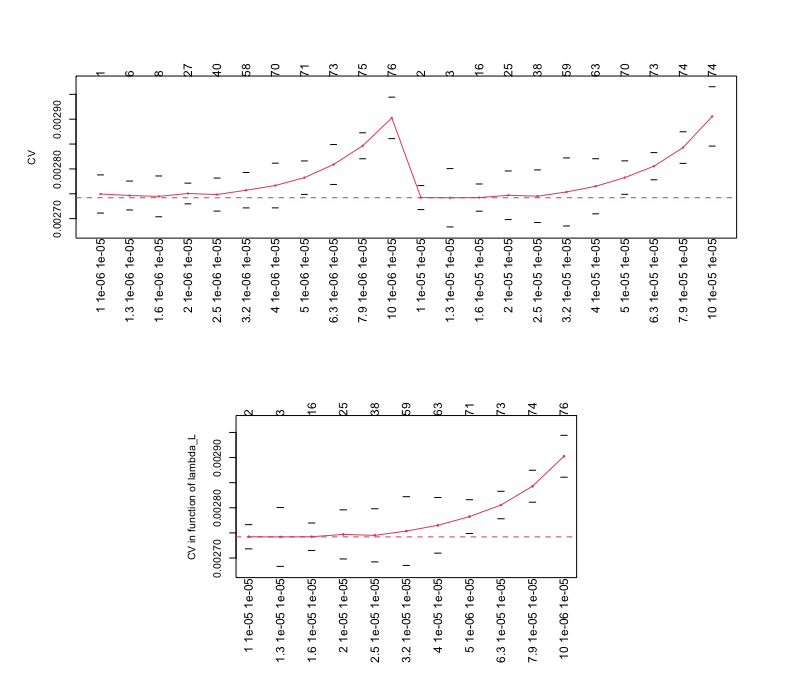 By using the model
selection method described in Centofanti et al. (2022), the optimal
values of $\lambda_L$, $\lambda_s$, and $\lambda_t$, are $3.98$,
$10^{-5}$, and $10^{-5}$, respectively.
By using the model
selection method described in Centofanti et al. (2022), the optimal
values of $\lambda_L$, $\lambda_s$, and $\lambda_t$, are $3.98$,
$10^{-5}$, and $10^{-5}$, respectively.
Finally, sasfclust is applied with $\lambda_L$, $\lambda_s$, and
$\lambda_t$ fixed to their optimal values.
mod_slasso<-slasso.fr(Y_fd = Y_fd,X_fd=X_fd,basis_s=basis_s,basis_t=basis_t,
lambda_L = mod_slasso_cv$lambda_opt_vec[1],lambda_s = mod_slasso_cv$lambda_opt_vec[2],
lambda_t =  mod_slasso_cv$lambda_opt_vec[3],invisible=1,max_iterations=1000)
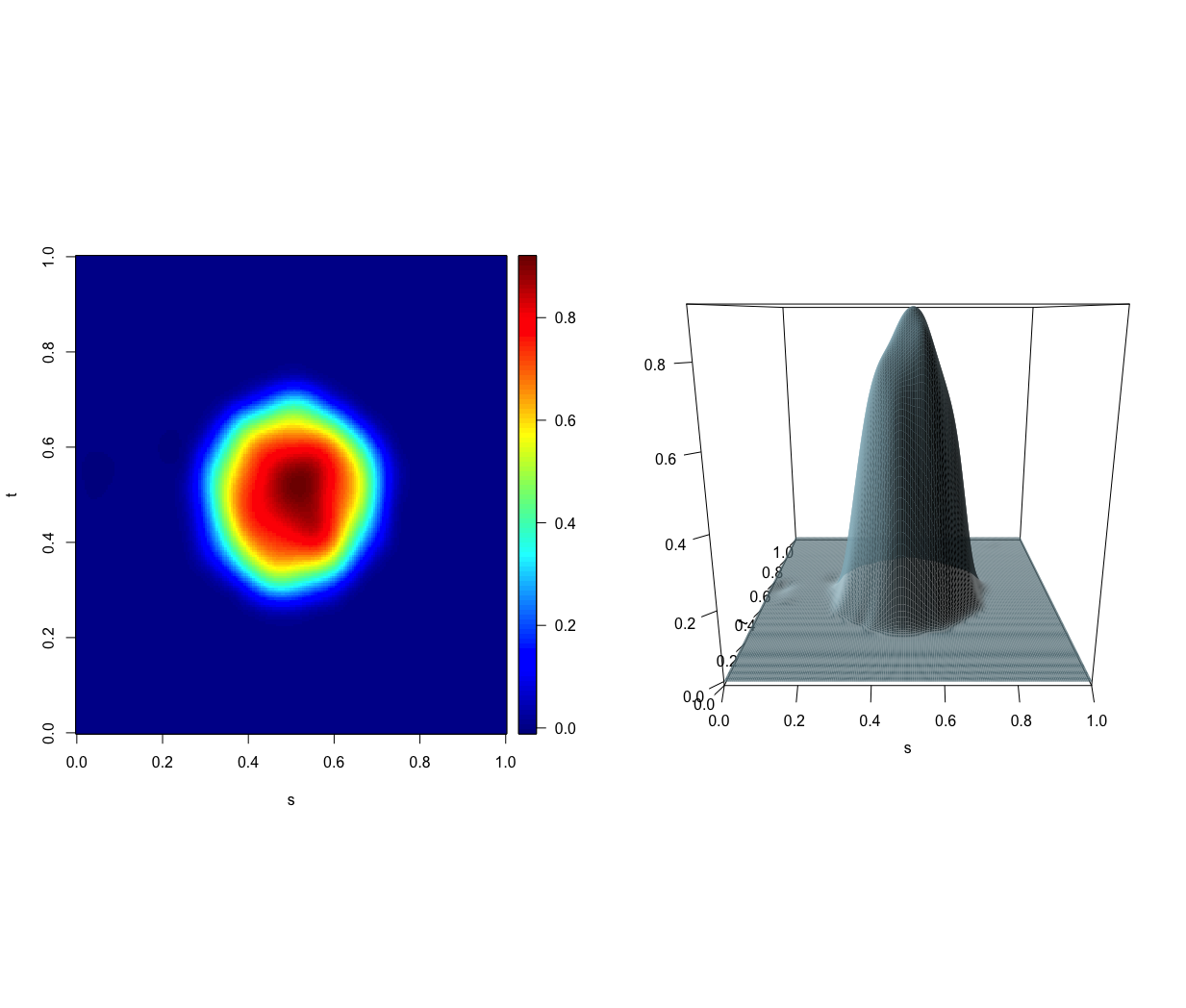
The resulting estimator is plotted as follows.
plot(mod_slasso)
References
- Centofanti, F., Fontana, M., Lepore, A., & Vantini, S. (2022). Smooth lasso estimator for the function-on-function linear regression model. Computational Statistics & Data Analysis, 176, 107556.