pdfsigner
Digitally Sign and Verify PDF Documents
Digitally sign PDF documents with a 'PKCS#12' keystore and verify their signatures. Signing produces a detached 'PKCS#7' / 'CMS' signature ('adbe.pkcs7.detached') over the document and is applied as an incremental update, so existing signatures remain valid. The cryptography and PDF manipulation are performed by a bundled, pure-'Rust' backend (the 'pdf_signer' crate); no Java runtime, 'OpenSSL', or external command-line tools are required. Visible signature appearances with custom text are supported.
pdfsigner 



pdfsigner is an R package to digitally sign PDF documents with a PKCS#12 keystore and verify their signatures.
The package is powered by a bundled, pure-Rust backend (the
pdf_signer crate, wrapped
with extendr). It no longer shells out to Java
(BatchPDFSignPortable.jar) or Poppler (pdfsig): no Java runtime, OpenSSL,
or external command-line tools are required — only a Rust toolchain at install
time.
Installation
Requires a Rust toolchain (cargo, rustc) to compile the bundled backend.
Install Rust from https://rustup.rs, then:
# install.packages("remotes")
remotes::install_github("StrategicProjects/pdfsigner")
What it does
- PAdES signatures up to B-LTA via
pades_level:"bb"(CAdESsigning-certificate-v2),"bt"(+ RFC 3161 signature timestamp),"blt"(+ a/DSSwith the certificate chain and CRLs),"blta"(+ a document timestamp over the whole file). Levels"bt"+ need atsa_url. - Incremental updates: signing again appends only, so earlier signatures stay valid — multi-signature is supported.
- Visible or invisible signatures, with a custom text box + validation link.
- Cryptographic verification of every signature (re-derives the signed byte range, checks the message digest and the signer's RSA signature).
Usage
sign_pdf()
library(pdfsigner)

sign_pdf(
  pdf_file          = "input.pdf",
  output_file       = "signed.pdf",
  keystore_path     = "keystore.p12",      # or env var KEYSTORE_PATH
  keystore_password = "password",          # or env var KEY_PASSWORD
  signtext          = "Document digitally signed by CastLab",
  validate_link     = "https://castlab.org/validate",
  reason            = "Approval",
  translate         = TRUE,                 # Portuguese date label
  font              = "Arial.ttf",          # embed a TrueType/OpenType font
  image             = "logo.png",           # draw a PNG/JPEG logo in the box
  tsa_url           = "http://timestamp.digicert.com",
  pades_level       = "blta"                # bb | bt | blt | blta
)
A visible signature box is drawn whenever signtext is non-empty; geometry is
controlled by page, x, y, width, height, font_size and border.
Pass font to embed a TrueType/OpenType font (WinAnsi/Latin-1 glyphs; the
default is Helvetica) and image to draw a PNG/JPEG logo in the box. Omit
signtext for an invisible signature.
verify_pdf_signature()
result <- verify_pdf_signature("signed.pdf")
length(result)                              # number of signatures
vapply(result, function(s) s$valid, logical(1))
result[[1]]$signer                          # signer distinguished name
Each entry is a named list: valid, signer, chain_trusted,
covers_whole_document, signed_len, byte_range, detail.
Pass roots (a PEM file of trusted roots, e.g. the ICP-Brasil AC Raiz set) to
validate each signer certificate chain; chain_trusted is then TRUE/FALSE
(and NA when no roots are given):
verify_pdf_signature("signed.pdf", roots = "icp-brasil-roots.pem")
TSA / CRL endpoints over HTTPS are supported (the bundled Rust backend is
built with its https feature, using rustls).
Generating a test certificate
openssl req -x509 -newkey rsa:2048 -keyout key.pem -out cert.pem -days 365 -nodes
openssl pkcs12 -export -inkey key.pem -in cert.pem -out keystore.p12
Architecture
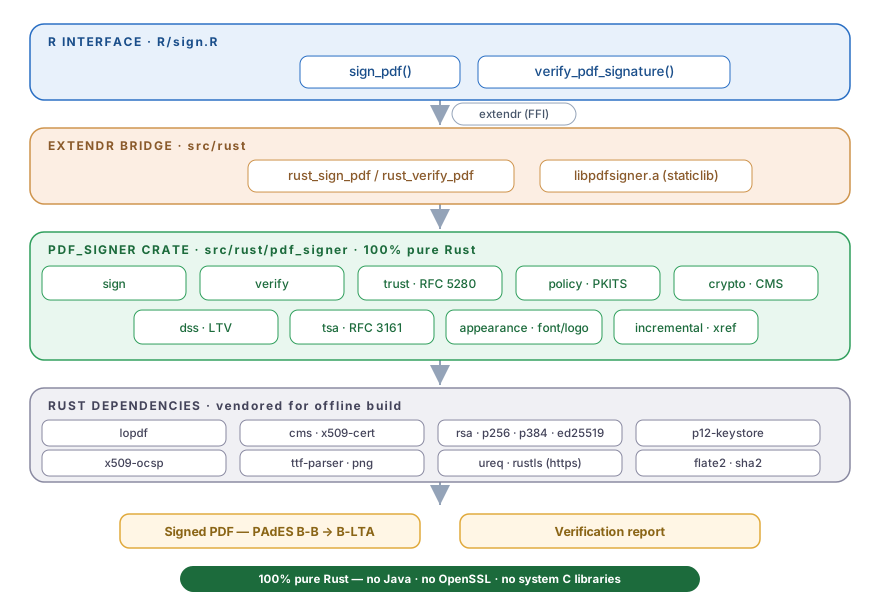
The R functions call a thin extendr bridge that links the
pure-Rust pdf_signer crate. Every Rust dependency is vendored under
src/rust/vendor.tar.xz so the package builds offline (CRAN policy:
SystemRequirements: Cargo, rustc).
License
GPL-3. The bundled pdf_signer crate and its vendored Rust dependencies retain
their own licenses.