ddModel
The Decision Diffusion Model
Provides functions for computing the density, distribution, and random generation of the Decision Diffusion model (DDM), a widely used cognitive model for analysing choice and response time data. The package allows model specification, including the ability to fix, constrain, or vary parameters across experimental conditions. While it does not include a built-in optimiser, it supports likelihood evaluation and can be integrated with external tools for parameter estimation. Functions for simulating synthetic datasets are also provided. This package is intended for researchers modelling speeded decision-making in behavioural and cognitive experiments. For more information, see Voss, Rothermund, and Voss (2004)
📦 ddModel: Core Functions for the Decision Diffusion Model


ddModel provides fast and flexible computational tools for the Decision Diffusion Model (DDM) - a widely used cognitive model for analysing choice and response time (RT) in speeded decision-making tasks.
🔍 Overview
This package supports:
- End-to-end DDM support: density, distribution, and random sampling functions
- Flexible parameterisation:
- Fix parameters globally
- Constrain by experimental conditions
- Vary subject-by-subject (hierarchical modelling ready)
- Efficient likelihood evaluation: fully vectorised for large-scale datasets
- Seamless integration: designed to work smoothly with the
ggdmc
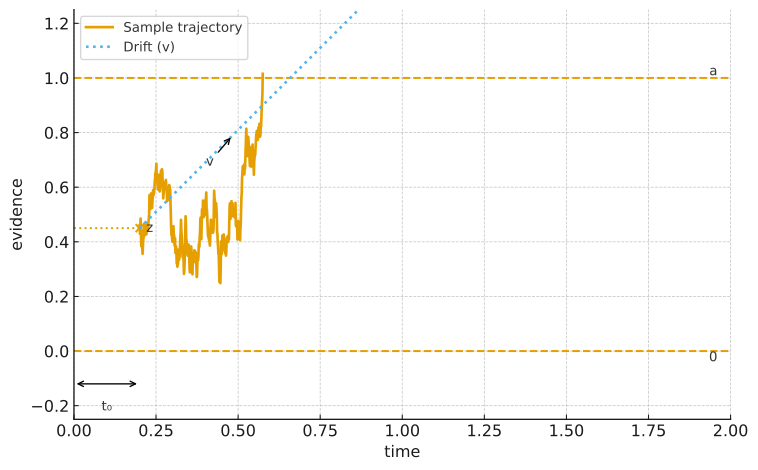 Figure: Illustration of the DDM. Evidence accumulates over time with drift rate v until it reaches one of the decision boundaries (a or 0). The starting point z and non-decision time t₀ are also shown; variability parameters, sv, sz, and st₀ were set to 0.
🧠 Key Features
- Implements canonical DDM components:
a(boundary separation),v(drift rate),t₀(non-decision time),z(starting point), plus optional variability parameterssv,sz,st₀ - Simulation tools for:
- Subject-level and population-level datasets
- Model recovery studies & power analysis
- Likelihood and density functions optimised for speed
- Ready for hierarchical modelling pipelines (
ggdmcModel,ggdmcPrior,ggdmcHeaders)
📌 Who Is It For?
- Experimental psychologists modelling two-alternative forced-choice (2AFC) tasks
- Cognitive scientists running simulation-based model recovery or parameter estimation
- Researchers and data scientists needing synthetic data for benchmarking or educational demos
🚀 Quick Start
# Install from CRAN
install.packages("ddModel")

# Or development version
# install.packages("devtools")
devtools::install_github("yxlin/ddModel")

library(ddModel)
library(ggdmcModel)
library(ggdmcPrior)
✅ Example Workflow
1. Build a DDM Specification
# Load packages
library(ggdmcModel)
library(ggdmcPrior)
library(ddModel)

# Set up a stimulus drift rate model
model <- BuildModel(
  p_map = list(
    a = "1", v = "1", z = "1", d = "1", sz = "1", sv = "1",
    t0 = "1", st0 = "1", s = "1", precision = "1"
  ),
  match_map = list(M = list(s1 = "r1", s2 = "r2")),
  factors = list(S = c("s1", "s2")),
  constants = c(d = 0, s = 1, st0 = 0, precision = 3),
  accumulators = c("r1", "r2"),
  type = "fastdm"
)
2. Set up Hierarchical Priors
# Set up a population-level prior distribution
pop_mean  <- c(a = 1, sv = 0.1, sz = 0.25, t0 = 0.15, v = 2.5, z = 0.38)
pop_scale <- c(a = 0.05, sv = 0.01, sz = 0.01, t0 = 0.02, v = 0.5, z = 0.01)
pop_dist  <- BuildPrior(
  p0    = pop_mean,
  p1    = pop_scale,
  lower = c(0, 0, 0, 0, -10, 0),
  upper = rep(NA, length(pop_mean)),
  dists = rep("tnorm", length(pop_mean)),
  log_p = rep(FALSE, length(pop_mean))
)

# Visualise the prior
plot_prior(pop_dist)
3. Simulate Data
# Subject-level and population-level model setup
sub_model <- setDDM(model)
pop_model <- setDDM(model, population_distribution = pop_dist)

# Simulate subject-level data
p_vector <- c(a = 1, sv = 0.1, sz = 0.25, t0 = 0.15, v = 2.5, z = 0.38)
dat      <- simulate(sub_model, nsim = 256, parameter_vector = p_vector, n_subject = 1)

# Simulate hierarchical data (32 subjects)
hdat     <- simulate(pop_model, nsim = 128, n_subject = 32)
⚙️ Core Function Demo pfastdm
RT <- seq(0.1, 1.2, 0.01)
params <- c(
  a = 1, v = 1.5, zr = 0.5, d = 0,
  sz = 0.05, sv = 0.01, t0 = 0.15, st0 = 0.001,
  s = 1, precision = 3
)
# Ensure parameter names are ordered
params <- params[sort(names(params))]

# Compute lower-bound response density
result <- pfastdm(RT, params, is_lower = TRUE, debug = TRUE)
🧩 Dependencies
- R (≥ 3.3.0)
Rcpp(≥ 1.0.7)RcppArmadillo(≥ 0.10.7.5.0)ggdmcModel,ggdmcPrior,ggdmcHeaders
🔎 How Does ddModel Compare to HDDM and fastdm?
If you’ve worked with other diffusion model toolkits, you might wonder how ddModel fits in. Here’s a quick comparison:
-
Language & Workflow Integration
HDDM: Python-based Bayesian modelling using PyMC; powerful but requires a Python workflow.fastdm: Stand-alone C++ executable; very fast, but limited R integration and less flexible parameter mapping.ddModel: Native R + C++ (via RcppArmadillo), integrates seamlessly with R packages likeggdmcfor hierarchical inference and DE-MCMC sampling.
-
Flexibility
ddModelsupports global, condition-wise, and subject-wise parameter specifications.- Exposes vectorised density and likelihood functions that can plug into any inference framework.
- Easy simulation pipelines for subject-level or population-level data.
-
Speed and Transparency
- Written in modern Rcpp/C++; matches
fastdmspeed but remains fully open and modifiable within R. - Direct access to all functions; no need for command-line wrappers or external scripts.
- Written in modern Rcpp/C++; matches
-
Educational and Research Use
- Simple API for teaching and generating synthetic datasets.
- Lightweight alternative if you don’t need
HDDM’s full Bayesian machinery.
A comparison table at a glance:
| Tool | Language | Speed | Bayesian Support | Integration Style |
|---|---|---|---|---|
HDDM |
Python | Medium | Yes (PyMC3/PyMC) | Python workflow only |
fastdm |
C++ binary | High | No | CLI / external program |
| ddModel | R + C++ | High | Via ggdmc (DE-MCMC) |
Native R, modular & open |
Why choose
ddModel?If you work primarily in R or use the
ggdmcecosystem,ddModelprovides fast, flexible, and fully integrated DDM tools out of the box.
📚 Key References
- Voss, A., Rothermund, K., & Voss, J. (2004). Interpreting the parameters of the diffusion model: An empirical validation. Behavior Research Methods, Instruments, & Computers, 36(3), 347–360. https://doi.org/10.3758/BF03196893
- Voss, A., & Voss, J. (2007). Fast-dm: A free program for efficient diffusion model analysis. Behavior Research Methods, 39(4), 767–775. https://doi.org/10.3758/BF03192967
- Ratcliff, R., & McKoon, G. (2008). The diffusion decision model: Theory and data for two-choice decision tasks. Neural Computation, 20(4), 873–922. https://doi.org/10.1162/neco.2008.12-06-420
📬 Contact & Contributions
- Yi-Shin Lin
- Email: [email protected]
- GitHub: @yxlin
Contributions welcome! Please open an issue or pull request on GitHub.