ZIPG
Zero-Inflated Poisson-Gamma Regression
We provide a flexible Zero-inflated Poisson-Gamma Model (ZIPG) by connecting both the mean abundance and the variability to different covariates, and build valid statistical inference procedures for both parameter estimation and hypothesis testing. These functions can be used to analyze microbiome count data with zero-inflation and overdispersion. The model is discussed in Jiang et al (2023)
ZIPG
We provide R code for Zero-inflated Poisson-Gamma Model (ZIPG) with an application to longitudinal microbiome count data.
Installation
You can install the development version of ZIPG like so:
devtools::install_github("roulan2000/ZIPG")
Example
Load Data
Load dietary data. Complete Dietary data can be found in “Daily sampling reveals personalized diet-microbiome associations in humans.” (Johnson et al. 2019)
library(ZIPG)
library(ggplot2)
data("Dietary")
dat = Dietary
taxa_num = 100
dat$taxa_name[taxa_num] # taxa name
#>                             OTU100
#> "Burkholderiales bacterium 1_1_47"
W = dat$OTU[,taxa_num] # taxa count
M = dat$M # sequencing depth
ggplot(NULL)+
  geom_boxplot(aes(
  x = as.factor(dat$COV$ALC01),y=log((W+0.5)/M)))+
  labs(title = dat$taxa_name[taxa_num],
       x = 'ALC',y='Relative Abundance')+
  theme_bw()
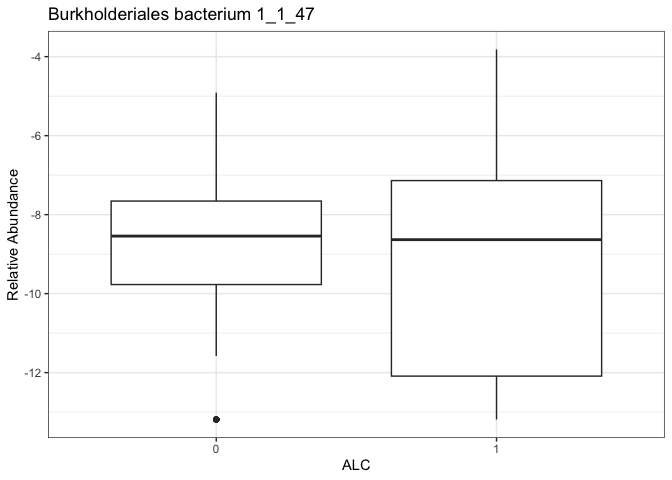
ZIPG Wald
Use function ZIPG_main() to run our ZIPG model.
Input :
W : Observed taxa count data.
M : Sequencing depth, ZIPG use log(M) as offset by default.
X, X_star : Covariates of interesting of differential abundance and
differential varibility, input as formula.
Output list:
ZIPG_res$init : pscl results, used as initialization.
ZIPG_res$res : ZIPG output evaluated at last EM iteration.
ZIPG_res$res$par : ZIPG estimation for
$\Omega = (\beta,\beta^*,\gamma)$.
ZIPG_res$wald_test : ZIPG Wald test
ZIPG_res$logli : ZIPG log-likelihood
ZIPG_res <- ZIPG_main(data = dat$COV,
                      X = ~ALC01+nutrPC1+nutrPC2, X_star = ~ ALC01,
                      W = W, M = M)
res = ZIPG_summary(ZIPG_res)
#>           ZIPG Wald
#>        Estimation     SE     pval
#> beta0      -7.371 0.1512 0.00e+00 ***
#> beta1       0.121 0.1985 5.41e-01
#> beta2       0.106 0.0188 1.41e-08 ***
#> beta3      -0.118 0.0287 4.17e-05 ***
#> beta0*      0.525 0.1199 1.20e-05 ***
#> beta1*      0.606 0.1406 1.63e-05 ***
#> gamma      -2.080 0.1460 4.93e-46 ***
ZIPG bWald
Set the bootstrap replicates B in bWald_list to conduct ZIPG-bWald,
results and covariance matrix can be find in ZIPG_res$bWald.
set.seed(123)
# Set bootstrap replicates B
bWald_list = list(B = 100)
# Wait for a wile
ZIPG_res1 = ZIPG_main(
  data = dat$COV,
  X = ~ALC01+nutrPC1+nutrPC2, X_star = ~ ALC01,
  W = W, M = M,
  bWald_list = bWald_list)
#> Running non-parametric bootstrap wald test
#> Finish
res = ZIPG_summary(ZIPG_res1,type = 'bWald')
#>           ZIPG bWald
#>        Estimation     SE     pval
#> beta0      -7.371 0.1896 0.00e+00 ***
#> beta1       0.121 0.2323 6.01e-01
#> beta2       0.106 0.0209 3.51e-07 ***
#> beta3      -0.118 0.0342 5.95e-04 ***
#> beta0*      0.525 0.1283 4.30e-05 ***
#> beta1*      0.606 0.1740 4.97e-04 ***
#> gamma      -2.080 0.3698 1.86e-08 ***
res = ZIPG_CI(ZIPG_res1,type='bWald',alpha = 0.05)
#>         ZIPG Wald Confidence interval
#>        Estimation      lb      ub
#> beta0      -7.371 -7.7421 -6.9990
#> beta1       0.121 -0.3338  0.5768
#> beta2       0.106  0.0655  0.1474
#> beta3      -0.118 -0.1847 -0.0505
#> beta0*      0.525  0.2734  0.7765
#> beta1*      0.606  0.2649  0.9470
#> gamma      -2.080 -2.8046 -1.3551
To test more complicated hypothesis, you may use the covariance matirx driven from bootstrap.
round(ZIPG_res1$bWald$vcov,3)
#>        [,1]   [,2]   [,3]   [,4]   [,5]   [,6]   [,7]
#> [1,]  0.036 -0.040  0.001  0.003  0.005 -0.009  0.013
#> [2,] -0.040  0.054 -0.001 -0.004 -0.006  0.009 -0.008
#> [3,]  0.001 -0.001  0.000  0.000  0.000  0.001 -0.001
#> [4,]  0.003 -0.004  0.000  0.001  0.001 -0.002  0.003
#> [5,]  0.005 -0.006  0.000  0.001  0.016 -0.014 -0.012
#> [6,] -0.009  0.009  0.001 -0.002 -0.014  0.030 -0.025
#> [7,]  0.013 -0.008 -0.001  0.003 -0.012 -0.025  0.137
ZIPG pbWald
Set bootstrap replicates B and the null hypothesis by formula X0 and
X_star0 in pbWald_list to conduct ZIPG-pbWald, results can be find
in ZIPG_res$pbWald
# test beta1star, the 6th parameter
#
pbWald_list = list(
  X0 = ~ALC01 + nutrPC1+nutrPC2,
  X_star0 = ~ 1,
  B = 100
)

ZIPG_res2 = ZIPG_main(
  data = dat$COV,
  X = ~ALC01+nutrPC1+nutrPC2, X_star = ~ ALC01,
  W = W, M = M,
  pbWald_list= pbWald_list)
#> Running parametric bootstrap wald test
#> Finish

res = ZIPG_summary(ZIPG_res2,type ='pbWald')
#>    ZIPG pbWald
#>  H0: beta1* = 0
#>  pvalue =  0.0099
References
- Jiang, Roulan, Xiang Zhan, and Tianying Wang. “A Flexible Zero-Inflated Poisson-Gamma Model with Application to Microbiome Sequence Count Data.” Journal of the American Statistical Association (2023): 1-13.