RegEnRF
Regression-Enhanced Random Forests
A novel generalized Random Forest method, that can improve on
RFs by borrowing the strength of penalized parametric regression. Based on
Zhang et al. (2019)
RegEnRF 

RegEnRF is the implementation of the Regression-Enhanced Random
Forests algorithm as described in Zhang et
al. (2019).
Installation
You can install RegEnRF like so:
install.packages("RegEnRF")
or the development version like so:
devtools::install_github("umbe1987/regenrf")
Example
This is an example showing how to perform Regression-Enhanced Random
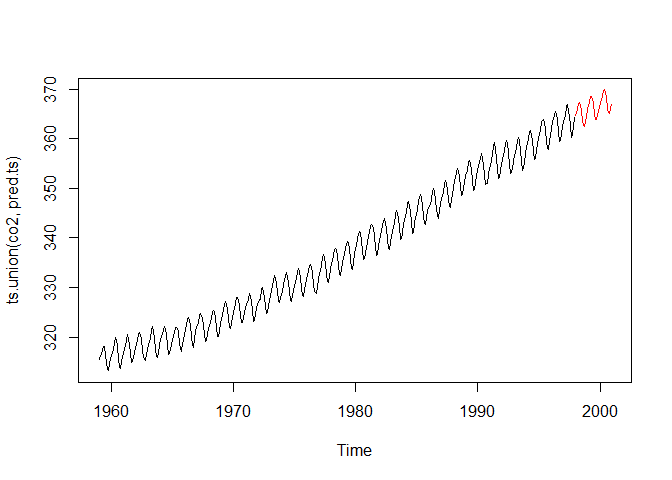
Forests with RegEnRF. It demonstrates how RegEnRF can extrapolate
beyond the training domain, as opposed to randomForest.
library(RegEnRF)

set.seed(111)
data(co2)
x <- matrix(c(time(co2), cycle(co2)), ncol = 2)
y <- as.numeric(co2)
mod <- RegEnRF(x, y, lambda = 0.1)
#> Warning in rfout$mse/(var(y) * (n - 1)/n): Recycling array of length 1 in vector-array arithmetic is deprecated.
#>   Use c() or as.vector() instead.
freq <- frequency(co2)
startt <- tsp(co2)[2] + 1 / freq
xnew.t <- seq(startt, by = 1 / freq, length.out = freq * 3)
xnew <- matrix(c(xnew.t, cycle(tail(co2, freq * 3))), ncol = 2)
pred <- predict(mod, xnew)
pred.ts <- ts(pred, start = startt, frequency = freq)
plot(ts.union(co2, pred.ts), plot.type = "single", col = c("black", "red"))